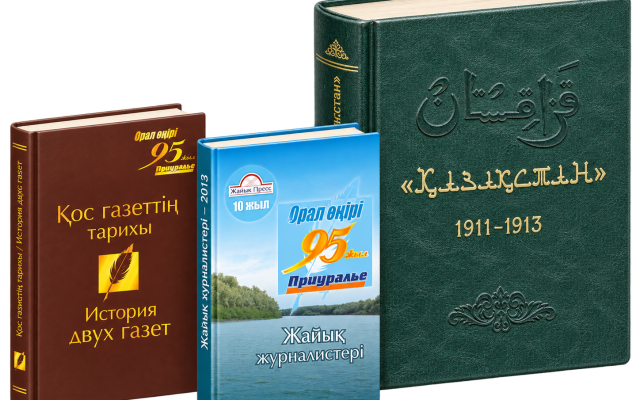
Government support has strengthened the publishing and technical capacity of Zhaiyq Press LLP, enabling us not only to produce our daily newspapers but also to embark on research into the history of our own publications. Last year, during celebrations marking the 95th anniversary of the regional newspapers Oral Oniri and Priuralye, we pointed out that their history went back further than 17 November 1918, the date we had long regarded as their starting point. We also emphasised the need for more thorough research and spoke of an earlier newspaper, Uran, which had preceded Izvestia–Khabar, whose first issue we had previously considered the beginning of our newspapers’ history. At the time, we announced our intention to begin searching for Uran. We had several reasons for doing so.
The Origins of Oral Oniri: The Newspaper Uran
First, last year we brought back from Moscow archives copies of almost every issue of Izvestia–Khabar published up to the end of 1918. The first issue, in its Arabic-script version, contained Protocol No. 12 of the Regional Central Committee. It stated:
“To ensure that the dissemination of printed publications progresses and proves fruitful and beneficial, the new printing house brought from Astrakhan and the Uran printing house in the Khan’s Headquarters shall be merged, with responsibility for managing the printing house entrusted to Comrade Vygdorshchik.”
The very reference to advancing the dissemination of printed publications suggests that an existing enterprise was being continued and adapted to a new system. This provides evidence that Izvestia–Khabar succeeded Uran.
Second, numerous individuals joined forces to publish Kazakhstan (1911–1913), Uran (1917–1918), Izvestia–Khabar (1918) and Durystyk Zholy (1919). Yet two figures played an active part in all four publications: Gumar Karash and Gabdolgaziz Musagaliyev.
Gumar Karash edited Kazakhstan, while Gabdolgaziz Musagaliyev organised subscriptions, helped raise funds and assisted with distribution. Musagaliyev subsequently became editor of Uran. The newspaper published many articles by Gumar Karash, including his poem Uran, which articulated the publication’s aims.
Their involvement with Izvestia–Khabar is further confirmed by an article written by Tamimdar Safiyev for the newspaper’s 50th-anniversary issue, published on 17 November 1968. Safiyev recalled discussions about publishing a single Kazakh-language newspaper in place of the newspapers Khabar and Kazak Durystygy, which had appeared in two languages. When, by common agreement, the newspaper was renamed Durystyk Zholy, its editorial board included Gumar Karash, Mustafa Kokebayev, Gabdolgaziz Musagaliyev, Khalel Yesenbayev and Safiyev himself.
These accounts demonstrate how closely these individuals were connected with the development of the press.
Unfortunately, during the Soviet period, the contributions made by such members of the national intelligentsia to their people went unacknowledged. In the case of Gumar Karash — an educator, poet and thinker — it was forbidden not only to discuss his work but even to mention his name. Accounts of Izvestia–Khabar generally referred only to Stepan Milyutin, chairman of the Regional Central Committee responsible for governing the Inner Horde, who was identified as the newspaper’s editor. The contributions of others were left in the shadows.
Yet Gumar Karash and Gabdolgaziz Musagaliyev hold a distinguished place in Kazakh history. Both worked tirelessly and selflessly for their people, making an immense contribution to awakening public consciousness through the printed word. However much the political system changed, these newspapers continued, as far as circumstances allowed, to serve the people.
Third, because we had only recently begun researching the history of the press, every discovery seemed to us a major breakthrough. Experienced specialists in the field, however, appeared to have known these facts all along.
At the Scientific Library in Almaty, the catalogue record relating to Oral Oniri contains the following information:
“Kyzyl Tu. Newspaper of the Ural Provincial Party Committee and Executive Committee. Uralsk, 1922–1929.
July 1917–1918 — Uran; 1919 — Durystyk Zholy; 1919–1920 — Sakhara Tany; 1920–1930 — Kyzyl Tu; 1931–1957 — Ekpindi Kurylys; 1958–1964 — Oktyabr Tuy; from 1 January 1965 — Oral Oniri.”
Here, the newspaper’s origins are traced back to Uran without the slightest hesitation. The succession of titles is set out clearly and systematically.
Fourth, Soviet political restrictions prevented Uran from being officially recognised as the starting point of the regional press. Evidence of this can be found in Saken Seifullin’s novel Tar Zhol, Taigak Keshu (The Arduous Path), in which he wrote:
“Some educated members of the Bukey Horde, led by the poet and mullah Karashuly, began publishing a newspaper called Uran, making Alash Orda their rallying cause…”
Since everyone associated with Alash Orda was branded an “enemy of the people”, the newspaper itself was presumably placed in the same category. Perhaps this explains why our initial attempts to find it proved unsuccessful.
Although the newspapers changed their names, they shared a printing house and were produced by many of the same people. They were publications that followed on from one another, each continuing the work of its predecessor.
Taken together, these findings establish that the history of today’s Oral Oniri and Priuralye newspapers can be traced back to Uran, which began publication in July 1917 under the editorship of Gabdolgaziz Musagaliyev.
How Was Uran Found?
Last year, as the 95th anniversary of the two regional newspapers approached, we had hoped to introduce Uran to the public and extend our understanding of the history of our publications. Despite an extensive search, however, we could find neither an original issue nor a copy. We therefore had to leave our plans for further investigation to the future.
Drawing on our earlier experience of locating issues of Kazakhstan, published between 1911 and 1913, in Russian archives, we sent enquiries to numerous archives and libraries across Russia. Unfortunately, none had preserved copies of Uran.
Yet there was no doubt that the newspaper had existed. Many contemporaries had seen it with their own eyes and had expressed their views about it. We continued our determined search, reasoning that copies might still survive somewhere — in an archive, a museum, a library or perhaps a private collection.
The first encouraging news came from the scholar Maksat Tazhimurat. He had discovered several issues of Uran at the Republican Museum of Books in Almaty. Knowing how urgently we had been searching for the newspaper, he decided to make these valuable materials available to us. He even arranged for electronic copies to be prepared in advance, ready for collection.
We travelled to Almaty and collected them. The cover of the bound collection bore the following inscription:
“From the personal collection of the folk poet Andash Nadraliyev (1889–1954), born in Zhanakazan village, formerly in the Bukey Horde of Astrakhan Region and now part of Zhanakala District.”
According to a museum employee, the collection had been deposited at the museum in 1978.
As soon as these long-sought copies of the newspaper, printed in the Arabic script, reached our editorial offices, my colleague Kazbek Kuttymuratuly began transcribing them into Cyrillic. With each issue he completed, our excitement grew. We read the articles with fascination, eagerly anticipating what the next issue might reveal.
Then another piece of good news arrived.
Nurzhan Tolepov, director of the Zhangir Khan Historical and Ethnographic Museum, informed us that he had seen copies of Uran at the West Kazakhstan Regional Museum of History and Local Lore.
It turned out that copies of the newspaper were preserved among materials collected by the researcher and scholar Mustafa Ismagulov. We thanked Nurzhan Tolepov for the valuable information and made our way to the regional museum.
We already knew that several sacks of documents collected by Mustafa Ismagulov during his lifetime had been transferred to the museum. He was also the first researcher to undertake a thorough study of the newspaper Kazakhstan. Unfortunately, the misguided policies of the Soviet era had prevented him from making his findings public.
Mustafa Ismagulov had carefully preserved photographic copies of the exceptionally rare Uran, keeping them together in a separate folder. He had also collected and studied a substantial body of work by Gabdolgaziz Musagaliyev, the newspaper’s editor-in-chief and organiser.
With the agreement of the museum’s management, we obtained copies of these valuable materials.
Judging by the copies now in our possession, approximately 40 to 50 issues of Uran appear to have been published. We have managed to find ten of them.
For now, that alone is a major achievement. We must be content with what we have found so far, although the amount of work still ahead of us is clear.
The early twentieth century was a period when the colonisation of the Kazakh people entered a more intensive phase. One colonial ruler was replaced by another, leaving the people uncertain about whom to trust or whose guidance to follow. Those who tried to point the way towards what was right often found that their voices could not reach the wider population. It was a time of deep uncertainty and confusion.
At such a moment, only the newspaper had the potential to unite Kazakhs around a common purpose and shared interests.
The Kazakh intelligentsia understood this well. In the western region, they established Kazakhstan (1911–1913), the first regularly published newspaper in the region. They subsequently organised the publication of Uran (1917), Izvestia–Khabar (1918) and Durystyk Zholy (1919).
We have never sought to move back the founding date of our newspaper simply to increase its age. Our foremost aim has always been to establish the historical truth.
For 73 years under Soviet rule, these were matters that people were forbidden to speak about — or even to contemplate.
We are grateful to live in an independent country. At last, the time has come to examine our past and tell future generations about all that was worthy and admirable in our history.
Zhantas NABIOLLAULY
General Director, Zhaiyq Press LLP
Originally published in Oral Oniri, 27 August 2014.