In its efforts to strip the Kazakh people of their national identity and bring them under colonial domination, the Soviet regime committed acts of brutality that surpassed even those of Tsarist Russia. One of the most disturbing manifestations of this policy was the deliberate and systematic destruction of ancestral burial grounds — places held sacred by every Kazakh.
While organising a comprehensive study of historical gravestones, we encountered evidence of precisely such destruction. Our discovery of this painful chapter of the past was no accident. It was the result of sustained, systematic research.
The Work Undertaken
The work we are carrying out today will itself become part of history in time.
In 2012, when the national historical and educational magazine DANAkaz began publication, we introduced a special feature entitled “Unlocking the Secrets of Gravestones” in its very first issue. From the outset, we realised that this field had received little serious attention in our region. Indeed, virtually no systematic research had been undertaken.
In 2014, seeking to draw public attention to the problem, we published a collection entitled “Uncovering the Secrets of Gravestones”, featuring fifty gravestones from the Akzhaik, Karatobe and Syrym districts.
During the presentation of the collection, a group of scholars led by Professor Ashirbek Muminov visited Oral. We took them to several ancient burial grounds across West Kazakhstan Region. The researchers were astonished by the sheer number of gravestones they encountered.
Following their visit, the scholars prepared a special research proposal for the R. B. Suleimenov Institute of Oriental Studies under the Science Committee of the Ministry of Education and Science of the Republic of Kazakhstan. The proposal called for a dedicated study of the region’s epigraphic monuments.
It received approval, and a research project entitled “Cultural Monuments of the Kazakh People as a Means of Preserving and Transmitting Spiritual Heritage (Based on the Epigraphic Monuments of West Kazakhstan Region)” was authorised for 2015–2017.
The issue was also discussed by the Miras Public Council under the West Kazakhstan Regional Branch of the Nur Otan Party, where it received strong support.
Our proposals were subsequently published in national and regional newspapers. We argued that all gravestones throughout Kazakhstan should be mapped and photographed, their Arabic-script inscriptions transcribed into Cyrillic, and the information they contain brought together in a single resource for comprehensive research into our authentic history. We also outlined why this work was essential and how it could be organised.
To coordinate these efforts, the West Kazakhstan Regional Branch of the Nur Otan Party, the West Kazakhstan Regional Department of Culture, Archives and Documentation, Zhaiyq Press LLP and the historical and educational magazine DANAkaz signed a memorandum of cooperation.
The newspaper Oral Oniri introduced a regular feature entitled “The Secrets of Gravestones”, while district newspapers began drawing attention to the subject. With the support of district akims, or local government heads, special working groups were established in every district to study historical gravestones. We prepared guidelines for these groups and explained how the research should be conducted.
In October 2015, the Coordinating Council on the Study of National History, operating under the Governor of West Kazakhstan Region, held a meeting. A resolution was adopted instructing all districts to carry out the work in accordance with the approved guidelines.
A Visit to Borli
As soon as spring arrived in 2015, we met with working groups in the Terekti, Borli, Shyngyrlau and Zelenov districts to review their preparations and coordinate the next stages of research. It was during this journey, in the village of Borli in Borli District, that we came face to face with a horrifying scene (Figure 1).
We had heard that gravestones used in the foundations of a machine and tractor station, or MTS, near Borli had been recovered in 2007, taken to a cemetery outside the village and honoured with a memorial meal. We decided to visit the site ourselves, see what had been done and find out what had become of the recovered gravestones.
The stones had been laid flat in the Muslim cemetery near Borli. Including the broken fragments, their number came to slightly more than one hundred.
We then travelled to the former site of the machine and tractor station, approximately 500 metres from the village. The facility had been built between 1930 and 1935.
Only heaps of rubble and the remains of its foundations indicated that a building had once stood there. But as we approached, we were astonished by what we saw. Fragments of broken gravestones lay scattered across the ground. The surviving foundations clearly showed that gravestones had been used as construction material.
We could scarcely believe our eyes. We examined the entire site and realised that the earlier effort to recover the stones had been left unfinished. Further enquiries revealed that practically everyone in the village, young and old alike, knew about what had happened.
The Events of 2007
The first newspaper report concerning the use of gravestones in the foundations of the Borli machine and tractor station appeared in the Borli district newspaper in 2004, following information provided by a man named Berik Ismagulov.
In 2007, the authorities became aware of the matter, and the West Kazakhstan Regional Branch of the Nur Otan People’s Democratic Party took the lead in organising the recovery of the gravestones. After some of the stones had been removed, a commemorative meal was held in honour of the deceased.
Those who attended included the then Governor of West Kazakhstan Region, N. Ashimov; Chairman of the West Kazakhstan Regional Branch of the Nur Otan People’s Democratic Party, M. Kulshar; Deputy Head of the Executive Secretariat of the Small Assembly of the People of Kazakhstan, V. Kiyansky; Borli District Akim K. Imashev; Secretary of the District Maslikhat I. Izmagambetov; Father D. Noskov of the Church of St Seraphim of Sarov; and other representatives of the regional community.
At the gathering, regional governor Nurgali Saduakasuly said:
“Let us leave the task of deciphering the inscriptions on these stones and identifying the people to whom they belonged to our scholars and researchers.”
He also announced that, once the history of the gravestones had been established, a special site would be allocated in the town of Aksai for a memorial burial ground where the monuments could be preserved.
For various reasons, however, the work subsequently came to a halt.
The Situation Today
On 15 May 2015, a meeting was held with local elders in the village of Borli to discuss the study and protection of gravestones destroyed during the construction of the machine and tractor station in the 1930s.
 Those present included Talgat Zhusupkaliyev, Head of the West Kazakhstan State Inspectorate for the Protection of Historical and Cultural Monuments; Azamat Safimaliyev, Deputy Akim of Borli District; and the author of this article.
Mukhtar Bokayev, an elder who had travelled from the district centre specifically for the meeting, shared a wealth of information about the village’s history. We also learned that elderly local residents, including Sagidolla Kabiyev, Nurzhan Zhumagulov and Gauaz Mukanov, knew which burial grounds the gravestones had originally been taken from.
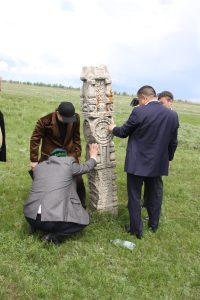
Following the meeting, we visited several of these old cemeteries. One was situated immediately outside the village, approximately 200 metres beyond the present-day fenced Muslim cemetery. The contours of the land made it clear that a large burial ground had once existed there. Almost at its centre stood a solitary upright gravestone.
The elders had told us an unusual story about it. According to local accounts, when workers had attempted to remove the gravestones, their tractors repeatedly broke down, stalled or became stuck in the ground. For one reason or another, they had been unable to take this particular stone.
And there it still stood.
Kazbek Kuttymuratuly deciphered the inscription. It recorded that Kenzhegul, son of Zhamankul, of the Kenzhebek branch of the Tama clan, had died in 1865 at the age of forty-nine. The inscription also stated that the monument had been erected by his son (Figure 2).
The next burial ground we visited was approximately forty kilometres from Borli, near the former village of Amangeldi. Sagidolla Kabiyev, a Borli resident born in 1936, guided us along an overgrown track across the steppe and brought us directly to the site.
Remarkably, here too, a single gravestone remained standing near the centre of what had once been a large cemetery. Its survival was associated with a story similar to that of the first stone.
The inscription stated that Zhanai Bai, son of Edil, a biy — a traditional judge and community leader — of the Kudaigul branch of the Tama clan, had died in 1856 at the age of eighty. The monument had been erected by his son Bekaidar (Figure 3).
More recently, Kazbek Kuttymuratuly, an employee of Zhaiyq Press LLP proficient in reading Arabic-script inscriptions, and Muratbek Zhakhatov, imam of the Zhanakala District Mosque, travelled to Borli to photograph, number and decipher the gravestones recovered in 2007. Despite torrential rain, they completed the work in just two days.
During the same visit, they also examined a burial ground at Masaitobe, approximately six kilometres from Borli. Only one gravestone had survived there as well.
Its inscription began with an Islamic invocation, reproduced here in a Latin-script rendering of the words recorded in the Kazakh article:
“Aghuzu billahi min ash-shaytan ir-rajim. Bismillahi ar-Rahman ar-Rahim. La ilaha illallah, Muhammad rasul Allah.”
In English, the invocation means:
“I seek refuge in Allah from Satan, the accursed. In the name of Allah, the Most Gracious, the Most Merciful. There is no god but Allah, and Muhammad is the Messenger of Allah.”
The inscription continued:
“Kosshy, son of Kubai, of the Kudaigul branch of the Tama clan, died in 1900 at the age of sixty-eight. This inscription was commissioned by Tailak Myrza” (Figure 4).
In this way, we gradually began to identify the precise locations from which gravestones had been taken for the construction of the machine and tractor station.
After being informed of the situation, regional governor Nurlan Askaruly instructed the relevant authorities to resume the recovery work and remove all the remaining gravestones. Most of this work has now been completed in Borli District (Figure 5).
Around one hundred gravestones, including broken fragments, were recovered in 2007. Following the renewed work in 2015, the reported number of recovered gravestones and fragments was approximately 170.
Victims of Political Repression Were Executed in Borli
After the meeting on 15 May, Mukhtar Bokayev took us to several other locations in Borli connected with the village’s history. One of them was the house shown in Figure 6.
According to Bokayev, the building had served as an NKVD office in 1937–1938. Bokayev, who had headed the Borli District archive for many years, had established that forty people were sentenced to death in Borli.
He also recalled the deeply distressing accounts of older residents who had witnessed the repression. With tears in their eyes, they would say:
“We saw it with our own eyes. They put sacks over people’s heads, tied their hands behind their backs and led them away. A short time later, the executioners returned alone.”
The elders also spoke of another site, approximately 250–300 metres from the house, beneath a group of large trees (Figure 7). According to their accounts, people sentenced to death by the courts were taken there, executed and thrown into pits at the same location.
Those who had witnessed the events left a solemn message for future generations:
“These great trees are witnesses to what happened here. The remains of our ancestors still lie beneath this ground. Whenever you pass this place, offer a prayer for them.”
To ensure that future generations understand the bloodshed and suffering endured by our ancestors, we must install memorial markers at these locations and protect the ground where human remains are believed to lie. Fencing off the burial sites and preserving them for posterity should be among our most urgent responsibilities.
All these horrific events occurred in the vicinity of a single village, within the decade between 1930 and 1940. How many more forgotten chapters of our history are still waiting to be uncovered?
Whether through a lack of awareness or sheer negligence, work of vital importance to future generations continues at an unacceptably slow pace. We cannot move forward without learning from the past.
We fell under foreign domination not because others were strong, but because we ourselves were weak.
If we are to avoid repeating the mistakes of history, we must reconstruct our past, confront its painful truths and learn the lessons it has to teach.