Barracks without lighting, surrounded by barbed wire. Riflemen stationed on high watchtowers. German shepherd dogs barking fiercely below, alongside ruthless guards. Unbearable living conditions and brutal mistreatment of prisoners…
Whenever we watch films depicting concentration camps of the twentieth century, such scenes horrify anyone with a sense of humanity and compassion. Yet research conducted in recent years has revealed that not just one, but several similar camps existed in West Kazakhstan Region. They were known as corrective labour camps. One of them was located in the village of Pridorozhny in Terekti District. Remarkably, part of a barrack built from adobe bricks has survived almost entirely intact. Its roof, walls, rooms, doors, stoves and corridor remain as they were.
Work towards the full rehabilitation of victims of political repression in West Kazakhstan Region began in 2021. Following Presidential Decree No. 456 of 24 November 2020, “On the State Commission for the Full Rehabilitation of Victims of Political Repression”, issued by President of the Republic of Kazakhstan Kassym-Jomart Tokayev, the Akim of West Kazakhstan Region adopted a resolution establishing a regional commission and forming working groups.
Taking into account our experience in academic research, the West Kazakhstan Regional Department of Public Development entrusted the Dana Research Centre with organising the work of a working group. My colleague Alfiya Baibolsynova, a researcher at the centre, was appointed responsible for identifying the locations of penal camps and offices of the People’s Commissariat for Internal Affairs (NKVD) in West Kazakhstan Region.
Alongside this assignment, Alfiya Sabyrgalikyzy was also researching the Western Branch of Alashorda. In May 2023, she made a special visit to the village of Pridorozhny in Terekti District to examine the site of a twentieth-century corrective labour camp and meet people who could provide accounts of it. She also discovered documents relating to the camp in the West Kazakhstan Regional State Archive. She is currently preparing a collection of archival documents concerning the camp.
In December 2023, we also made a special journey to the site. Our aim was to examine the former camp, take aerial photographs and video footage, and, if possible, find people in nearby settlements who could share their recollections.
The visit to the camp site and meetings with witnesses were organised by Zhumaziya Ualiollakyzy, a librarian from the village of Algabas in Terekti District. With the support of Kanatkali Yergaliyev, a local entrepreneur with a keen interest in history, she arranged to bring her maternal uncle, Samigolla, who had served a sentence at the camp, from Algabas to Pridorozhny.
Kenzhebay Rakhimov, whose father had once served a sentence in the same camp, accompanied us from Oral to show us the way. He is a descendant of the Tore lineage. Kenzhebay himself was born in 1956 in the village of Kobensai in Terekti District. His father, Zhuma Rakhimov, was born in 1913 in the village of Karakemer in Borli District. He was convicted in 1950, after the war.
“I do not know the exact reason, but it is clear that it was nothing particularly serious. He served his sentence at the corrective labour camp in Pridorozhny. Altogether, he spent three years in custody. In the spring of 1953, after Stalin’s death, the highest authorities issued a decree, and many prisoners were released. My father was among them,” Kenzhebay told us.
As he shared his recollections, he also spoke about other details.
“According to my father and the other men from our area who were imprisoned there, everyone lived in barracks. They worked on the plantations surrounding the camp. There was also a pig farm,” he recalled.
Later, sometime around the 1990s, Kenzhebay heard another account from an acquaintance. According to that person, a serious conflict once broke out among prisoners at the camp in Pridorozhny. The camp guards reportedly shot those blamed for starting the dispute on the spot, in front of everyone else. The man who told Kenzhebay this story has since died. There was also a separate burial ground for prisoners who took their own lives while at the camp.
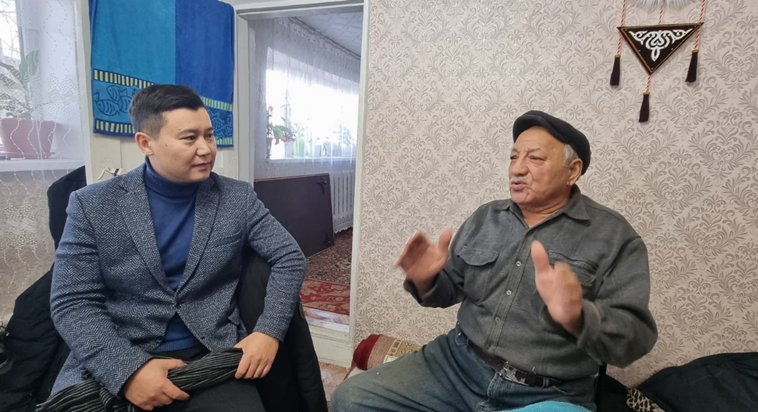
Listening to Kenzhebay’s recollections and talking along the way, we eventually arrived in Pridorozhny. As arranged, another elderly man had come to share his memories: Samigolla Kazhimuratov, born in 1956 and a resident of Algabas in Terekti District.
Samigolla’s maternal uncle had been held in the camp nearby. Having grown up listening to his uncle’s stories, he shared with us what he could remember.
According to Samigolla, his uncle’s name was Zukul Tasbolatov. Born in 1916, he had once been a manager in the village of Shoptikol. At the time, oxen were used to plough the fields, while women followed behind scattering seed. The authorities had rewarded him with a bicycle for his good work.
One day, a neighbour came and asked insistently to borrow the bicycle, but his uncle refused. That evening, because darkness had fallen before they could finish sowing, he brought home two buckets of seed that had been left over, intending to continue the work the following day.
That same night, NKVD officers came to his home and arrested him, apparently because of the seed. He was subsequently sentenced to ten years’ imprisonment. He served half his sentence in a prison in Oral before being transferred to the camp in Pridorozhny. He later spoke of having tended livestock there. Following Stalin’s death, a special decree was issued, and he was released.
“When I was a child, my uncle used to tell me that there was a punishment cell at the camp and that women were imprisoned there alongside men. They kept pigs and milked cows.
‘They would march us out to work in the morning, bring us back in the evening and lock us up again. There were watchtowers on higher ground, with soldiers keeping watch from above. Everything was surrounded by barbed wire. There was no chance of escaping. They made us dig the ground among the hills. Later, a club and an office building were erected on those sites. Conditions were harsh. Many people died of hunger and disease,’ my uncle used to say.
“He also told me that there were many graves near Stalinka. When I grew older, I went there myself to look. There really were a great many burial mounds,” Samigolla recalled.
We recorded the recollections and filmed aerial footage using a drone. But the most valuable outcome of our visit was meeting Shapagat, who had personally seen the site of the former camp and had preserved part of one of its barracks.
Although rather stern in his manner at first, he turned out to be a warm-hearted, open and generous man who shared valuable memories with us.
Shapagat Myrzakhmetuly is a long-standing resident of Pridorozhny, born in 1950. His ancestors had been mullahs and were highly educated and literate people.
According to Shapagat, his grandfather, Kusaiyn Shegenbayuly, had lived in the Atyrau area. He was a highly educated and literate man, a mullah who was also wealthy. He was a large man, approximately two metres tall.
During the confiscation campaign, he was persecuted and fled far from his homeland. In December 1941, believing that Soviet authority had weakened and that life had become peaceful again, he returned home. He was arrested and shot immediately upon his return.
“This was not simply a prison. It was a labour camp. The whole surrounding area was covered with plantations where vegetables were grown,” Shapagat recalled.
Many of his neighbours had themselves been imprisoned in the camp and subsequently settled in the area after it closed. Although the camp was abolished, some former prisoners remained in the village, started families, worked and raised their children there.
According to local elders, Germans, Tatars and people of other ethnic backgrounds lived on the side of the village beyond the camp, towards Semenovka.
“In the early 1970s, the camp buildings were deliberately demolished. The barracks were made of adobe bricks. They were about 50 metres long and approximately 15 metres wide.
“The building near us was said to have served as an office where the officers were based, with accommodation for prisoners as well. I now use it as a storage building.
“There is a long corridor down the middle, with rooms on either side. One stove served two rooms, providing heat for the barrack. The prisoners used to sleep on two-tier iron beds. Later, local residents sold those beds as scrap metal.
“There was also a large barrack with numerous rooms in Kobensai. At one time, Kobensai also had a dairy factory. The wife of a man named Antipov was the factory director. They produced butter, milk and cheese there, transporting the products to Fedorovka,” the elderly man explained.
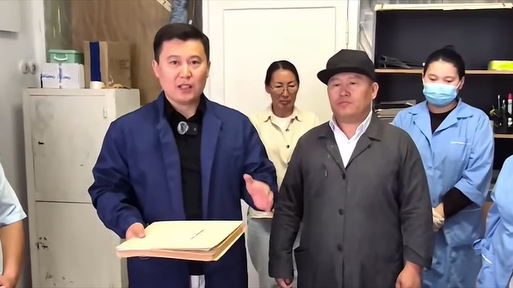
He took us to see the surviving part of the camp barrack that he now uses for storage. We were astonished. Even my companions, who had visited the village many times before, were amazed.
The old building still had its original doors and windows from the camp years. The stoves, too, remained in place. Walking through the rooms of what is now a storage building, one could imagine what the camp had looked like in those days.
After thanking Shapagat for his generous hospitality, we set off for the place formerly known as Stalinka.
The distance between Stalinka and Pridorozhny is approximately 16 kilometres. There had been various gardens and plantations around Pridorozhny. Prisoners held in Stalinka were marched on foot to Pridorozhny from five o’clock in the morning to work there.
There is a cemetery in this area where people of different ethnic backgrounds are buried. One striking detail is that the gravestones bear only the names and years of death of those buried there; their years of birth are not recorded.
Alfiya Baibolsynova identified documents relating specifically to this camp, dating from 1949 to 1952, in the West Kazakhstan Regional State Archive.
On the basis of these findings, the Dana Centre plans to publish a special collection for the Day of Remembrance of Victims of Political Repression, devoted to camps that existed in West Kazakhstan Region between the 1920s and 1950s. It will include archival documents concerning Separate Camp Unit No. 12.
The regional archive contains documents relating to inspections carried out by prosecutors around 1949–1952, reports sent by camp officials to their superiors, a handover document drawn up when the camp’s leadership changed, and other valuable records.
However, no documents specifying exactly when the camp opened or when it closed have been found.
According to records from September 1949, Separate Camp Unit No. 12 occupied four sites. Site No. 1 was located in the city of Oral, Site No. 2 was eight kilometres from Site No. 1, and Site No. 3 was three to four kilometres from the city.
Site No. 4, the agricultural and production centre, was located in the village of Pridorozhny in Terekti District, West Kazakhstan Region, approximately 80–90 kilometres from Oral (West Kazakhstan Regional State Archive, Fonds 1582, Inventory 1, File No. 5, folios 5–8).
An agricultural site was situated at Kobensai, 16 kilometres from Pridorozhny and 85 kilometres from Oral. The total area of the camp’s agricultural operations was 15,022 hectares (West Kazakhstan Regional State Archive, Fonds 1582, Inventory 1, File No. 9, folio 2).
The headquarters office was located within Site No. 1, separated from the prisoners’ quarters by a wire fence (West Kazakhstan Regional State Archive, Fonds 1582, Inventory 1, File No. 5, folio 49).
In September 1949, the camp held a total of 1,130 prisoners, including 903 men and 227 women (West Kazakhstan Regional State Archive, Fonds 1582, Inventory 1, File No. 3, folios 21–22).
Records from 1949 classified the prisoners according to the legal provisions under which they had been sentenced:
- Article 58-10 — 55 prisoners;
- Decree of 4 June 1947 — 299 prisoners;
- Resolution of 7 August 1932 — 56 prisoners;
- Article 107 — 96 prisoners;
- Article 166 — 23 prisoners;
- Decree of 26 June 1940 — 28 prisoners;
- Other articles of the Criminal Code of the Russian Soviet Federative Socialist Republic — 349 prisoners.
(West Kazakhstan Regional State Archive, Fonds 1582, Inventory 1, File No. 8, folios 12–15.)
Article 58-10 of the Criminal Code in force at the time concerned those punished for agitation or propaganda aimed at overthrowing or weakening Soviet authority, or for distributing or producing literature of a similar nature, regarded as counter-revolutionary offences.
Following a prosecutorial inspection in 1949, the camp director was issued specific instructions for implementation. Among them was an order to house prisoners serving sentences under articles relating to counter-revolutionary offences separately from other inmates. The instructions also called for subscriptions to the regional newspaper Ekpindi Kurylys to be arranged.
According to records dated 25 September 1949, the camp’s military guard battalion had a total of 94 personnel: three officers, 18 sergeants, 19 corporals, 47 riflemen and seven security guards.
In other words, at least 94 personnel were responsible for maintaining security and order.
In January 1952, Major A. Ya. Doktorov was appointed director of the camp, replacing Major F. I. Miroshnichenko.
A formal handover document was prepared when the leadership changed. It recorded the camp’s total area as 15,022 hectares.
The document indicates that prisoners were engaged in gardening, crop cultivation, livestock farming and poultry keeping. It also details how much land was allocated to each activity and records the condition of the canteen, bathhouse, wells and other facilities.
The document also provides livestock and poultry figures for the camp’s agricultural operations: 697 cattle, 746 pigs, 228 horses and 721 birds, including 518 chickens, 200 geese and three ducks.
In January 1952, the camp held 590 prisoners, comprising 478 men and 112 women (West Kazakhstan Regional State Archive, Fonds 1582, Inventory 1, File No. 9, Bundle 1, folios 2–8).
Compared with 1949, the number of prisoners had fallen by almost half.
During our visit in December 2023, Shapagat agreed to show us, the following year after the snow had melted, the burial places of people who had died from mistreatment and hunger.
However, severe flooding the following spring prevented us from visiting the site immediately after the snow had melted. We were finally able to return for our arranged meeting on 24 May.
Shapagat is a hardworking man who spends more time outdoors attending to his work than at home. Fortunately, we caught him just as he was about to leave on business.
He took us straight to the place where, according to local accounts, people had been buried in large numbers.
The site is immediately beside the village, across the hard-surfaced road leading from the city to Pridorozhny. It consists of pale, raised mounds.
According to Shapagat, the area covers approximately two hectares. Its full extent is difficult to appreciate from ground level, but everything became clear when we viewed it from above using a drone.
The site is extensive. It is difficult to say exactly how many people are buried there, but there appear to be a great many.
The accounts provided by those who shared their recollections are consistent with the archival documents. We spoke to only a small number of people who could provide recollections relating to the camp.
The archival documents we have obtained cover only three or four years and are themselves incomplete. Further evidence must therefore be gathered, and more detailed research needs to continue.
Every effort should be made to establish the names of those who died in the camp from mistreatment and hunger, to undertake archaeological surveys and excavations, and to investigate the site comprehensively.
If it is confirmed to be a mass burial site, consideration must be given to installing a memorial marker and fencing off the area.
We express our gratitude to Alfiya Sabyrgalikyzy for her exceptionally productive research on this subject; to Zhumaziya Ualiollakyzy, the librarian of Algabas village, for helping organise our visit to the camp site; and to Kenzhebay Zhumauly, Samigolla Kazhimuratov, Shapagat Myrzakhmetuly and Kanatkali Otesuly for sharing their recollections and assisting our work.
Zhantas NABIOLLAULY
Head of the Dana Research Centre
West Kazakhstan Region
Egemen Qazaqstan
Translated from Kazakh.