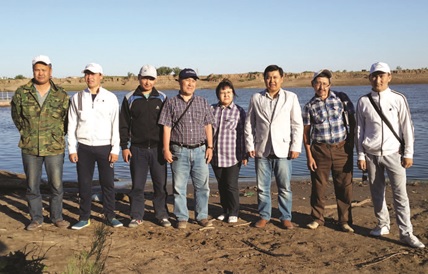
A special expedition from the R. Suleimenov Institute of Oriental Studies recently visited West Kazakhstan Region to gather information and collect documents for a research project entitled “The Spiritual Values of the Kazakh People: The Role and Significance of Sacred Sites in Preserving Traditional Culture.” The expedition was led by Doctor of Historical Sciences Ashirbek Kurbanuly Muminov and included two senior research fellows, Candidates of Historical Sciences Aitzhan Shaimerdenkyzy Nurmanova and Dina Yesirkepkyzy Mederova.
We accompanied the scholars during the first two days of their ten-day expedition, discovering previously unknown aspects of our region’s rich history and witnessing remarkable findings. We were astonished by the depth of our ancestors’ religious knowledge, their learning and intellectual accomplishments. Once again, we were reminded that our forebears had preserved this vast land not through physical strength alone, but through profound knowledge and sound upbringing. According to the visiting scholars, the discoveries made here are significant not only for our region, but also for Kazakhstan and world history.
The journey strengthened our conviction that the example set by our ancestors could provide a foundation and a pillar of support for our national ideology. We returned with one overriding thought: this priceless heritage must be put to good use for the benefit of our people while there is still time.
I therefore decided to share these newly uncovered historical findings with discerning readers who care about our country’s future and to recount some of the extraordinary work accomplished in just two days — achievements worthy of an entire year’s effort.
A Meeting of Scholars and Local Historians
We recently presented our project, “Let Us Unlock the Secrets of the Gravestones,” and announced its first results. If the work still awaiting us is as vast as an ocean, what we have achieved so far amounts to no more than a single drop. Yet that drop represents an 85-page collection in A4 format containing inscriptions from fifty gravestones in the Akzhaik, Syrym and Karatobe districts, transcribed from the Arabic script into Cyrillic and accompanied by detailed information about the people commemorated on them.
As the Kazakh proverb says, “Good people gather around a worthy endeavour.” And indeed, just as we were preparing to present our collection to the public and outline our future plans, the scholars mentioned above arrived from Almaty on their research expedition.
The expedition leader, Ashirbek Muminov, who heads the institute’s Department of Near and Middle Eastern Countries, gave our work a remarkable assessment: “An eighteen-volume chronological collection of Arabic-script epigraphic monuments from Muslim countries is being published in Paris, yet none of the inscriptions in your collection appears in it. If this work were translated into English, it would attract the attention of scholars around the world.”
He went further, describing our collection as “a contribution to world scholarship, a scholarly publication of international significance”. His words were a source of tremendous encouragement. They confirmed that we had chosen the right direction and strengthened our determination to continue our work with even greater responsibility.
The visiting scholars aimed to undertake a systematic and comprehensive study of Kazakhstan’s sacred sites, their history and present condition, and the spiritual traditions associated with them. Their programme included identifying the locations and names of these places, recording historical and contemporary variations of those names, documenting sacred structures and natural features — mausoleums, gravestones, guesthouses, mosques, caves and springs — and measuring them. They also intended to decipher and photograph gravestone inscriptions and record the legends and oral histories associated with the sites.
Their objectives closely matched our own. We therefore discussed the itinerary together and agreed to help guide the expedition around the region. Kazbek Kuttymuratuly, a journalist and respected local historian who had undertaken much of the painstaking research behind “Let Us Unlock the Secrets of the Gravestones,” agreed to lead the way. Once the route had been settled, we arranged to depart after the presentation of our collection.
Maulimberdi Burial Ground
As planned, we set off in the afternoon. By evening, we had reached Maulimberdi Burial Ground, situated eighteen kilometres west of Bazartobe village in Akzhaik District.
Kazbek Kuttymuratuly, who had tackled the Arabic-script inscriptions on the fifty gravestones in our collection with remarkable ease, had brought us here for a particular reason. The burial ground contained several unusually shaped gravestones of a kind rarely encountered elsewhere, and their inscriptions had proved beyond even his ability to decipher.
The scholars immediately set to work, carefully measuring the stones, examining their proportions and studying the inscriptions. The monuments were indeed unusual: their rectangular form was rarely seen in our region.
Amantai Salimov, the head of the Bazartobe village administration, welcomed the visitors warmly. Deeply interested in the history of his native land, he showed us the site of the former Maulimberdi Mosque beside the burial ground and explained that descendants of the Kalkaman branch of the Tana clan were buried there.
It was not long before the first mystery began to unravel. Ashirbek Muminov started reading an inscription. While we marvelled at his ability to decipher the text, the scholars themselves were struck by the standing of the person commemorated on the stone. Muminov read the inscription aloud in Arabic, translating it into Kazakh as he went:
“This is the grave of Haj Ali, son of Maulimberdi. The second line describes the scholarly standing of his father, Maulimberdi. He was a man of exceptional learning, a scholar who had acquired profound knowledge and written books. His son Haj Ali was born in the year 1286 according to the Hijri calendar. His teacher was Muhammad Ali Kargali, and the inscription identifies him as his pupil. It also tells us that Haj Ali was a highly respected and influential imam, a scholar without equal in his time. Here, the year of his death is given as 1336 in the Hijri calendar, corresponding to 1919 in the Christian calendar. His younger brother Abdurahim is buried to the north of him. He also died that year, at the age of forty-four.”
Having completed his reading, Ashirbek Muminov could not conceal his admiration.
“This gravestone was erected in the early twentieth century. The inscription is written entirely in Arabic. The calligraphy is exceptionally beautiful and contains no errors. It was clearly executed by someone with an excellent command of the Arabic language. The person who composed the epitaph was evidently highly educated as well.”
He then explained in greater detail who the man buried there had been:
“This gravestone marks the resting place of the great scholar Haj Ali, also known as Kazhygali, son of Maulimberdi. He lived from 1286 to 1336 according to the Hijri calendar, corresponding to 1869–1919. He died at the age of fifty, while his younger brother Abdurahim died at forty-four. In my view, they died very young. It is possible that they were killed, for those were extremely turbulent times.
“This single gravestone tells us an extraordinary amount. Haj Ali was a damolla who taught at the local madrasa — a position comparable to that of a senior religious teacher or lecturer today. His father, Sheikh Maulimberdi, was an eminent scholar. In those days, the title sheikh denoted someone regarded as one of the foremost authorities in learning. Haj Ali, too, was among the leading intellectual figures of his age, earning recognition through his scholarship.”
An extraordinary amount of our history had emerged from a single gravestone. Until then, I had assumed that such monuments recorded little more than the deceased person’s name and ancestry, dates of birth and death, the names of those who commissioned the stone, and perhaps a clan emblem. But as Haj Ali’s inscription was deciphered, I began to understand the true significance of these memorials for our country’s history. To those who recognise their value, they are nothing less than authentic historical records carved in stone.
With the visiting scholars at our side, we were determined to make the most of the opportunity to decipher other gravestones bearing Arabic-language and Arabic-script inscriptions.
The next stone lay on the ground near Haj Ali’s grave. It was partly broken, and much of the inscription around its edges could no longer be read. Nevertheless, the writing on its upper surface yielded the following words: “This is the grave of Nigmatolla, a student of religious learning and a mullah, son of His Eminence Maulimberdi. He died in the year 1325 according to the Hijra of the Prophet…”
Another upright gravestone commemorated several members of the same family. The inscription on its front read: “This is the grave of Baysherkesh, a pilgrim who visited the two holy cities of Mecca and Medina. He was seventy years old. Among his descendants was the student Tuhfatulla, who died at the age of twenty-five, and Abduzhappar [the following word could not be deciphered]. These were the sons of Baysherkesh.”
On the right-hand side were the names: “Zeynep Rakhimkyzy [possibly his daughter-in-law]; Maulimberdi Baysherkeshuly.” The inscription on the left read: “Zhani Muhammad, his two children; Mullah Maulimberdi died at the age of eighty.”
It was evident that the gravestone commemorated several generations of one family: a father, his son, grandchildren and a daughter-in-law.
While we were exploring the burial ground, Aitzhan Shaimerdenkyzy had been preparing another rectangular gravestone standing immediately beside Haj Ali’s. She had applied chalk to the parts of its inscription that were difficult to distinguish, making the lettering easier to read. Working together, the scholars succeeded in deciphering the entire text:
“Abdulkarim Sheraliuly, originally from Balaklava, born in 1877, died in 1924, on the third day of Khut. He was a great scholar who had mastered both the outward (zahiri) and inward (batini) sciences. He studied the outward sciences in Kargali and the inward sciences under scholars in Bukhara, attaining a high degree of mastery in both. He was the foremost scholar of his time, and many students benefited from his teachings. He was forty-seven years old when he died. May God grant him His mercy. This stone was erected by his student Abdulkarim Berishi.”
(A photograph of Abdulkarim’s gravestone appeared on page one.)
Maulimberdi Burial Ground contains approximately sixty-five gravestones. Around ten belong to more recent graves and bear inscriptions in Cyrillic. The remainder are inscribed in the Arabic script: some in Arabic, others in Kazakh written with Arabic letters. During our visit, four Arabic-language inscriptions were deciphered. That alone gives some idea of the work still awaiting researchers at this single site.
After nearly two hours of examination and documentation, Ashirbek Muminov offered his assessment:
“We have found the gravestones of three or four eminent scholars here. The foremost among them is Sheikh Maulimberdi. Local people regard him as a saint, but we can now see that he was also an outstanding scholar. His father, Baysherkesh, was a religious man who performed the pilgrimage to Mecca several times. We have also learnt that Maulimberdi’s son, Haj Ali, was a distinguished scholar who received his education in Kargali. These findings alone are of considerable importance. If the remaining inscriptions could be deciphered, it would make an immeasurable contribution to the history of our country and to world history.”
Itemgen, Who Supported Bokey’s Confirmation as Khan
Delighted by the success of our first day, we returned to Bazartobe with a wealth of discoveries. The following morning, we resumed our expedition.
Our first stop was Taikozha Burial Ground, situated near the boundary between Bazartobe and Bazarsholan villages in Akzhaik District. There were approximately ten gravestones. The roofs of two traditional pointed tomb structures remained intact, although their walls had partially collapsed. The earthen mounds beside the other gravestones suggested that similar structures had once stood over those graves as well.
Because time was limited, the scholars decided to measure and photograph the gravestones, leaving a more detailed examination of the inscriptions on a computer for later. Even so, Ashirbek Muminov and Kazbek Kuttymuratuly managed to decipher one inscription on the spot.
It read: “Itemgen Bai, son of Zhanmyrza Tileuuly, of the Asan branch of the Tana clan, died at the age of ninety-three in the month of Ramadan, 1836.”
Itemgen is a figure known to history. He was the younger brother of Yesengeldi Zhanmyrzauly, remembered in oral tradition as Yesengeldi Bai. Yet Yesengeldi was far more than a wealthy man. He was a clan elder who held the rank of tarkhan and exercised considerable authority — a prominent figure whom even khans treated with deference and whose views they took seriously.
On 17 September 1811, leading representatives of the Baiuly tribal confederation of the Junior Zhuz sent a letter to the military governor of Orenburg proposing that Bokey Nuralyuly be confirmed as khan in place of Zhantore Aishuakuly. The document is discussed in Dana.kaz, Nos. 2–3 (13), 2014, pp. 48–51.
Among those who signed and affixed their seals to that letter was Itemgen Zhanmyrzauly — the very man named on the gravestone before us. This discovery alone reveals that he was a person of considerable standing who occupied an important place in Kazakh history.
A Dream Fulfilled
We continued our journey without delay, stopping at an old burial ground beside a dirt road near Bayantobe village. From a distance, a tall pole with a strip of white cloth tied to its top stood out near the centre of the burial ground.
Although the original gravestone had not survived, the descendants had left an inscription: “A memorial from his great-grandchildren to our revered ancestor Kulman, son of Dos, of the Tolybai division, Kubiley branch of the Alasha clan. Gizat.”
There were about ten gravestones at the site, most commemorating members of the Tokpas division of the Alasha clan. While the scholars counted and measured the stones, Ashirbek Muminov and Kazbek Kuttymuratuly succeeded in deciphering another inscription.
The front of the stone read: “Narucha Zharkynbaiuly, of the Tokpas branch of the Alasha clan, died at the age of seventy-two and was buried on the sixteenth day of Jadid in 1879.” The inscription on the side stated: “And his wife, Tynyshtyk Shyniyarkyzy. This stone was erected by Onsha Myrza.”
When the scholars had completed their work, we continued onwards to Bazarsholan village, where we visited a local resident named Samat Bakhtiyarov. He led us to a burial ground on the outskirts of the village, where old gravestones stood among more recent graves.
Local people believed that one of the ancient stones marked the grave of a saint and had tied a strip of white cloth to it as a sign of reverence. We were told that people suffering from illness sometimes came to spend the night there.
According to Samat, one of his ancestors was buried at this site. During his lifetime, Samat’s father, Gaziz, had brought many people to the grave, hoping that someone would be able to decipher the inscription. None, however, had possessed the necessary knowledge. Gaziz passed away without ever discovering exactly who lay buried beneath the stone.
While Aitzhan Shaimerdenkyzy and Dina Yesirkepkyzy began counting and measuring the gravestones, Ashirbek Muminov and Kazbek Kuttymuratuly turned their attention to the inscription that had remained a mystery for so many years. This time, the words finally yielded their meaning.
The inscription read: “Saudabai, son of Kokkoz, of the Tokpas division of the Baramyk branch of the Alasha clan, died at the age of seventy-seven. The inscription was commissioned by his sons, Tilas, Bulas, Karubai, Nauryzbai, Kurman and Turymtai, all referred to as myrza. Year 1849.”
The gravestone immediately beside it belonged to Saudabai’s wife. Its inscription stated: “Akbanu Barlybaikhyzy, wife of Saudabai Kokkozuly, of the Tokpas branch of the Alasha clan, died at the age of forty-five in the month of Jadi, 1864. This stone was erected by her son, Karubai Myrza.”
At last, a wish that Samat’s father had carried throughout his life had been fulfilled. We congratulated Samat Gazizuly and shared in his joy at finally learning the names recorded on his ancestors’ gravestones.
Yesim Khan, Who Drank the Cup of Death
Our next destination was a burial ground near the village of Eski Yesim, approximately three kilometres from Bazarsholan.
Our collection, “Let Us Unlock the Secrets of the Gravestones,” included the gravestone of Yesim Nuralyuly, who ruled as Khan of the Junior Zhuz from 1794 to 1797. However, the inscription, written in Arabic and Chagatai, had not previously been deciphered in full. This was why we had brought the visiting scholars to the site.
As usual, Aitzhan and Dina began their work. Ashirbek Muminov examined the inscription on Yesim Khan’s gravestone, written in a mixture of Arabic, Turkic and Chagatai, and translated it directly into Kazakh without hesitation.
The inscription read:
“He is alive and shall never die [a reference to Allah — A. M.]. This is the grave of one who has been granted forgiveness. The possessor of victories, blessed with divine support, the noble and valiant warrior Eshali Khan Nuralyuly, son of the late Abulkhair, departed this world. In the year 1211, at the age of fifty-three. The stone was erected by his son, Sultan Kaiyp Ali.”
The inscription continued in verse. Its direct translation was:
“A man of the Junior Zhuz killed him through an act of violence. He drank the cup of death, and his soul departed. He now rests in peace in Paradise. If a Muslim should read these words, let him recite a verse of the Holy Qur’an that he knows well and offer a prayer.”
The inscription ended with the dynastic emblem of the tore.
At the Shrine of Maten Kozha
Around midday, we set off for the burial place of the man popularly revered as the saint Maten Kozha. The shrine lies approximately one hundred kilometres from Bazarsholan, in Atyrau Region. People seeking relief from ailments of body and soul visit the site and spend the night there. A mausoleum has been erected over the grave, and accommodation has been provided for pilgrims.
The day was hot, and the road was little more than a dirt track across the open steppe. There was scarcely a sign of life. We saw neither people nor livestock, and not even a bird crossed the sky. Only every ten or fifteen kilometres did rows of gravestones appear beside the road — silent reminders of communities that had once flourished in these seemingly deserted places.
Our destination was the saint’s shrine, and time was short. We therefore passed the other burial grounds without stopping.
After about two hours on the road, we arrived at the shrine, where we were warmly welcomed by Niyaz Kozha, who had served as its caretaker for eleven years. He answered our questions patiently before leading us to the saint’s grave.
Inside the small mausoleum, the surviving gravestone had been securely reinstalled. Its appearance was striking: the surface looked as though it had been deliberately coated with black oil, yet nothing came away when it was touched. Visitors would offer prayers for the saint, run their hands over the stone and then pass them over their faces.
This time, Ashirbek Muminov, Aitzhan Nurmanova and Kazbek Kabzhanov worked together to decipher the inscription. The stone appeared to have broken across its centre and subsequently been put back together. Reading the lettering where the two sections met proved particularly difficult.
After nearly an hour, the scholars managed to decipher the inscription on the front of the stone. It read:
“Maten Kozha ibn Tolek Kozha, of the Kozha lineage among the Baiuly, lived sixty-three years in this transient world and, by the will of Allah, the One God, died in 1802 and was buried at this place. During his lifetime and … at his death, in his final days, kiraddin [word of uncertain meaning] … a certain oil … a remedy for an illness affecting the body … still exists. This stone was erected by his grandson Ainakozha, son of Kylyshkozha.”
The passage concerning the substance and its healing properties is only partially intelligible in the transcription published in the original Kazakh article. The gaps and uncertain wording are retained rather than supplied with a conjectural meaning.
The emblem of the Kozha lineage appeared at the end of the inscription.
We had been delighted by the arrival of the historians in our region, but the caretaker of the Maten Kozha shrine, who had served there for twelve years, was even more overjoyed. During those years, many visitors had tried to decipher the stone, yet none had succeeded in reading it as fully as the scholars had that day. The caretaker expressed his heartfelt gratitude.
This burial ground, too, contained many ancient gravestones. We photographed and measured as many as possible before setting off on our return journey. We feared that if darkness fell while we were still crossing the deserted steppe, we might lose our way.
Thus ended our two-day expedition. Having helped uncover some of the secrets concealed within our region’s history, the visiting scholars continued their journey under the guidance of Kazbek Kuttymuratuly, determined to make further discoveries and eventually put their most significant findings to use for the benefit of the people.
We later learnt that the remaining eight days of their expedition had been equally productive.
We were deeply impressed by the meticulous, systematic work of these knowledgeable, capable, conscientious and devout scholars. Yet travelling alongside them also brought a painful realisation. We had been living amid an extraordinary historical inheritance without truly valuing or respecting it. Far from knowing our own history, we had scarcely understood the treasures that lay before our eyes. That thought weighed heavily on me.
The scholars, who had travelled throughout Kazakhstan, told us: “Having visited every region of Kazakhstan, we are now firmly convinced that the west of the country has the greatest number of gravestones, and that West Kazakhstan Region stands out even within the west.”
Their observation alone gives some indication of the enormous task that lies ahead.
However often scholars from Almaty or Astana come to our region to conduct research, it is clear that they cannot document and study every monument on their own. Meaningful progress will be possible only if local historians, regional heritage researchers and members of the intelligentsia join forces, with the support of the authorities, and work towards a common goal.
As the saying goes, “Where there is quantity, there will be quality.” Moreover, future generations have much to learn from our forebears, who cherished their ancestry and strictly observed the tradition of knowing one’s forebears through seven generations.
What matters is that we act while there is still time. Otherwise, as so often happens, we may find ourselves bitterly regretting missed opportunities, lamenting what might have been achieved and realising too late that we should have acted sooner.
P.S.
The scholars themselves believe that the individuals buried at Maulimberdi Burial Ground are of considerable historical importance. They suggest that a dedicated government research project should eventually be established to study their lives and contributions in greater depth.
Dear readers, if you possess information about the people buried at Maulimberdi, know stories of their lives or their service to the country, or are their direct descendants, I kindly ask you to contact the newspaper’s editorial office.
Zhantas NABIOLLAULY
Originally published in Oral Oniri, No. 88, 7 August 2014.