The Kazakh word kulpytas, meaning a gravestone, carries a profound significance. It is almost as though it invites us to find the key, unlock its secrets and discover the knowledge it holds. The key itself is remarkably simple: knowledge of the Arabic script. Yet today, only a handful of people possess that knowledge, and efforts to unlock the historical information preserved in these stones are progressing slowly.
In some regions of Kazakhstan, gravestones have already been placed under state protection. Inventories are being compiled, and efforts are being made, wherever possible, to transcribe their inscriptions from Arabic script into Cyrillic. Some people concentrate solely on counting, numbering and cataloguing the stones for the purpose of securing state protection, while others selectively document gravestones erected in memory of particular individuals who are of interest to them.
In the future, we must compile a comprehensive map showing the locations of all kulpytas gravestones throughout Kazakhstan, photograph every monument and transcribe into Cyrillic all surviving inscriptions in Arabic script that can still be deciphered. There are many important reasons for undertaking this work. I would like to consider some of them.
First, gravestones preserve invaluable historical information
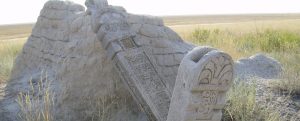 Most gravestones bearing inscriptions in Arabic script date from the eighteenth to the twentieth centuries. These stones record the names of the deceased, their years of birth, their ages at death, their clan affiliations and the identities of those who erected the memorials.
Some inscriptions even contain information about where the deceased received their education and who their teachers were. Such details are of exceptional importance to historical research and may provide evidence that would be extremely difficult, if not impossible, to obtain elsewhere.
Second, time is steadily destroying the history preserved in stone
In another fifty or a hundred years, rain, snow, sunlight, wind and other natural forces will inevitably erode these gravestones, leaving their inscriptions illegible. Over time, some monuments collapse, while others are buried beneath shifting sands and disappear underground.
We often speak of the enormous sums of money required to bring historical documents back from foreign archives. Yet if we fail to document the history inscribed on stones lying before our very eyes, almost under our noses, what answer will we give to future generations? I believe this is a question that concerns us all.
Third, honouring our ancestors is a duty we owe to ourselves
Our people have a proverb: “Öli razy bolmai, tiri baimaidy” — “The living cannot prosper unless the departed are honoured.” But who truly needs this expression of respect — the dead or the living? The dead are your ancestors; the living are you, their descendant. Surely, it is you who need it. Nowadays, when someone’s parents pass away, families may organise lavish memorial gatherings on a scale resembling a grand celebration. By the fortieth or hundredth day after the death, a gravestone or memorial structure may already have been erected over the grave. Some people even build magnificent mausoleums. But consider this: where are the parents of those parents? Is it right that we should forget them? It is abundantly clear that our parents had little opportunity to trace and preserve the burial places of their own ancestors. The Soviet authorities gave them no such freedom. They sought to erase our history, make us forget our forebears and take possession of our land. There were instances when stones and gravestones from ancient burial grounds were taken away and used as building materials. Kazakhs who dared to ask, “How can this be allowed?” were sometimes punished under the pretext that they were acting against the authorities.
Elderly witnesses still recount how tractors were deliberately used to topple gravestones scattered across the steppe, destroying many of them. Yet how can it be that, even after gaining independence, we stand by while machinery passes over the remains of our ancestors, livestock tramples their graves and unprotected burial grounds, left without so much as a fence, gradually disappear before our eyes? As long as our national spirit remains alive, should we not fulfil our duty to those who came before us? The principle of zheti ata, or seven generations of ancestry, should be understood as more than a prohibition on marriage between relatives within seven generations. It also requires us to know and honour our ancestors for at least seven generations.
Fourth, gravestone inscriptions can help us rediscover our ancestral lineage
There is another Kazakh saying: “Zheti atasyn bilmegen zhetesiz” — “A person who does not know seven generations of their ancestors lacks a fundamental understanding of their own roots.” Who can deny the important role that the tradition of knowing one’s seven generations has played in preserving our people and ensuring that we remain the custodians of our vast ancestral lands? In our traditional understanding, the purity of family bloodlines, intellectual development, sound upbringing and the cultivation of noble character are closely associated with ancestry. Much of this, we believe, depends upon a person’s lineage and the qualities inherited from earlier generations. Unfortunately, as a consequence of colonial policies, many people today do not know even their fourth or fifth generation of ancestors, let alone the seventh.
If we take the average interval between generations to be thirty-five years, our seventh generation of ancestors would take us approximately 245 years into the past. It is therefore clear that some of the neglected gravestones scattered across our vast steppe, forgotten and left without prayers being offered for those buried beneath them, must belong to the ancestors of one or another of us. If the inscriptions on these stones were deciphered, many people would be able to identify their forebears, establish their seven-generation family histories and recognise a wider circle of relatives with whom marriage is prohibited under Kazakh customary rules. This knowledge would help families provide their children with a sound upbringing, preserve the values associated with honourable ancestry and raise future generations who will serve their country faithfully.
Fifth, knowledge of ancestral land is essential to patriotic education
Another important reason concerns the upbringing of younger generations in a spirit of patriotism. Kazakhstan is the homeland of every Kazakh. Yet love for that homeland begins with the place where a person, their parents and their ancestors were born and raised. Anyone who has spent years away from home and retains a sense of belonging knows the joy of returning to their native land. They rejoice in being there once more, breathe deeply, fill their lungs with its fresh, invigorating air and draw renewed strength from it. Gravestones can be found in great numbers near both modern cities and villages. If we examine them closely, we can begin to discover where our roots lie. Today, much of the population, particularly young people, lives in cities. This is a natural development of modern life. But living among rows of high-rise buildings is not, in itself, enough to cultivate a genuine sense of patriotism. If we wish to make up for what is missing, we must learn about the places where our ancestors were born and raised. We must visit those places, bathe in their waters, lie upon their sands, breathe their air and draw spiritual strength from our ancestral homeland.
Sixth, gravestones can restore forgotten historical figures to public memory
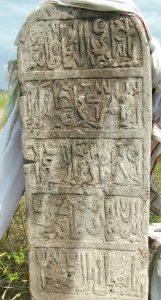 As a result of colonial policies, we reached a point where the names of people who had rendered outstanding service to the nation and played important roles in its history were no longer mentioned. Their memory was erased, and we no longer knew where many of them had been buried. Thankfully, independence has enabled us to begin correcting these historical injustices. The practice of tending the burial places of distinguished figures and erecting mausoleums in their honour is being revived. Unfortunately, however, some of these undertakings end in disputes and disagreements, dividing people into opposing groups. This is a mistake and a dangerous course of action. A systematic study of gravestones, conducted without unnecessary disputes, would undoubtedly help resolve such problems. In this regard, the painstaking work of our colleague Kazbek Kuttymuratuly deserves particular recognition. He has devoted considerable effort to uncovering the secrets of ancient gravestones and examining them through systematic journalistic research and analysis. Let me offer one example.
The inscription on the gravestone of the celebrated batyr Daukara Karakozhauly, whose name became a traditional battle cry, was deciphered for the first time. Daukara Batyr was born in 1687 and died in 1751 at the age of sixty-four. Although our revered Syrym Batyr was younger, he had seen Daukara Batyr during his lifetime. Nausha Batyr was also a contemporary of Syrym Batyr. For many years, numerous researchers had maintained that it was unknown when and where Nausha Karzhauuly had died. However, a respected local elder, Nauryzbai Abilkhaiyrov, identified his burial place. His gravestone has also survived. Nausha died in 1849 at the age of eighty-one. Why have I mentioned these two batyrs alongside our revered Syrym? My purpose is to draw readers’ attention to the periods in which these historical figures lived. This is what the continuity of generations means.
If we wish to honour Daukara and Nausha Batyr by building mausoleums in their memory, their burial places are known and their gravestones have been preserved. Their descendants are also living among us. For them, this presents a wonderful opportunity to fulfil their duty to their ancestors. Let someone take the initiative, and let the others lend their support! I have given these examples to demonstrate that studying gravestones can indeed help us revive the memory of our past.
Seventh, historic burial sites could become centres of cultural tourism
We would have much to gain if the resting places of khans, biys — traditional Kazakh judges and community leaders — batyrs, saints and scholars who devoted themselves to the welfare of their people became important destinations for tourism. After all, everyone hopes that their descendants will earn respect through honest service to their country, follow the example of their forebears and carry on their legacy with dignity. By visiting the resting places of historical figures they regard as role models and exploring their ancestral homeland, people can seek to raise descendants who would never betray their nation or their land. They can also take visiting guests to these places, thereby helping to revitalise tourism.
Eighth, gravestone inscriptions challenge claims that the Kazakh people lacked literacy
This work also exposes the falsehood of those who sought to discredit the Kazakh people by portraying them as ignorant and unable to read or write. The inscriptions on gravestones demonstrate that the Kazakhs possessed a rich language and a tradition of literate written expression. Let me give just one example.
At the Maulemberdi burial ground, situated eighteen kilometres west of the village of Bazartobe in Akzhaiyk District, West Kazakhstan Region, scholars examining the gravestones were astonished by the remarkable literacy evident in the inscriptions written in Arabic. They observed that the people buried there had been exceptionally well educated, some of them scholars, and that those who erected the gravestones were themselves people of considerable learning and standing.
Several gravestones at the site belonged to members of the same family line. The inscriptions indicated that all of them had possessed extensive knowledge and a deep understanding of religion. This is what honourable ancestry truly means. It is an example of profound knowledge and sound upbringing being passed from generation to generation. If our people had truly been illiterate, could they have left behind such remarkable historical monuments? Colonial powers resorted to such injustices in an attempt to prevent our nation from awakening and to keep it in subjugation.
Ninth, gravestone inscriptions bear witness to our common roots with other Turkic peoples
The inscriptions on gravestones demonstrate that we share common ancestral roots with other Turkic peoples, as well as common national traditions and religious beliefs. These gravestones also provide evidence that we once used the same calendar system.
Tenth, preserving gravestones is a duty to the ancestors of the Alash intellectuals
The beginning of the twentieth century was a time of extraordinary upheaval. The intellectuals of the Alash movement placed the interests of their people above their own personal concerns. With determination and perseverance, they devoted all their efforts to preserving their native land. It is thanks to their efforts that we live in an independent country today. These courageous individuals, who stood ready to defend their people in times of hardship, were raised by forebears of exceptional strength of spirit.
We must therefore ensure that none of these ancestors is left forgotten or neglected. By studying their gravestones, we should restore their names to public memory and accord them the honour they deserve. These are the ten reasons I have put forward to explain why the study of gravestones is necessary. I hope that others, too, will reflect upon this important matter.
Zhantas NABIOLLAULY
Head of the Miras Public Council
West Kazakhstan Region, Kazakhstan
Photograph: A view of historic gravestones.