Historical research often takes unexpected turns. One piece of evidence leads to another, sometimes yielding discoveries that could scarcely have been anticipated at the outset. What begins as an investigation into the life of a single individual may ultimately uncover the history of an entire burial ground and shed new light on the lives of prominent historical figures.
Such was the course of our research into a historic burial ground near the village of Bekey in Terekti District, West Kazakhstan Region, Kazakhstan.
Tracing the Story of Yesengeldi Bai
The origins of this research lie in DANA, a magazine devoted to history and historical education, whose publication I once organised. Through the magazine, we paid particular attention to gathering information about individuals whose names were known in regional history but whose lives had not been fully researched.
One such investigation focused on Yesengeldi Bai (bai, a traditional Kazakh designation for a wealthy individual).
After commissioning an article about Yesengeldi, we began searching for information about his son, Bekey Yesengeldiuly. During this research, Nurtas Nabiollauly learned of an old burial ground near the village of Bekey where historic gravestones had survived. He visited the site, photographed the stones and shared the images on his social media page.
At the time, no one paid particular attention to the inscriptions in Arabic script. Three years later, Facebook resurfaced the original post, and the photographs were shared again.
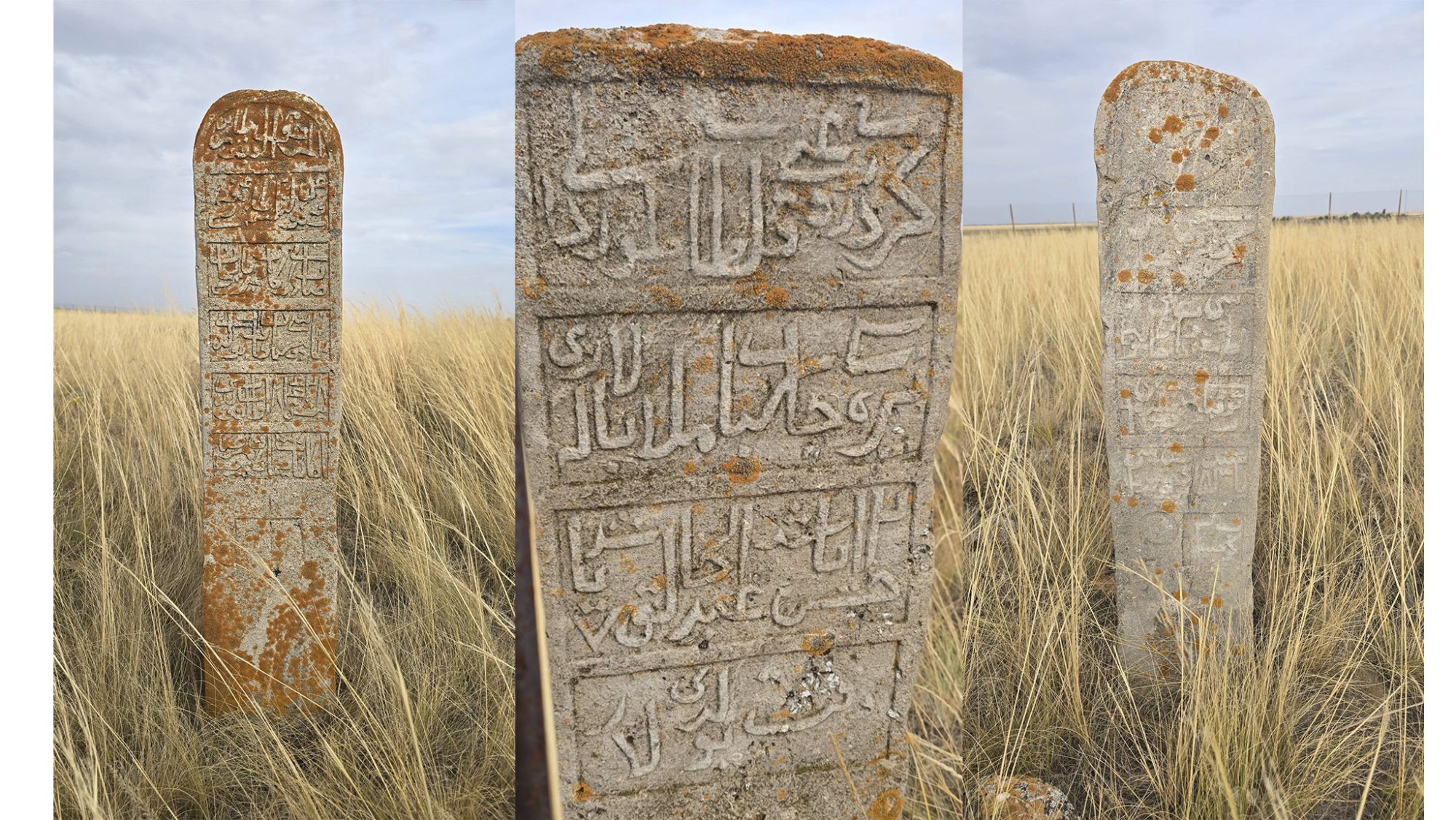
It was then that Muratbek Zhakhatov, who had been working on deciphering gravestone inscriptions, clearly identified the name “Aishuaq Khan, son of Abulkhair” in a moss-covered inscription visible in one of the photographs.
What began as research into Yesengeldi Bai and continued with a search for his son Bekey thus led to an important discovery concerning the history of the Junior Zhuz (Kishi Zhuz, one of the three traditional Kazakh tribal confederations).
2017: Identifying Khan Aishuaq’s Gravestone
On 17 June 2017, we visited the burial ground near Bekey in Terekti District specifically to examine the gravestone. Once the moss had been removed, Muratbek Zhakhatov and Qazybek Qabzhan deciphered the inscription.
According to the revised reading, the inscription on the front of the gravestone reads:
«Һуә ль-Мәлик уль-Хайю лләзи лә йәмуту әбәдән.
Һәзә ль-марқад әл-мархум әл-мағфур әл-мабрур.
Әбу ль-Музаффар уә ль-Мансур, сәйид баһадүр хан.
Айчуақ ибн хан Әбулхайыр ибн Хажы сұлтан, алейһи ль-афу уа р-рахмат уә ль-ғуфран.
Аллаһуммә джъаль қабраһу раудатән мин рияд әл-джинән, уә лә тәджъаль хуфратән мин хуфрат ән-ниран. Кәфә биль-мәути [уағизан].
Тарих 1227 сәнә, 15 маһ-и сәуірде рихлат ейледі, сексен беш йашында».
English translation:
“He (Allah) is the Ever-Living King who shall never die.
This is the grave of the deceased, forgiven and righteous Aishuaq Khan, the possessor of victories and the victorious one, a noble and valiant khan, son of Khan Abulkhair and grandson of Sultan Haji. May Allah grant him pardon, mercy and forgiveness.
O Allah, make his grave one of the gardens of Paradise, and do not make it one of the pits of Hell. Death alone is sufficient as an admonition.
Date: in the year 1227, on the fifteenth day of April, he departed this life at the age of eighty-five.”
The following lines have survived on the reverse of the gravestone:
«Кічі йүз қазақ халқы ічінде,
хүкүмет ейлейүб ханлық ічінде,
олыб разы …сында,
… едерді хызметі …,
хайатында екі ұғлы хан олды,
бірі Жантөре, бірі Шерғазы,
шәриф …,
қойұбды ішлетіб Алғазы сұлтан».
English translation of the surviving text:
“Among the Kazakh people of the Junior Zhuz,
Exercising authority as khan,
… content …,
… service …,
During his lifetime, two of his sons became khans,
One was Zhantore, the other Shergazy,
Noble …,
Sultan Algazy had [the stone] made and erected.”
The discovery established more than the final resting place of Aishuaq Abulkhairuly. The inscription itself provided direct epigraphic evidence clarifying important details of the khan’s biography.
The stone records that Khan Aishuaq died on 15 April 1812, at the age of 85, and that two of his sons, Zhantore and Shergazy, became khans. It also preserves the name of Sultan Algazy.
Aishuaq Abulkhairuly ruled the Junior Zhuz from 1797 to 1805.
During our earlier research into historic gravestones, we had identified the gravestone of Yesim Nuralyuly, who ruled as khan from 1795 to 1797, in Aqzhaiyq District, and that of Zhantore Aishuaquly, who reigned from 1805 to 1809, in Terekti District.
Together, the gravestones of these three successive khans provide direct epigraphic evidence documenting an entire period in the history of the Junior Zhuz.
Nine Years Later: New Evidence Emerges
In 2026, I returned to the burial ground near Bekey with my colleague Orynbasar Nurlanuly, who has considerable expertise in deciphering and translating gravestone inscriptions written in Arabic script.
As we examined the site again, we identified another historic gravestone that had previously received little attention.
Its inscription reads:
«Һуә Ллаһ әл-Бақи әл-Әбәд.
Байбақты руғы Тоқсаба тайфасы.
Чұмақ Өмірзақ би ұғлы офат болды отыз тоқыз йашында.
Иннә лиЛләһи уә иннә иләйһи раджиъун.
Бұ ташны әкесі Өмірзақ би қылдырды.
1810 сәнә».
English translation:
“He is Allah, the Eternal.
Baybaqty clan, Toqsoba branch.
Shumaq, son of Omirzaq Bi, died at the age of thirty-nine.
Indeed, we belong to Allah, and to Him we shall return.
This stone was commissioned by his father, Omirzaq Bi.
The year 1810.”
The inscription brings two names from the Toqsoba branch of the Baybaqty clan back into the historical record: Shumaq Omirzaquly and his father, Omirzaq Bi (bi, a traditional Kazakh authority on customary law, judicial matters and dispute resolution).
As Shumaq died in 1810 at the age of 39, he was born around 1771.
His father’s name appears twice on the gravestone, both times accompanied by the title bi: “son of Omirzaq Bi” and “his father, Omirzaq Bi”.
The available epigraphic evidence therefore identifies Omirzaq by both his personal name and social title.
His biography, his position within the Toqsoba branch and his descendants remain to be established through further archival and genealogical research.
A Burial Ground in Use Before Khan Aishuaq’s Death
The discovery of Shumaq Omirzaquly’s gravestone has made it possible to draw an important new conclusion about the history of the burial ground.
Shumaq was buried there in 1810.
Khan Aishuaq was buried there in 1812.
The burial ground had therefore already been established before Khan Aishuaq’s death.
His burial at the site indicates that an existing cemetery subsequently became associated with the khan’s dynasty.
Establishing the precise nature of that association will require further examination of the kinship, social and political ties among those buried there, alongside the relevant archival records.
The other surviving gravestones provide further insight into the history and character of the site.
According to documented measurements, the burial ground near Bekey covers 29,891.69 square metres, with a perimeter of 753.85 metres. Approximately 20 gravestones survive at the site today.
Most importantly, this was not a cemetery belonging to a single clan. Alongside members of the Töre dynasty (the hereditary Kazakh ruling lineage descended from Genghis Khan), representatives of the Baybaqty, Kerderi, Tama, Tabyn, Masqar and Ysyq clans were also buried here.
Danekoz Bai of the Tama Clan
Among the individuals identified at the burial ground so far, Danekoz Zharylgapuly has one of the earliest estimated birth dates.
His gravestone bears the following inscription:
«Әл-мархум әл-мағфур.
Тама руғының Дәулеткелді тайфасы.
Қарачаның нәбирасы Жарылғаб баласы.
Дәнекөз бай офат болды 88 йашында.
1827 сәнәда әл-хукм лиЛләһи…
Иннә лиЛләһи уә иннә иләйһи раджиъун».
English translation:
“The deceased, forgiven one.
Of the Dauletkeldi branch of the Tama clan.
Grandson of Qaracha, son of Zharylgap.
Danekoz Bai died at the age of eighty-eight.
In the year 1827. Judgment belongs to Allah …
Indeed, we belong to Allah, and to Him we shall return.”
Danekoz belonged to the Dauletkeldi branch of the Tama clan. He was the grandson of Qaracha and the son of Zharylgap.
The inscription explicitly identifies him as “Danekoz Bai”. He died in 1827 at the age of 88, placing his birth at approximately 1739.
The cemetery thus preserves the gravestone of a man born in the first half of the eighteenth century.
Satybai Qaraqulaquly of the Masqar Clan
A gravestone dated 1833 carries the following inscription:
«Масқар руғы Өтебай тайфасы Қарақұлақ баласы.
Сатұбай офат 35 йашда.
1833 йылда бұ ташны қойды інісі…».
English translation:
“Masqar clan, Otebai branch, son of Qaraqulaq.
Satybai died at the age of thirty-five.
In 1833, this stone was erected by his younger brother …”
Satybai belonged to the Otebai branch of the Masqar clan and was the son of Qaraqulaq. He died at the age of 35.
His younger brother erected the gravestone, although the brother’s name has not been fully deciphered.
The inscription provides further evidence that, during the first half of the nineteenth century, the cemetery served as a common burial ground for members of different clans.
Dosqan Taimanuly of the Tabyn Clan
An inscription dating from 1846 reads:
«Әл-мархум әл-мағфур Табын руғы … тайфасы.
Сарыкөкен немересі Тайман баласы Досқан офат болды.
28 йашында, 1846. Ташны қойды әкесі Тайман мырза».
English translation:
“The deceased, forgiven one, of the Tabyn clan, … branch.
Dosqan, grandson of Sarykoken and son of Taiman, died.
At the age of twenty-eight, in 1846. This stone was erected by his father, Taiman Myrza.”
Dosqan died at the age of 28. His father, Taiman Myrza, erected the gravestone.
The designation myrza (a traditional Kazakh honorific conveying respect and social standing) indicates that the inscriptions at the burial ground also recorded the social status of the individuals they named.
The Four Children of Mullah Zhasbai
A gravestone dating from 1854 has preserved the names of four children from the same family.
The inscription reads:
«Кердері руғы Құлтай Тұрдалы нәбирасы Жасбай молла балалары.
Хасан 12 йашда, Ғабдолхалық 7 йашда офат болдылар.
Ғабдысаттар 2 йашда, Фатима 2 йашда офат болдылар.
1854 сәнә».
English translation:
“Kerderi clan, Qultai, children of Mullah Zhasbai, grandson of Turdaly.
Hasan died at the age of twelve, and Gabdolkhalyk at the age of seven.
Gabdysattar and Fatima died at the age of two.
The year 1854.”
Hasan was 12 years old, Gabdolkhalyk was seven, and Gabdysattar and Fatima were both two. All four children died in 1854.
The inscription does not reveal the cause of their deaths. There is therefore insufficient evidence at present to associate their deaths with an epidemic or any particular historical event.
Nevertheless, the deaths of four children from the same family in a single year are a significant finding that warrants a closer investigation of local archival records relating to 1854.
A Son of Besbai from the Ysyq Clan
A gravestone dating from 1860 contains the following inscription:
«Ұсық руғының Қадырғұл тайфасы.
Сейдек аймағы Іздібай немересі Бесбай баласы.
… офат.
1860 сәнәда 37 йашында».
English translation:
“Of the Qadyrgul branch of the Ysyq clan.
Seydek lineage, grandson of Izdibai, son of Besbai.
… died.
In the year 1860, at the age of thirty-seven.”
Although the deceased’s personal name has not survived in full, the remaining inscription clearly establishes that he belonged to the Qadyrgul branch of the Ysyq clan, was the grandson of Izdibai and the son of Besbai, and died in 1860 at the age of 37.
Members of the Kerderi Clan
A considerable proportion of the later gravestones at the site belong to members of the Kerderi clan.
An inscription dated 1869 reads:
«Һәзиһи әт-турбәт.
Кердері руғы Жабағы тайфасы Есенай аймағы Жәнібек баласы.
Жауқачар офат болды 58 йашында 1869 йылда.
Бұ ташны қойды балалары Жұмғали, Қоңырбай».
English translation:
“This is the grave.
Kerderi clan, Zhabagy branch, Yesenai lineage.
Zhauqachar, son of Zhanibek, died at the age of fifty-eight in the year 1869.
This stone was erected by his children, Zhumgali and Qongyrbai.”
The gravestone of Aikenzhe Orazqyzy, dated 1902, carries the following inscription:
«Әл-мутәуәффәт Айкенже Ораз қызы.
Кердері руғы, Жанбас тайфасы, Сұлтанқұл аймағының Мұхаммеджан
Баймұхаммед ұғлының жамағаты.
1902-нчі сәнә хұт йұлдызында 36 йашында…».
English translation:
“The deceased Aikenzhe, daughter of Oraz.
Wife of Mukhammedzhan, son of Baimukhammed, of the Sultanqul lineage, Zhanbas branch of the Kerderi clan.
In the year 1902, under the sign of Hut (a traditional zodiacal calendar designation), at the age of thirty-six …”
This inscription preserves more than the name of an individual. It also records clan affiliation, the branch within the clan and family relationships.
The gravestone of Arystan Tolekuly, dated 1904, bears the following inscription:
«Аллаһуммә джъаль қабраһу нуран.
Кәфә биль-мәути уағизан.
Кердері руғы Жабағы тайфасы.
Арыстан Төлек баласы офат.
55 йашында 1904-нчі йылда.
Бұ ташны йаздұрды баласы Өтеғали мырза».
English translation:
“O Allah, fill his grave with light.
Death alone is sufficient as an admonition.
Kerderi clan, Zhabagy branch.
Arystan, son of Tolek, died.
At the age of fifty-five, in the year 1904.
This stone was inscribed at the request of his son, Otegali Myrza.”
Here, the honorific myrza appears once again. The inscription was commissioned by the deceased’s son, Otegali Myrza.
The dates of the gravestones deciphered so far extend as late as 1944. An inscription from that year preserves the following lines:
«Кердері Жабағы тайфасы.
Малашы Бесбей жамағаты офат болды.
Әсет айында 1944 жылда.
75 жасында. Бұл тасты қойдырды қызы…».
English translation:
“Kerderi clan, Zhabagy branch.
The wife of Malashy Besbei died.
In the month of Aset (a traditional calendar designation), in the year 1944.
At the age of seventy-five. This stone was erected at the request of her daughter …”
Taken together, the Arabic-script gravestone inscriptions examined to date provide dated evidence documenting at least 134 years of the burial ground’s history, from 1810 to 1944.
The Historical Character of the Burial Ground
Examining the deciphered inscriptions as a single body of historical evidence reveals several important characteristics of the burial ground.
First, this was not the ancestral cemetery of a single clan. Members of the Töre dynasty were buried here alongside representatives of the Baybaqty, Tama, Masqar, Tabyn, Ysyq and Kerderi clans.
Second, the cemetery was already in use by the early nineteenth century, before Khan Aishuaq was buried there. The gravestone of Shumaq Omirzaquly, dated 1810, provides direct evidence of this.
Third, the inscriptions frequently record titles and honorifics indicating an individual’s standing in society.
Aishuaq is identified as a khan, Algazy as a sultan, Omirzaq as a bi, Danekoz as a bai, Taiman and Otegali as myrza, and Zhasbai as a mullah (a Muslim religious scholar or cleric).
These titles are not descriptions assigned by later researchers. They are recorded directly in the gravestone inscriptions themselves.
This suggests that, during the early nineteenth century, the burial ground near Bekey held considerable importance within the local community.
Its precise historical status, however, remains to be established. Further archival and archaeological research is needed to determine whether the site was associated with the khan’s dynasty, a particular political centre or the settlement patterns of the period.
Khan Aishuaq’s burial in this already-established cemetery may not have been a matter of chance.
To assess this possibility, further research is needed into where the khan lived during his final years, where the sultans and bis of the area resided, and how the individuals buried at the site were connected to one another.
The Significance of the New Evidence Concerning Omirzaq Bi
Against this background, the gravestone of Shumaq Omirzaquly, identified in 2026, is of particular significance.
We now have several concrete pieces of evidence concerning Omirzaq Bi. He belonged to the Toqsoba branch of the Baybaqty clan and had a son named Shumaq, who was born around 1771 and died in 1810 at the age of 39. Omirzaq Bi commissioned a gravestone for his son at this burial ground.
These details suggest that Omirzaq Bi lived during the second half of the eighteenth century and the early nineteenth century.
His biography and public role remain to be established through the genealogical traditions of the Baybaqty–Toqsoba lineage (shezhire, traditional Kazakh genealogy) and archival documents from the period.
The importance of this evidence extends beyond the recovery of Omirzaq Bi’s name.
The fact that his son was buried at this very site two years before Khan Aishuaq provides a new chronological reference point for reconstructing the early history of the burial ground.
Gravestones: An Archive Carved in Stone
Our research into the burial ground near Bekey once again reinforces a point we have been making for several years: an ancient gravestone is far more than a grave marker. It is a historical source in its own right.
A gravestone can sometimes preserve information that cannot be found in archival records: a person’s name, father’s name, clan affiliation, branch within the clan, social standing, the period in which they lived, age at death, children and other family relationships.
Khan Aishuaq’s gravestone established the date of his death and his age at the time. It also preserved in stone the fact that two of his sons, Zhantore and Shergazy, became khans.
Shumaq’s gravestone brought the name of Omirzaq Bi of the Toqsoba branch of the Baybaqty clan back into the historical record and demonstrated that the burial ground existed before Khan Aishuaq was buried there.
Danekoz’s gravestone preserved the fact that he was a bai from the Tama clan.
From Dosqan’s gravestone, we learn that his father, Taiman, bore the honorific myrza.
The gravestone commemorating the children of Mullah Zhasbai has preserved all four of their names.
From Zhanibek’s gravestone, we learned the names of his children, Zhumgali and Qongyrbai. [See editorial note below.]
Viewed together, these inscriptions are far more than a collection of individual grave markers. They constitute an archive carved in stone, preserving the biographies of several generations.
A Continuing Investigation
Looking back at the course of this research as a whole, we can see how it developed into a continuous line of historical inquiry.
Research into Yesengeldi Bai undertaken through DANA magazine led to the search for his son, Bekey Yesengeldiuly.
The search for Bekey brought us to the historic burial ground near the village of Bekey.
One of the photographs taken there led to the identification of Khan Aishuaq’s gravestone. Our visit in 2017 established his burial place and clarified the text of the inscription.
Nine years later, our return to the cemetery led to the identification of Shumaq Omirzaquly’s gravestone. That discovery, in turn, brought Omirzaq Bi to our attention as a historical figure.
The combined study of the other gravestones has revealed that the burial ground is associated with far more than a single historical figure or clan. It is a complex historical site preserving evidence from different periods in the history of the Junior Zhuz.
Nine years ago, a moss-covered gravestone standing silently in the steppe led to the discovery of Khan Aishuaq’s final resting place.
Nine years later, another stone in the same burial ground brought the name of Omirzaq Bi back into the historical record.
This is a tangible result of the systematic study of historic gravestones.
Zhantas Nabiollauly Safullin
Director of the West Kazakhstan Regional Museum of History and Local Lore
Oral, Kazakhstan
15 September 2026