A museum’s work should not be limited to preserving artifacts in its collections or presenting history through exhibitions. Identifying unexplored chapters of regional history, gathering evidence preserved in local communities, visiting historic sites, and documenting their present condition are all essential aspects of museum research. These activities help preserve cultural heritage and establish a foundation for further scientific investigation.
With this purpose in mind, we organized a field expedition with staff from the West Kazakhstan Regional Museum of History and Local Lore to Saryomir (Kazakh: Сарыөмір), a village in Terekti District of West Kazakhstan Region, in western Kazakhstan. Our main objectives were to conduct a comprehensive study of the area’s historical and cultural heritage, collect oral accounts preserved in the memories of local residents, clarify information about historical figures, expand the museum’s collections with new artifacts, and document materials that could provide a foundation for future research.
An Artifact Preserved by the Community Is Tangible Evidence of History
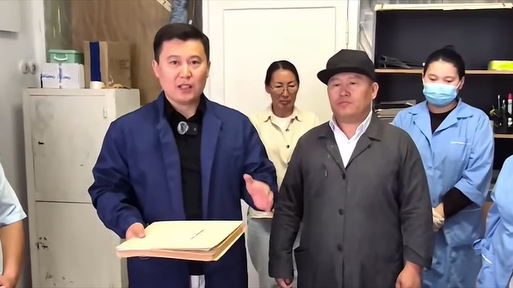
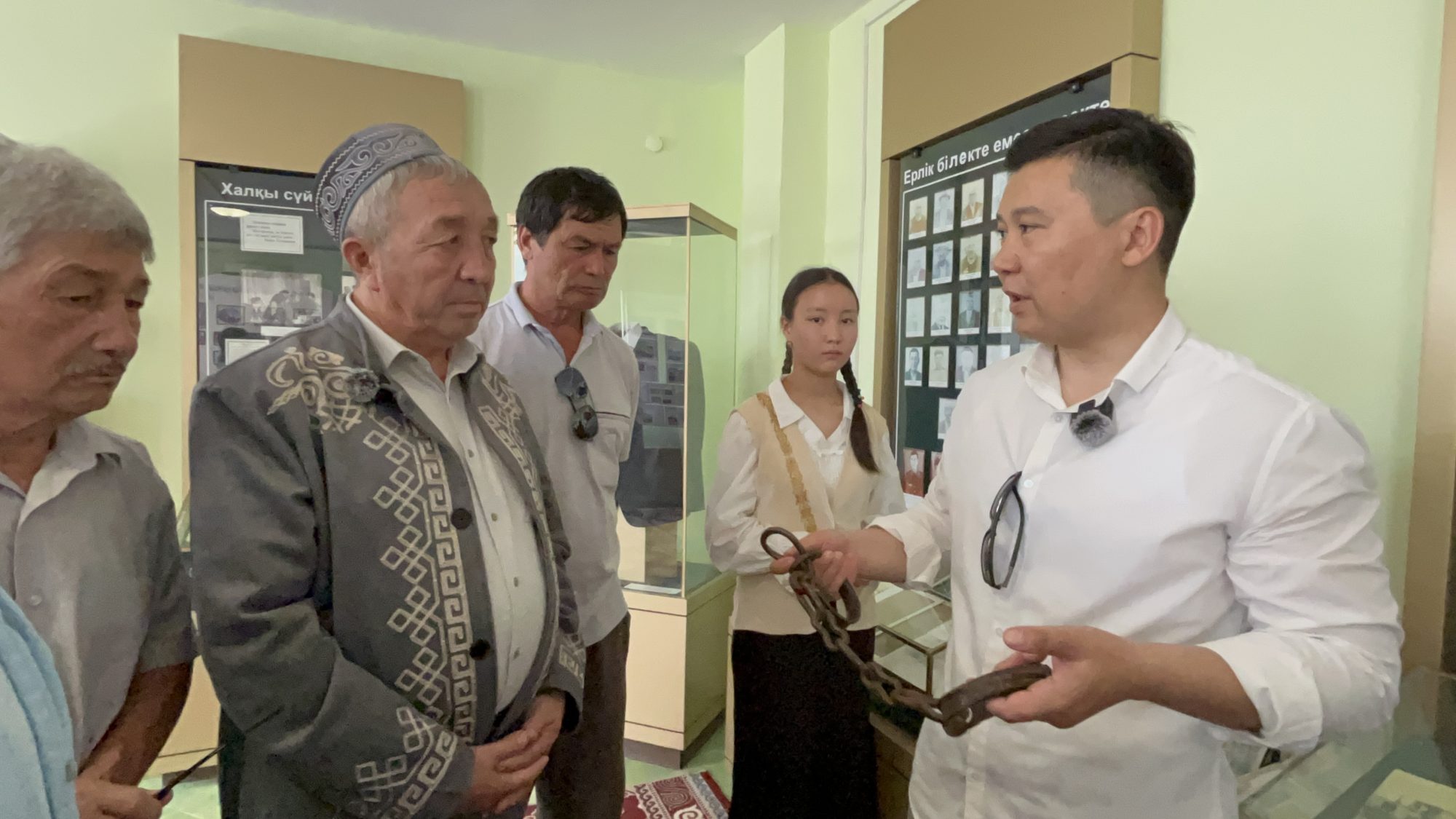 Our expedition began with a visit to the Khamza Yesenzhanov School Museum in Saryomir. There, we met with village elders and school administrators and recorded their recollections of the area’s past, former settlements, historic sites, and notable individuals associated with the region. The residents’ accounts were recorded in audio and video formats and registered in the museum’s research collections.
One of the expedition’s significant achievements was the acquisition of a set of shackles associated with the name of Kunyskerei, which were transferred to the regional museum’s collections. According to local oral accounts, the shackles were discovered in 1976 in Kunyskerei’s Cave on Mount Yelaman. Over the following decades, the artifact was kept by several individuals before eventually being entrusted to the Khamza Yesenzhanov School Museum. During our expedition, we sought to document its history of preservation as thoroughly as possible, recording the recollections of people familiar with the object and supporting the information with photographic and video evidence.
The value of such artifacts lies not merely in their physical characteristics. Behind each object are human memories, stories passed down through generations, and traces of a particular historical period. For a museum, therefore, preserving the history of an artifact is just as important as preserving the object itself.
A Private Art Gallery in the Village
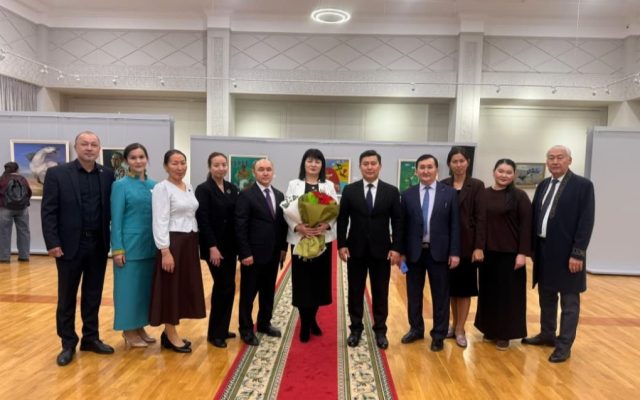
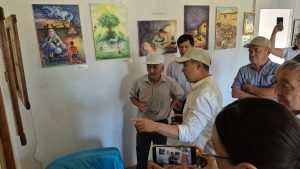 During our visit to Saryomir, we also explored the private exhibition house of artist Ginayat Daulbayev and became acquainted with his artistic heritage. His works reflect the worldview of the Kazakh people, their customs and traditions, and the lives of prominent historical and cultural figures.
At the conclusion of our visit, the artist donated his painting Äjemniñ Äñgimesi (My Grandmother’s Story) to the regional museum for permanent preservation. He also provided another work, Tört Mezgil (The Four Seasons), for temporary deposit. Thus, the expedition enriched the museum’s collections not only with a historical artifact but also with a new work of fine art.
Five Historic Wells in the Saryomir Steppe
One of the most intriguing outcomes of our expedition, and one that opened up new possibilities for future research, was the identification of five historic wells.
Local residents had previously informed us about old wells in the surrounding area. Until now, however, we had been unable to visit their exact locations, examine their structures firsthand, or systematically document them for scientific purposes. We therefore made locating and recording these wells a particular priority during this expedition. With the assistance of local residents, we surveyed the Taskuduk settlement area, situated along the route from Saryomir toward Olenty, together with the surrounding territory. As a result, we identified five historic wells.
The First Well
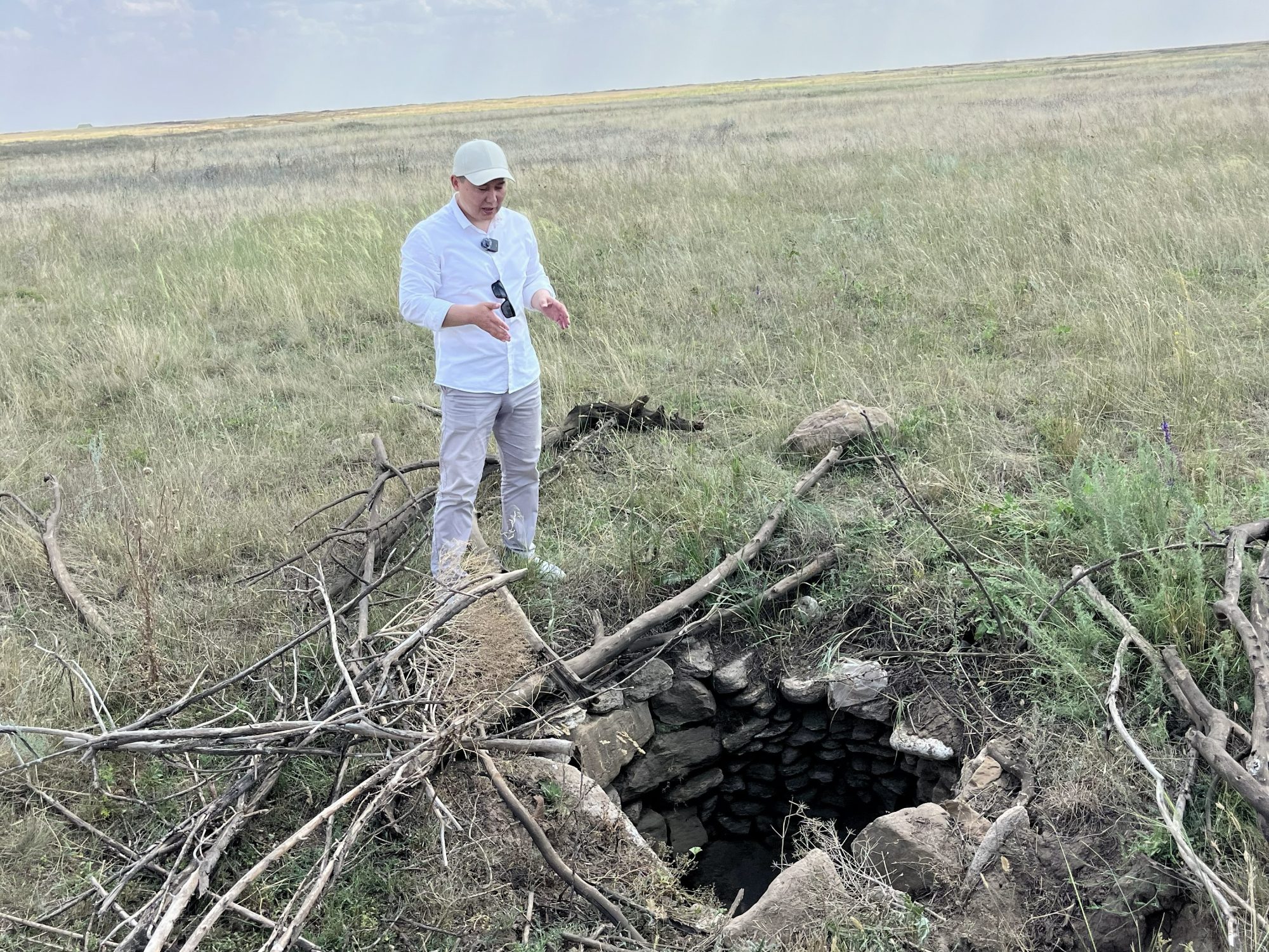
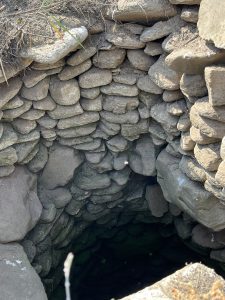
The first well is located near the Taskuduk settlement area, approximately 12 kilometers from Saryomir in the direction of Olenty. Its inner walls are constructed from broad, flat natural stones arranged to form a circular shaft. At present, the stonework is clearly visible to a depth of approximately four to five meters. Water and accumulated sediment obscure the lower section, making it impossible to determine the well’s full depth. During the expedition, we recorded the site’s geographical coordinates and photographed the structure for documentation.
The Second Well
The remains of the second well were discovered approximately ten paces from the first. Over time, the well has become completely filled with soil. Only traces of its former location can now be seen on the ground. Consequently, it was not possible to examine the internal stonework or investigate its construction in detail. Nevertheless, the close proximity of the two wells is noteworthy and may provide valuable information for future research.
The Third Well
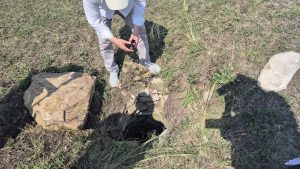
The third well
The third well attracted particular attention because of its unusual design. Its opening had been covered by a large, flat stone. After removing the stone, we conducted a visual examination of the interior. The opening measures approximately 60–70 centimeters in diameter. The well’s most distinctive feature is its shape: although the opening is relatively narrow, the shaft gradually widens downward, forming a jar-shaped structure. Its walls are lined with flat natural stones of varying sizes. According to local oral accounts, the well is associated with the 12th and 13th centuries. However, this dating remains unverified. Only archaeological investigation can establish when the structure was actually built.
The Fourth Well
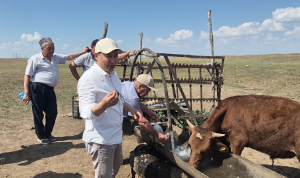
The fourth well is remarkable because it continues to serve its original purpose as a source of water. Its inner walls are lined with stone. The owners of a nearby farm have cleaned the well, installed an electric pump, and use the water for their livestock. According to the farm owner, water is pumped from a depth of approximately five meters, and the well has been back in use for the past three years. Local residents associate the structure with the 12th century. As with the other wells, however, this proposed date requires scientific verification.
The Fifth Well
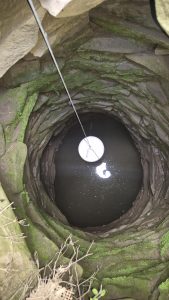
The fifth well lies in a natural depression in the landscape. Like the others, its walls are constructed from broad, flat natural stones. Its design resembles that of the third well: a narrow opening leads into a shaft that widens toward the bottom, giving it a jar-like shape. Water remains at the bottom, while moisture has encouraged moss to grow along the upper sections of the walls. Interestingly, local farmers have found an alternative use for this well. Taking advantage of the naturally cool conditions inside the structure, they use it to store food and household supplies.
What Can the Five Wells Tell Us?
What interested us was not simply the survival of five individual wells, but the fact that they are located within the same area, close to the sites of former settlements. According to local resident Rauan Amangeldiuly, these may not be the only wells in the area. Similar structures could still exist in nearby ravines and valleys, awaiting investigation.
Village elders have traditionally associated the wells with the Golden Horde period of the 13th and 14th centuries. According to Rauan Amangeldiuly, the concentration of wells in one area may suggest that a substantial settlement once existed there. These oral accounts are of considerable interest, but their scientific verification is essential.
Archaeological research has already been conducted in this area. In 2020, archaeological investigations identified the site of a medieval mausoleum dating to the Golden Horde period. The identification of several old wells nearby now provides additional material for a more comprehensive investigation of Saryomir’s medieval history.
Nevertheless, we are careful not to definitively classify the newly documented wells as monuments of the Golden Horde period without sufficient scientific evidence. At this stage, the expedition’s primary task was to identify the structures, establish their locations, describe their construction, record local oral accounts, and assemble a body of evidence for future scientific research. Determining precisely when the wells were built and which historical period they belong to will require archaeological investigation.
Traces of Different Historical Periods in One Landscape
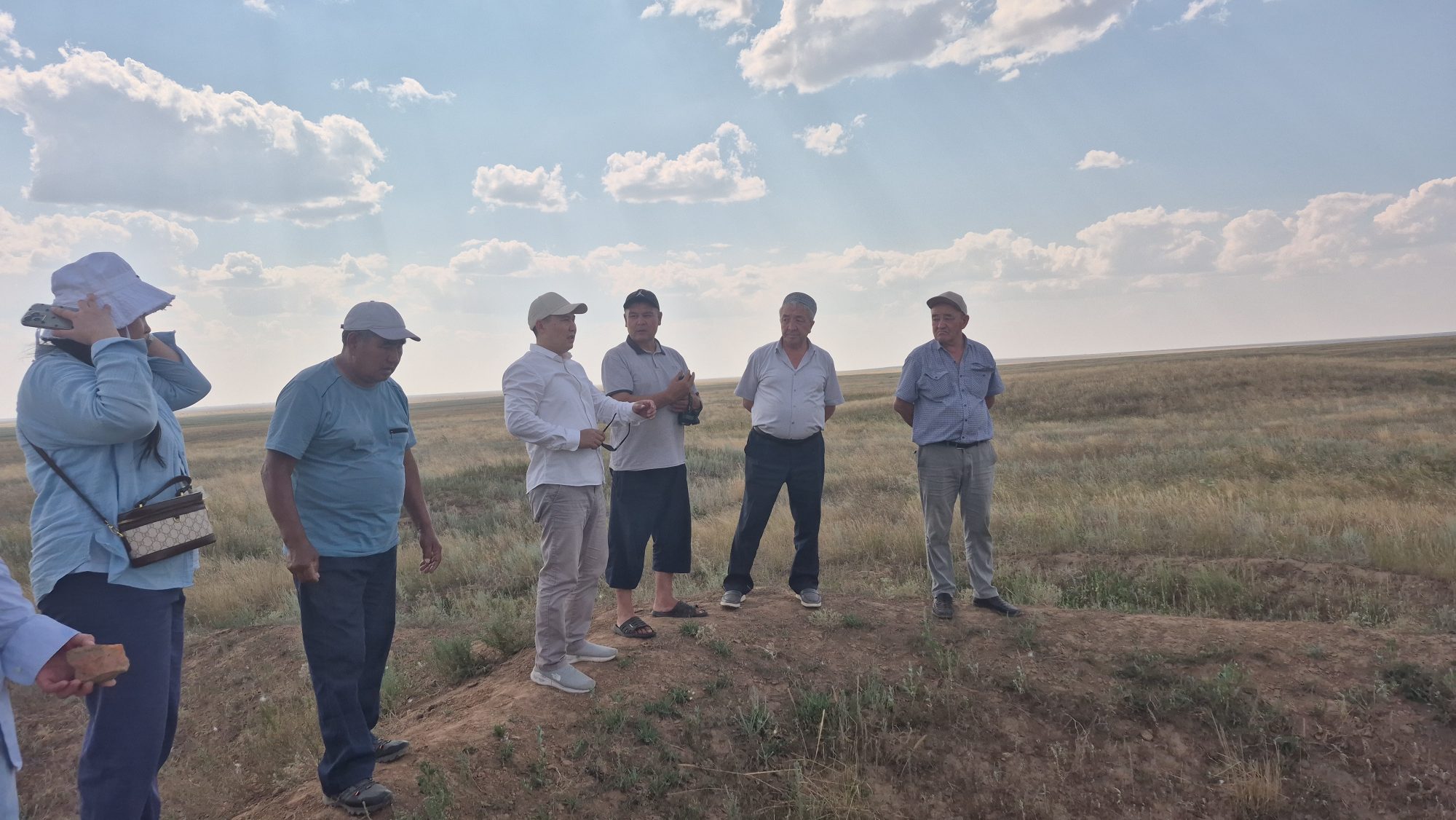
The next destination of our expedition was the site of a medieval mausoleum associated with the Golden Horde period, where archaeological excavations had been carried out in 2020. We conducted a field survey of the area and examined the surrounding historical and cultural landscape.
We then visited the mausoleum of Aksakal Ata, a historical figure associated with the Baibakty clan. There, we assessed the present condition of the mausoleum and documented traces of ancient burial mounds and kurgans in the vicinity. To obtain a broader view of the area, we also carried out aerial photography using a drone.
Taken together, these observations suggest that Saryomir should not be studied solely in connection with a single historical period. Rather, it should be considered an interconnected historical and cultural landscape preserving evidence from different eras.
Historical Evidence Preserved in the Steppe Must Not Be Lost
Our expedition to Saryomir highlighted another important issue: how much valuable historical evidence remains in our villages, still largely outside the scope of scientific research? Some of this heritage consists of archaeological sites scattered across the landscape. Another part is preserved in objects kept by local families. Yet another survives in the recollections of village elders and in stories passed down through generations.
As time passes, the number of people who possess this knowledge inevitably decreases. Some historic sites also face the threat of deterioration caused by natural processes and human activity. This is why museum professionals cannot simply wait for historical objects and documents to arrive at their institutions. We must travel to villages, speak with local residents, record their recollections, identify historic sites, document artifacts, and work alongside scientific institutions to conduct further investigations.
As a result of our expedition to Saryomir, the museum acquired a historical artifact associated with Kunyskerei. We recorded the recollections of village residents and gathered information about the area’s historical heritage. We also studied the artistic legacy of Ginayat Daulbayev, whose donation added a new painting to the museum’s collection.
Five historic wells were identified, while historic sites were documented through photography, video recordings, and drone footage. We surveyed the areas surrounding the medieval mausoleum and the mausoleum of Aksakal Ata, collecting materials that may prove valuable in future research.
Yet these achievements do not mark the end of our work. On the contrary, they signal the beginning of a new phase of investigation. Our next priority is to undertake comprehensive studies of the identified sites in cooperation with archaeologists, historians, and other relevant specialists. This will involve establishing their chronology on a sound scientific basis, as well as considering measures for their official registration and protection.
For a museum, history is much more than an artifact displayed behind glass. History lives in an old settlement hidden among the vast expanses of the steppe, in a stone well preserved through the passage of time, in an object treasured by a village family, and in the memories of an elder who carries the stories of earlier generations. Finding this evidence in time, studying it, preserving it, and passing it on to future generations is our fundamental responsibility.
Zhantas Nabiollauly Safullin
Director, West Kazakhstan Regional Museum of History and Local Lore
Oral, Kazakhstan — August 5, 2026
Translated from the original Kazakh