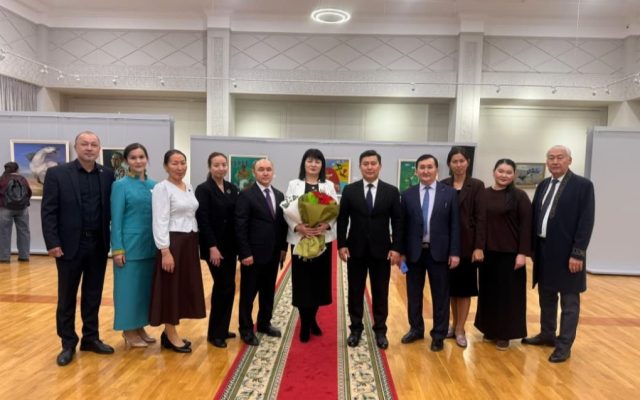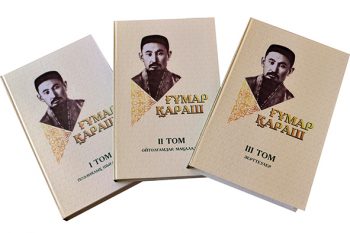
Recently, at L. N. Gumilyov Eurasian National University in Astana, we presented a three-volume collection bringing together the works of Gumar Karash and previously unpublished research by scholars, in the presence of academics and students. This publication is the result of several years of dedicated work. I would therefore like to share with a wider readership the foreword to the collection, which explains why we undertook this project and where we obtained the materials.
Our principal aim in compiling this collection is closely connected with the ideas Gumar Karash himself expressed in the forewords to his publications Shaiyr, or the Principal Poems of Kazakh Poets and Koksilder, or Songs about the Noblemen, Great Men and Nogai Heroes of Former Times, and Other Meaningful Verses.
He begins the foreword to Shaiyr with these words: “People of knowledge have said: ‘A nation that does not preserve its songs, poetry and words of wisdom is a nation without a soul.’ These words are entirely true. Why? Because the identity of every nation — whether Kazakh, Tatar or Russian — is preserved through the continued use of its distinctive ancestral language, without allowing that language to disappear. A nation cannot preserve its language without preserving its songs and traditional sayings. That is why educated and enlightened nations take such great care over the preservation of their languages…”
In Koksilder, he develops this idea further: “The first and foremost purpose of composing poetry is to preserve the mother tongue of each nation and the eloquence inherent in it. The second purpose is to influence readers through beautiful poetry, encouraging such admirable qualities as ‘heroism’, ‘generosity’ and ‘curiosity about the world’…”
Only after a century had passed and our country had gained independence did we come to appreciate fully how the words, writings and deeds of Gumar Karash could serve as an example to the present generation. As the saying goes, “Even if you cannot become like him, strive to follow his example.” Our endeavour is to continue, as far as we can, the work Gumar Karash undertook for the good of his people and, through the books now in your hands, to reunite our nation with the legacy of an ancestor who sacrificed his life for future generations.
These volumes are the fruit of several years of work. For me, however, the most important objective was not only to fulfil our duty to future generations and our obligation to Gumar Karash, but also to honour a promise I had made to his granddaughter, the scholar Nadezhda Burkhanovna Karasheva, who lives in Moscow.
It is clear that we have yet to understand Gumar Karash fully. Much more research will be needed before we can appreciate the full extent of his life and legacy. For now, the materials available to us allow us to establish the following.
Gumar Karash was a progressive poet, philosopher and educator who described the beginning of the twentieth century as a period of hardship and profound upheaval. He was a man whose words were matched by his actions. Having acquired extensive religious knowledge, he held senior positions in the religious sphere. Later, however, he openly exposed the ignorance of poorly educated mullahs and devoted himself to the cause of enlightenment.
He dreamed of independence for his country and devoted all his strength and energy to achieving it. He accomplished a great deal in education and public enlightenment and made a substantial contribution to the development of both the oral and written literary traditions of the Kazakh people.
He published the poetry collections Oiga Kelgen Pikirlerim, Badel-Hajy, Bala Tulpar, Aga Tulpar, Karlygash, Ornek, Tumysh and Turymtai, and wrote works of philosophical reflection. Between 1910 and 1912, he also published collections of Kazakh heroic poetry under the titles Shaiyr, or the Principal Poems of Kazakh Poets and Koksilder, or Songs about the Noblemen, Great Men and Nogai Heroes of Former Times, and Other Meaningful Verses.
At a time when there was not a single newspaper in the Kazakh steppe representing the interests of the people, he organised the publication of a newspaper called Kazakhstan, intended to spread knowledge and teach practical skills and trades. He also established and directed the publication of Mugalim (Teacher), a scholarly journal devoted to education, literacy and moral upbringing.
His articles, reflections and poems, which offered guidance to the public, called for unity and solidarity, and encouraged education and the acquisition of useful skills, appeared in widely circulated publications of the period, including the journals Aiqap, Mugalim and Shora, the newspapers Kazakhstan, Uran and Durystyk Zholy, and other Tatar-language periodicals.
At that time, Gumar Karash was the only Kazakh author to have published such a large number of collections.
Regarding service to his people as the purpose of his life, he taught at the teacher-training college in Orda in 1918. In 1919, he laid the foundations of the first association bringing together Kazakh writers in Orda and published the newspaper Durystyk Zholy. He also organised an agricultural cooperative called Kyrkudyk in his native region. These activities provide further evidence of the extraordinary contribution Gumar Karash made to his people.
Gumar Karash was born in 1875 in the locality of Kyrkudyk in the Inner Bukey Horde, in what is now Zhanibek District. In 1921, at the age of just 46, he was killed by assailants in Kunanشapkan. Despite his relatively short life, he left behind a rich legacy and an enduring mark on history.
One of his contemporaries, the prominent scholar Esmagambet Ismailov, described Gumar Karash as “a major classical poet after Abai…” Yet in 1947, following a resolution of the Central Committee of the Communist Party of Kazakhstan entitled On Gross Political Errors in the Work of the Institute of Language and Literature of the Academy of Sciences of the Kazakh SSR, Gumar Karash was labelled “one of the figures of the bourgeois-nationalist Alashorda party, hostile to the revolution”. His name was removed from school textbooks, while further research into and promotion of his work were prohibited.
The cruelty of the system and the tragedy of his fate were compounded by the fact that the Soviet authorities, whose power had by then been firmly established, neither sought nor punished those responsible for his murder. Just a year later, his eldest son Abdulkadyr, who had already reached adulthood, was also killed by assailants. Thus, both the father who had worked tirelessly for the future of his people and the son who followed in his footsteps were destroyed.
When I heard in 2012 that a direct descendant of this distinguished figure — his own granddaughter — was living in Moscow, I was delighted. My joy was even greater when I travelled there specifically to meet and interview her later that year.
I spent several hours talking with Nadezhda Burkhanovna Karasheva, and our meeting was subsequently covered extensively in the media. There was, however, one question I asked during our conversation, and one answer I received, which I chose not to make public at the time.
The question was: “Do you have any documents or materials relating to Gumar Karash?” I kept both the question and the answer private because they carried a considerable responsibility.
When I asked, she replied without hesitation that she did have such materials and led me into the next room. She brought out approximately ten folders and placed them before me. Perhaps she was watching to see how I would react.
As I opened each folder and examined the important documents inside, my intense interest must have been plainly visible.
I could not bring myself to ask for the originals, so I requested permission to make copies of the most significant materials. At that moment, she became emotional, and tears came to her eyes.
“Having reached this age, what has troubled me most has been the papers collected in these folders,” she said. “Various researchers have contacted me, but perhaps because I did not trust them, I never handed the materials over. After meeting you in person and learning about the work you have done, I have come to trust you. Take everything back to our homeland. Make use of what you need, and afterwards hand the materials over to the local museum.”
In this way, she entrusted the collection to me.
There was emotion in her voice, but also an extraordinary sense of calm. She continued: “I am grateful to Allah. I have grown old, and now, whatever happens, I have no regrets. A heavy burden has been lifted from my shoulders.”
She then offered me her heartfelt, motherly gratitude and good wishes.
And so I returned home carrying a substantial collection of materials that Nadezhda Burkhanovna had gathered since her youth, together with documents entrusted to her by Mustafa Ismagulov and Gulzhau Sultangaliyeva.
As soon as I returned, we began examining the folders one by one, organising the documents and preparing the most significant materials for inclusion in the future publication.
For example, we had heard of Gumar Karash’s collection Kyrgi, but neither earlier researchers nor we ourselves had been able to locate it anywhere. Material relating to this work was discovered in a folder labelled “Unpublished Works of G. K.”
At the beginning was the following note:
“Copied from a notebook written and submitted by the pensioner Imanbai Zhumagaliyev of Kyrgi q/b. Gumar Karash’s unpublished work entitled Kyrgi was copied by hand from one person to another and read during the years 1918–1920. I read it too. Below I have written down a few short passages that have remained in my memory. I have also forgotten the longer sections and their titles…”
Another major discovery was an original copy of the collection Ornek, published 106 years earlier, which we found in a different folder.
There were many other materials of similar importance. I could write at length about each one. Rather than introduce them individually, however, we decided to include a complete list at the end of this book (Table 1), trusting that discerning readers would appreciate the value of the materials we had brought back.
The life of Nadezhda Burkhanovna Karasheva, Gumar Karash’s granddaughter, who was living in Moscow at the time of writing and whose assistance opened a new direction in our research, clearly reflects the distinguished family from which she descends.
She was born in Oral in 1930. In 1948, she graduated from a Russian-language secondary school in Almaty with a gold medal. In 1953, she graduated with honours from the Oriental Studies Department of the Faculty of Philology at Lomonosov Moscow State University.
Between 1953 and 1962, she worked at the Institute of Language and Literature of the Academy of Sciences of the Kazakh SSR. During this period, she defended her Candidate of Sciences dissertation on “Grammatical and Linguistic Features of Kazakh Literary Language in the Early Twentieth Century (Based on Materials from the Journal Aiqap)”.
She has lived in Moscow since 1963. Until she was well into her eighties, she worked as an academic secretary at a philological centre of the Russian Academy of Education. She is the author of more than 120 publications on language and language-teaching methodology.
Alongside her contribution to scholarship, she has done an enormous amount to research and promote the legacy of her grandfather. Her translation of Gumar Karash’s works into Russian and publication of them as a booklet, together with her compilation of the family genealogy (Table 2), which she distributed among relatives, are clear evidence of this work.
Recognising the importance of knowing one’s ancestry, we have included the genealogy in this collection.
Nadezhda Karasheva’s exceptional trust and warm words inspired me to work tirelessly. At the same time, I must admit that the responsibility she entrusted to me weighed heavily upon my shoulders. I made it my principal objective to fulfil that responsibility to the highest standard I could achieve.
We could simply have gathered the available materials, organised them carefully and published a collection. But my conscience would not allow me to stop there.
We knew that many works by Gumar Karash had appeared in newspapers and journals in the early twentieth century. It would therefore have been wrong to overlook those publications without examining them and, wherever possible, including the relevant works.
This was one of the reasons behind our efforts to locate Uran, Durystyk Zholy, Qazaq Durystygy and other newspapers after finding Kazakhstan, and to transcribe their contents from the Arabic script.
Nevertheless, we cannot claim to have collected everything. We have not examined all issues of the newspaper Qazaq or the journal Aiqap, let alone the periodicals published in the Tatar language. Even so, we decided to organise and bring together the materials we had managed to obtain.
It is no coincidence that the grave of Gumar Karash was included among Kazakhstan’s sacred sites as part of the work undertaken under the Rukhani Zhangyru programme initiated by the Leader of the Nation.
Those who murdered Gumar Karash and his son sought to keep the Kazakh people firmly under colonial domination, eliminating through various means anyone who opposed them.
At the time, they may have believed that they had succeeded in destroying Gumar Karash himself, along with his words and writings. Yet a century later, the dream he cherished has come true: our country has gained independence, and those who sacrificed their lives for that cause are being reunited with later generations through the restoration of their memory and legacy.
They are becoming guiding figures in our national consciousness, while their burial places are being recognised as sacred sites where people can visit and pay tribute to their memory.
Just as the place where Gumar Karash rests is important to us as a site at which to honour him, his written works are equally important for understanding the man himself.
With this in mind, we collected as many of the poet’s writings as possible and initially prepared a two-volume edition. The first volume contained his poetry, while the second brought together his prose. We also included the relevant poetic and prose works found among the valuable documents brought from Moscow.
Following further discussion, we decided to publish a third volume. It contains biographical material about Gumar Karash and his works translated into Russian by Nadezhda Burkhanovna herself, research studies on Gumar Karash written by Mustafa Ismagulov and Gulzhau Sultangaliyeva, and a range of important recollections.
Just as Nadezhda Burkhanovna placed her trust in me when she handed over all her documents, the two scholars, Mustafa Ismagulov and Gulzhau Sultangaliyeva, had placed their trust in her when they travelled to Moscow and entrusted her with the materials they had painstakingly collected during the Soviet period.
They had sought to gather every available piece of evidence and ensure that this remarkable figure would somehow become known to future generations.
But in those days there was no place in the official narrative for a man who had dreamed of his country’s independence and worked tirelessly towards it. Indeed, his name and legacy had been prohibited.
The researchers therefore tried to introduce him to the public by whatever means were available. Just as Mukhtar Auezov, in his novel The Path of Abai, portrayed Abai’s father Kunanbai negatively in order to bring Abai’s legacy to the people, researchers also presented Gumar Karash as a supporter of Soviet ideology to enable their work to pass censorship.
In truth, these two scholars had already completed the essential work for us. What remained was to bring their research together and publish it when the time was right.
We considered it important that their contributions should appear in the third volume with their authorship fully acknowledged.
In this way, the materials we had collected grew into three volumes. To ensure that the publication was produced to the highest possible standard, we presented an initial version to scholars in Almaty, invited their comments and suggestions, and sought their advice on what should be added or amended.
It is well known that the scholar and researcher Kabibolla Sydyikov previously compiled works by Gumar Karash and published them in a book entitled Zamana. Our task has been to follow the path established by that publication and, as far as possible, supplement it with additional materials.
This work has been carried out by a small group of dedicated individuals who joined forces out of genuine concern for preserving this heritage. None of us holds an academic title. I therefore ask readers not to judge us too harshly if they find shortcomings in the collection. In the future, these can be corrected, further materials can be added, and the volumes can be republished.
We also considered it essential to identify precisely where each work had been obtained and, where a text had originally appeared in the Arabic script, to record who had transcribed it. For this purpose, we included a special table at the end of the edition.
I wish to express my gratitude to my colleagues, who devoted themselves to organising this work without regard for the time it demanded. Searching for materials, locating them, negotiating access, paying any necessary fees, obtaining copies, transcribing texts and arranging the results systematically — every stage required considerable responsibility. It is thanks to these sustained efforts that the works of Gumar Karash, an outstanding figure in Kazakh history, are now reaching readers.
Previously, we published numerous books devoted to the history of the press, gravestone inscriptions and other aspects of our spiritual heritage. We undertook all those projects of our own initiative, guided by a genuine personal commitment.
This project was no different in that respect, but the responsibility was far greater. It was a task entrusted to me as a solemn obligation, one that I had promised to fulfil.
Now that I have done my utmost to justify the hopes of the descendant of this distinguished man, as well as those of the two scholars who placed their trust in her, and have fulfilled my promise, I too feel as though a heavy burden has been lifted from my shoulders.
Read, reflect and share these works with others!
Zhantas NABIOLLAULY
Director General, Zhaiyk Press LLP
Oral Oniri newspaper, 9 June 2018
Translated from Kazakh.