— Zhantas Nabiollauly, I would like to interview you in your capacity as head of the Dana Research Centre, which is working towards the full rehabilitation of victims of political repression in West Kazakhstan Region. Although I am broadly familiar with the subject, I would like to hear from you how this work began and what prompted it.
— Last year, on 24 November 2020, President of the Republic of Kazakhstan Kassym-Jomart Tokayev issued Decree No. 456, “On the State Commission for the Full Rehabilitation of Victims of Political Repression”. Our current work is being carried out under this Decree and is directed towards fulfilling the tasks set out in it.
— Once a decree has been issued, meetings and discussions are held to implement it, and regional commissions are established at the local level. Is that correct?
— Yes. On 3 December 2020, the first meeting of the State Commission for the Full Rehabilitation of Victims of Political Repression took place under the chairmanship of Krymbek Kusherbayev, State Secretary of the Republic of Kazakhstan. The Commission comprised 49 members, including representatives of the Presidential Administration and the Government, deputies of the Senate and Mazhilis, heads of relevant government organisations, representatives of public organisations and academics. At the meeting, the State Secretary emphasised that the Commission’s principal objective was to fully restore historical justice for all categories of victims of political repression during the Soviet period. The meeting considered the State Commission’s work plan for 2020–2021 and proposed establishing special working groups to develop approaches to the rehabilitation of different groups of people subjected to repression.
— Could you clarify what you mean by “all categories”?
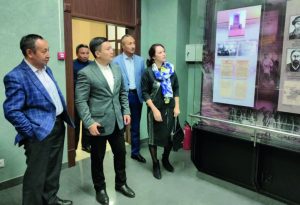 — I shall answer your question by referring to the words of Yeraly Tugzhanov, Deputy Prime Minister of the Republic of Kazakhstan, who attended the second meeting of the State Commission for the Full Rehabilitation of Victims of Political Repression on 8 April 2021, chaired by State Secretary Krymbek Kusherbayev. He stated:
“The State Commission has been entrusted with a number of important tasks. These include:
- preparing proposals to restore historical justice for victims of political repression;
- conducting scholarly research into the rehabilitation of people who were unjustly convicted or subjected to political repression;
- ensuring that researchers have access to materials concerning political repression held in closed archives;
- preparing proposals to commemorate victims of political repression who demonstrated courage in the struggle for our country’s freedom, independence and territorial integrity.”
The Minister of Education and Science of the Republic of Kazakhstan, Askhat Aimagambetov, also identified the subjects and areas of work to be undertaken by the working groups. These included:
- searching for supreme state acts of the former USSR;
- studying the nature and distinctive characteristics of political repression in Kazakhstan;
- investigating executions carried out without trial or investigation during the suppression of 372 uprisings;
- rehabilitating victims of repression among peoples forcibly resettled in Kazakhstan and special settlers who have not yet been rehabilitated;
- examining the rehabilitation of kulaks, wealthy landowners (bais), semi-feudal landowners (middle peasants) and peasants who have not been rehabilitated;
- studying punitive actions by the state between 1916 and 1930, as well as various campaigns of political violence conducted by the authorities during periods of repression;
- investigating the victims of intensified collectivisation and purchasing campaigns directed against peasants under the Bolshevik-Stalinist regime;
- studying victims of political repression held in the 26 camps of the NKVD’s Gulag system, as well as members of their families;
- preparing opinions and recommendations concerning the legal and political rehabilitation of participants in political demonstrations;
- investigating the rehabilitation of Kazakhstani prisoners of war held captive in Nazi Germany, Finland and other European countries between 1939 and 1945;
- conducting research aimed at rehabilitating representatives of traditional religious communities who became victims of political repression.
— Similar commissions were also established in the regions, were they not?
— Yes. Regional commissions have been established locally and are working in the archives.
— I imagine our readers would be interested to know who serves on the commission in our region.
— The regional commission is chaired by Bakytzhan Narymbetov, Deputy Akim of West Kazakhstan Region. The group investigating popular uprisings against confiscations, forced collectivisation and other unlawful actions is headed by the historian Yeskairat Khaidarov.
The group researching the famine and its consequences is led by the historian Baktyly Boranbayeva. I have undertaken the research into wealthy Kazakhs whose property was confiscated.
The study of the Alash movement and its leading figures is being carried out by a group headed by the historian Alfiya Baibolsynova.
Research into religious figures subjected to repression, as well as the history of mosques and churches, has been entrusted to the local historian and researcher Kazybek Kuttymuratuly.
Akhmediyar Batyrkhanov is working on the Second World War, the fate of prisoners of war and those unjustly convicted.
Aibolat Kurymbayev is researching Kazakhs who were forced to leave their ancestral homeland and move abroad as a result of political repression, as well as people of other nationalities deported to Kazakhstan. Of course, this division of responsibilities is only provisional. As we are engaged in a common undertaking, we help one another and regularly exchange information.
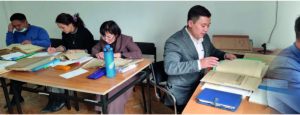 — Although the regional working group is investigating the political repression experienced by residents of West Kazakhstan Region, it seems that your research is not confined to the region itself.
— That is correct. Although the West Kazakhstan Regional Archive is our working group’s principal research location, we often need to work in other regions, archives, libraries and similar institutions. Some of the information we need, indeed a considerable proportion of it, is held outside the region. We therefore have to examine those materials as well. It was for this reason that our regional working group visited Almaty this October.
— Could you tell us more about that research trip?
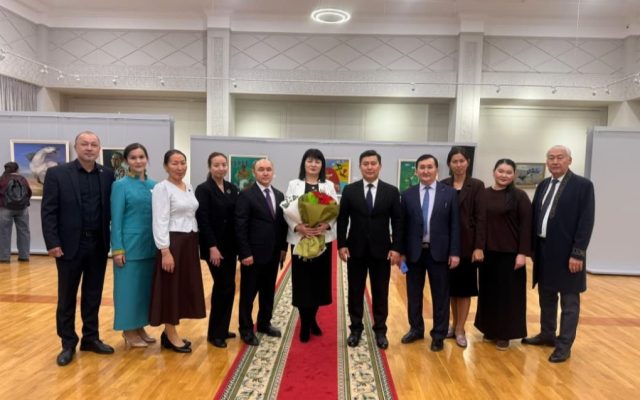
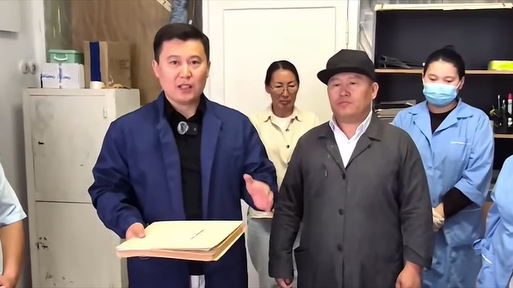
— Members of the West Kazakhstan Regional Commission for the Full Rehabilitation of Victims of Political Repression travelled to Almaty to gather information and exchange experience, working in archives and research centres. Both the regional commission’s activities and the trip to Almaty were made possible with the support of the Akimat of West Kazakhstan Region and the regional Department of Internal Policy. The commission members began their work in Almaty by meeting Sabit Shildebay, Director of the Central State Archive of the Republic of Kazakhstan. During the meeting, it was noted that the delegation from West Kazakhstan was the first regional delegation to arrive with such a large group to investigate political repression. Sabit Kamytbekuly introduced the working group to the archive’s senior staff, provided them with a separate room and ensured favourable working conditions.
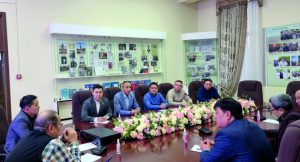 During the trip, members of the regional commission also visited the Shokan Ualikhanov Institute of History and Ethnology, where they met its director, Ziyabek Kabuldinov, and senior researchers Shamek Tileubayev and Arman Abikey. An agreement was reached with the institute’s director, Ziyabek Yermakhanuly, on future joint research into the history of West Kazakhstan. The commission members received support in arranging subject-specific meetings with members of the State Commission and Almaty-based researchers, using the institute’s facilities and organising events.
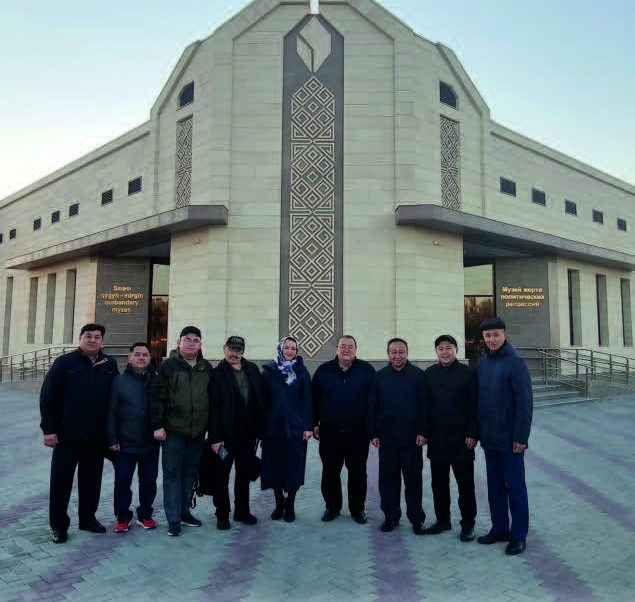
On the second day of the trip, the regional commission members visited the Museum Complex for Victims of Political Repression in Zhanalyk village, Talgar District, Almaty Region. During their visit, they paid their respects at the burial ground of victims of political repression in the village. In the past, the bodies of people executed by the NKVD in Almaty had been brought there at night and buried. Personally, I believe that museums of this kind should be established in every regional centre.
Following the visit to the burial ground, a meeting was organised to exchange experience. At the meeting, Professor Garifolla Anes, head of the Arys Foundation, which researches the legacy of Kazakh intellectuals subjected to political repression, spoke about the progress of the project “Zhetisudyn Sherli Tarikhy” (“The Sorrowful History of Zhetisu”) in Almaty Region. The meeting was also attended by historians and specialists from Almaty, including Candidate of Historical Sciences Shamek Bayanuly, archivist Rashid Orazov, PhD doctoral researcher Yerkin Stamshalov and Meirzhan Musabayev, head of the Zhanalyk Museum. They shared information about archival collections in Almaty containing valuable material on the history of West Kazakhstan.
Researchers from West Kazakhstan intend to continue working with materials relating to the region’s history held at the Central State Archive, the Presidential Archive, the National Library, the Manuscripts Centre, the special archives of the Almaty Police Department and the National Security Committee, the Almaty City State Archive, and a research institute within the National Academy of Sciences.
— The two-week research trip to Almaty appears to have been productive. I believe this is partly because the commission is made up of qualified specialists who take their responsibilities seriously.
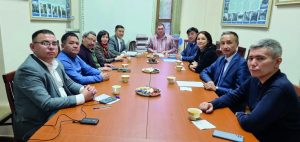 — Yes, I too have great confidence in the members of our regional commission. Even at weekends, when the archives were closed, my colleagues did not remain idle. They devoted their Saturdays and Sundays to research and work of benefit to society. I think the following Facebook post by my colleague Akhmediyar Batyrkhanov illustrates this particularly well:
“…During our research trip to Almaty, we, the members of the regional commission for the full rehabilitation of victims of political repression, spent two weeks working at the Presidential Archive of the Republic of Kazakhstan, the Central State Archive in Almaty, the Almaty City State Archive, the archive of the Almaty Department of Internal Affairs and the National Library of the Republic of Kazakhstan. When we discovered that the National Library was open on Saturdays and Sundays, my colleagues Kazybek Kuttymuratuly, Aibolat Shamuratuly and Alfiya Sabyrgalikyzy and I were as delighted as children. We spent both our days off at this centre of learning and culture, where we were able to see with our own eyes and handle manuscripts and periodicals preserved from years of tragedy and the terrible years of war, and to examine materials telling the stories of our fellow countrymen.
I read poems and essays written during the difficult war years by writers from the Zhaiyk region who had served at the front — Abdolla Zhumagaliyev, Taiyr Zharokov, Sagingali Seitov, Zhuban Moldagaliyev and Bisen Zhumagaliyev — and recorded references to materials published in the periodical press. Through the library’s electronic database, we learnt that nearly 600 articles about Manshuk Zhiyengalikyzy, a heroine revered by the entire Kazakh nation, had appeared in newspapers and magazines between 1943 and 2021. God willing, 2022 will mark the centenary of Manshuk Mametova’s birth. With this in mind, I selected copies of more than 200 newspaper and magazine articles about the first young woman from the East to be awarded the title Hero of the Soviet Union. We worked in the National Library’s Periodicals Department, Department of Rare Books and Manuscripts, and information and reference departments…”
— Your work towards the full rehabilitation of victims of political repression will continue in the future, will it not?
— This work is not the project of an individual, an organisation or a particular region. It forms part of state policy. I therefore believe it will continue. Moreover, I consider the full rehabilitation of victims of political repression to be a far greater undertaking than something that can be completed in a few months, or even within a year or two. Whatever happens, we are willing to continue carrying out the duties entrusted to us with a profound sense of responsibility. We belong to a generation brought up hearing the wise saying, “The living cannot prosper until the departed are at peace.” We therefore regard it as our sacred duty to contribute to the rehabilitation of our ancestors who endured every form of repression: those who were unjustly executed or imprisoned, who died of starvation, whose possessions were taken from them, or who were forced to flee their homeland. Personally, I am deeply pleased that the state has undertaken the full rehabilitation of victims of political repression. I wish every possible blessing to all those involved in this worthy cause.
— Thank you for the interview. I wish you every success in carrying out this important work with honour.
DANA.qaz magazine, No. 56, 20 October 2021.
Translated from Kazakh.