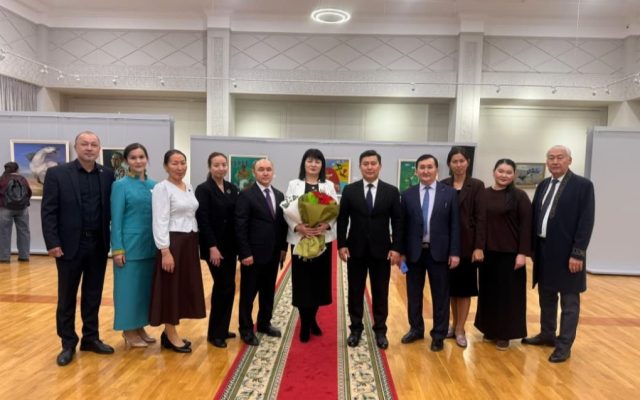
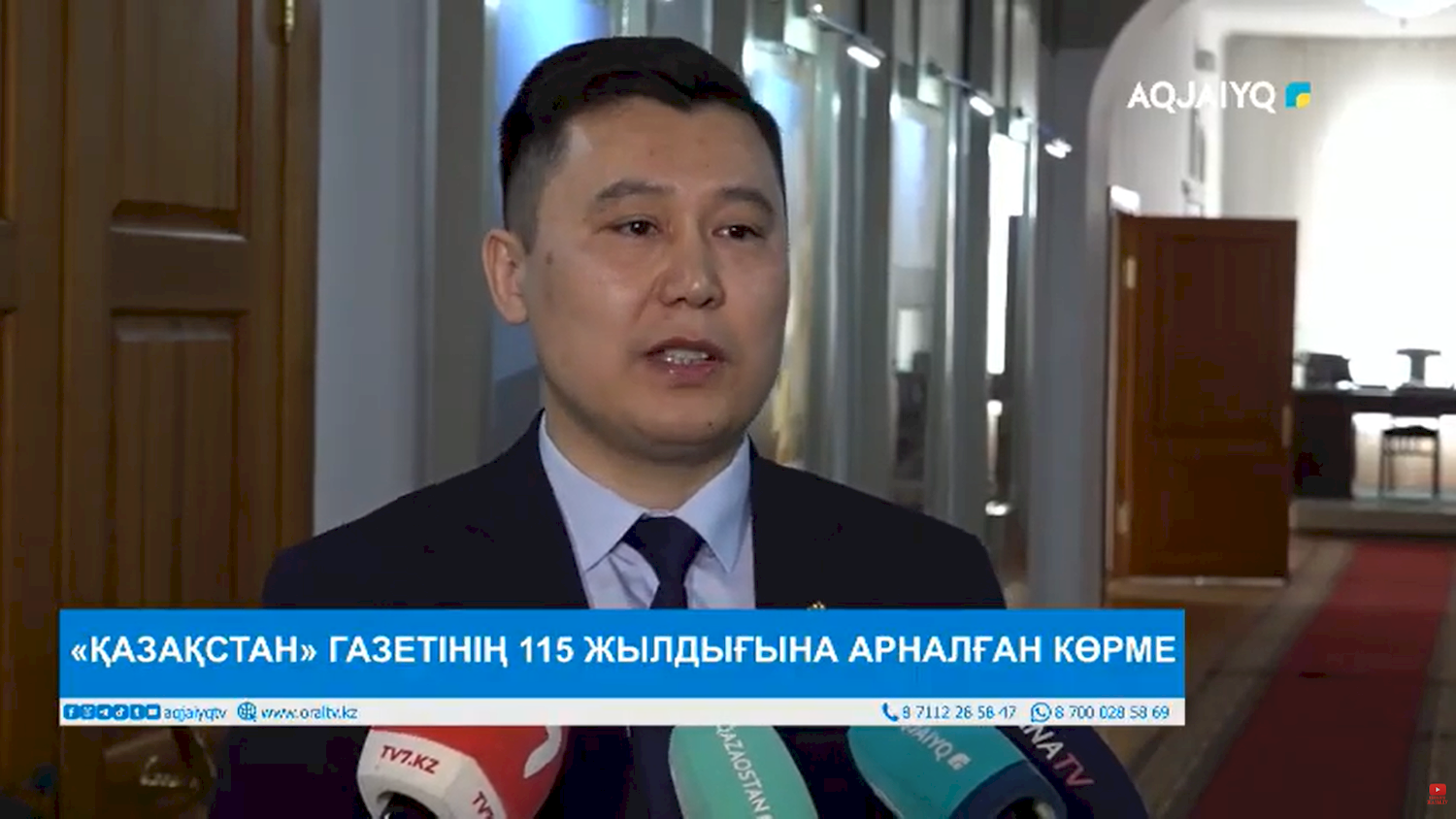
Extensive work is being undertaken in Kazakhstan to implement the objectives outlined in the Leader of the Nation’s article Course towards the Future: Modernisation of Kazakhstan’s Identity. One of these objectives was to identify sites of national sacred significance across the country. Seven sites from our region were included in the national list.
This article concerns two of those seven sites: the burial place of Gumar Karash and the Alashorda House in Zhympity. More precisely, I shall focus on Gumar Karash and Zhahansha Dosmukhamedov, the leader of the western wing of the Alashorda government. Both men were victims of political repression. As though the brutal murder of Gumar Karash in 1921 for his convictions, words and actions had not been enough, his entire literary legacy was subsequently subjected to repression. Zhahansha Dosmukhamedov, who lived through a turbulent period of upheaval and relative liberalisation, devoted all his strength to the struggle for our country’s independence. He was arrested in Moscow and executed at the Butovo firing range. During my visits to Moscow, I had the opportunity to collect the writings of one of these distinguished figures and trace the places associated with the life of the other. Both had contributed to bringing closer the independence we enjoy today.
About six years ago, I learnt that Gumar Karash’s granddaughter, Nadezhda Karasheva, was living in Moscow, and I travelled there specifically to interview her. Our meeting received extensive media coverage at the time. During that visit, Nadezhda Burkhankyzy entrusted me with all the materials concerning her grandfather that she had collected over the years. Since then, we have worked tirelessly to locate Gumar Karash’s literary heritage and transcribe his writings from the Arabic script into the modern alphabet. As a result, we published a three-volume collection. This was an extensive undertaking involving considerable responsibility and the most comprehensive publication of its kind since Kabibolla Sydykov’s Zamana. I was fortunate to return to Moscow and personally present the three volumes to Nadezhda Burkhankyzy, a direct descendant of this remarkable figure. In December of the previous year, I had also travelled to Moscow to sit my state examination. Whenever I had some free time, I visited the burial places of Zhahansha Dosmukhamedov and Alikhan Bokeikhanov to pay my respects. During my visit to the Butovo firing range, where Zhahansha was buried, I learnt a great deal.
I shall now recount the most significant aspects of these journeys in order.
Positive changes
When I visited Moscow last year, I noticed considerable changes compared with my visit approximately five years earlier. Previously, it had been customary to hail a taxi by raising a hand at the roadside. Now, taxis are booked online using applications downloaded to mobile phones. Among taxi drivers, I encountered many Kyrgyz, Uzbek, Azerbaijani and Tajik people, but no Kazakh drivers. Most of the drivers who responded to my bookings were Kyrgyz. I would greet them in Kazakh and continue speaking Kazakh throughout the journey. I asked the drivers whether they had encountered Kazakhs working as taxi drivers, cooks or in similar occupations. They all replied that they had not: they only met Kazakh visitors at airports and railway stations and drove them to their destinations. According to the drivers, most young Kazakhs came to Moscow to study, while the others were probably engaged in business.
Donskoye Cemetery
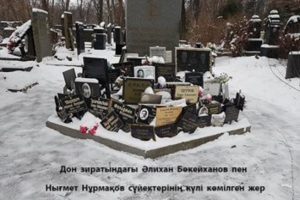
During my visit in December of the previous year, I first went to Donskoye Cemetery in Moscow. Between 1930 and 1950, approximately 40,000 people were sentenced to death on political charges in Moscow. The ashes of around 7,000 of them, or approximately 10,000 according to some sources, were buried near the crematorium built at this cemetery in 1927. There are three burial sites for victims of political repression within the cemetery. The first contains the remains of those executed between 1930 and 1942. Among them are Alikhan Bokeikhanov and Nygmet Nurmakov, both executed on 27 September 1937. L. Mirzoyan, who led Kazakhstan between 1933 and 1938 and oversaw the bloody repression of that period, even requested permission from the higher authorities to execute a further 1,600 people. He himself was executed in 1939, and his ashes were buried at the same site. After offering prayers for the victims of political repression, I continued my journey to the Butovo firing range on the outskirts of Moscow.
The Butovo firing range — Zhahansha’s final resting place
A dedicated scientific and educational memorial centre has been established at the site. Through the efforts of volunteers, considerable work has been undertaken to research its history and preserve the memory of those who died there.
Around 1935, the administrative department of the NKVD began searching for sites where bodies could be buried. Three locations were identified in the vicinity of Moscow, one of them near the village of Butovo. Local residents were told that a military training and shooting ground would be established near the village. In reality, between 8 August 1937 and 19 October 1938, a total of 20,761 people were executed and buried there.
Thirteen burial trenches had been excavated in advance using mechanical excavators. They were approximately 4–4.5 metres deep, 4.5–5 metres wide and around 70 metres long. Those sentenced to death were transported at night from Moscow’s prisons to the Butovo firing range. On arrival, they were confined while their identities and documents were checked. At dawn, a special execution squad arrived from Moscow and began the killings. The prisoners were brought in small groups to the edges of the trenches, shot at close range and thrown into them.
On the morning of 3 August 1938, Zhahansha was at the Butovo firing range. That morning, he was taken to one of the thirteen trenches, shot at point-blank range by the executioners and thrown into the pit. Thus, a man who had struggled for the brighter future we enjoy today became a victim of oppression.
In 1962, the Butovo firing range was enclosed by a high wooden fence. It was only from 1990 onwards that documents relating to the execution of death sentences began to be declassified. From that time, descendants of those who had been killed started visiting the site to pay their respects.
At first, neither the state nor any political organisation assumed responsibility for transforming the site of these mass killings into a place of remembrance. Instead, descendants of the victims of political repression came together and undertook the work voluntarily. They cleared the land, which had become overgrown with trees and grass, and improved the grounds. As the soil above the thirteen trenches had subsided, creating depressions, additional earth was brought in to raise the surface. In 2002, the Butovo Scientific and Educational Memorial Centre was opened.
Through the centre’s efforts and with public support, the names of all those who had perished were recorded and a special memorial was established. Taking the dimensions of the original thirteen trenches as a reference, a trench 70 metres long was excavated and lined with marble slabs. Zhahansha Dosmukhamedov’s name is also included among those recorded on the memorial.
Zhahansha’s university student file
Before I left for Moscow, Dametken Suleimenova, a scholar specialising in the Alash movement, made a request. “We know that Zhahansha Dosmukhamedov studied at the Imperial University in Moscow between 1906 and 1910,” she said. “But we do not have his diploma. If possible, please try to find it.” I found time to visit the central archives. The university’s records dating from before 1917, including those relating to Zhahansha Dosmukhamedov’s studies, had been transferred to the Central State Archive of Moscow. The records were held in Fond 418, Opis 320. On the day I located the documents, I submitted an application to examine them. I obtained copies of his student file, which contained approximately fifty pages. However, the diploma was not among the documents. At the end of the file was an incomplete handwritten note: “Докум и диплом не выдава…” (“Documents and diploma not issu…”). The final letter was unclear and could have been either “т” or “л”. Thus, although I succeeded in obtaining Zhahansha’s student file, I was unable to locate his diploma.
Recently, I prepared a complete copy of the file relating to Zhahansha Dosmukhamedov’s studies at the Imperial University in Moscow between 1906 and 1910, transcribed it into the modern alphabet and presented it in booklet form to Svetlana Bakhisheva, Director of the pedagogical college named after Zhahansha Dosmukhamedov.
An exhibition dedicated to Zhahansha in Moscow
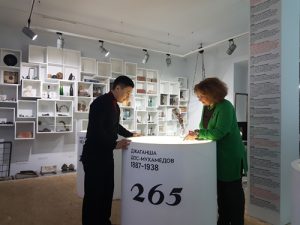
An exhibition commemorating the victims of political repression was held at the Shabolovka Gallery, which is administered by Moscow’s Department of Culture. The gallery is located at 24 Serpukhovskoy Val, near the building where Zhahansha Dosmukhamedov once lived. A special section of the exhibition was dedicated to Zhahansha. One of the people responsible for organising this initiative was Inna Drobinskaya, who lives at 19/1 Lesteva Street in Moscow.
It was Ainagul Oishybaeva, head of the museum named after Syrym Datuly, who directed me towards this work. In her spare time, Inna volunteers with the Last Address (Posledny Adres) memorial project.
The aim of this initiative is to install small commemorative plaques on the buildings where people who were persecuted and sentenced to death under Soviet rule last lived before their arrest. This is a demanding undertaking, and Inna Drobinskaya has been involved in obtaining the necessary permissions to place plaques on residential buildings. She herself lives in the Shabolovka district, which was developed around 1927. “I began to think that rather than searching for victims in other parts of Moscow, I should look for those who had lived in the buildings in my own neighbourhood, identify them and arrange for memorial plaques to be installed,” she explained. So far, she had identified five individuals. One of them was Zhahansha Dosmukhamedov.
With the support of Alexandra Selivanova, a senior researcher at the Museum of Moscow, Inna began organising the exhibition. She contacted Ainagul Oishybaeva in Syrym District and obtained the photographs and information required for the display. Using their own funds, they prepared the exhibition materials and made arrangements for Moscow residents to visit the exhibition from November onwards.
The work undertaken by Inna Drobinskaya and Alexandra Selivanova deserves great respect and recognition. During my visit in December of the previous year, I was able to see the building where Zhahansha Dosmukhamedov had lived and visit the exhibition, although I did not yet know which apartment had been his.
Zhahansha’s last address
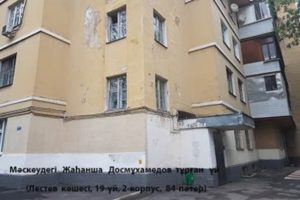 After seeing the building where Zhahansha had last lived, I continued wondering how we might identify his actual apartment. It was Ainagul Oishybaeva who subsequently shared the welcome news. She wrote the following on her Facebook page:
“We knew that Zhahansha Dosmukhamedov had been arrested at his residence in Moscow, formerly recorded as 11 Khavsko-Shabolovka Street, Building 7, Apartment 265. Recently, we personally confirmed that the street had been renamed Lesteva Street. Among the documents, we found the will of Olga Dosmukhamedova, written after the address had been changed to Lesteva Street. It gives the address as: Moscow, 117-419, 19 Lesteva Street, Building 2, Apartment 84. This is their correct address following the changes. At the time, the apartment had been obtained for them by Turar Ryskulov. When Olga Dosmukhamedova became elderly and ill, she returned the apartment to Ryskulov’s children and wrote a testamentary letter to that effect. We had previously heard that she died in December 1986. However, an accompanying document confirms that she actually died on 26 June 1986, as she was approaching her 90th birthday. Yes, perhaps this is what happens when time and documentary evidence meet on the stage of history.”
In May of this year, I travelled to Moscow to present Gumar Karash’s three-volume collection to Nadezhda Burkhankyzy. During that visit, I made a special trip to the address identified in Ainagul Oishybaeva’s post: 19 Lesteva Street, Building 2, Apartment 84, where Zhahansha had lived. Previously, although the building had been identified, uncertainty about the apartment number had slowed progress on the Last Address project. I first met Inna Drobinskaya, the project’s coordinator for the neighbourhood where these historic residential buildings are located. Together, we approached the entrance to Zhahansha’s former building and pressed the intercom button for Apartment 84. A woman answered and opened the entrance door remotely. We took the lift to the fourth floor and knocked on the apartment door. It was opened almost immediately. After we explained the purpose of our visit, the occupant welcomed us inside and had no objection to our taking photographs and recording video. The owner, Yuliana Gennadyevna Krasovskaya, had purchased the apartment in 2003 from Elena Pavlova, the daughter of Russia’s ambassador to Turkey. She explained that when she first moved in, the apartment contained beautiful antique furniture. When the furniture was removed, some pieces proved too large to pass through the doorways and had to be dismantled. The apartment has two rooms and high ceilings. It consists of a long entrance corridor, one small room, one larger room, and separate kitchen and washing facilities. The building has five entrances, with twelve apartments in each entrance. It was constructed in 1927. The current owner, Yuliana Krasovskaya, expressed her support for installing a commemorative plaque on the exterior of the building as part of the Last Address project. She also said that she was willing to help obtain the consent of the other residents. The purpose of the Last Address project is to identify the last residences of people sentenced to death during Soviet-era political repression, gather the necessary documentary evidence and, with the written consent of residents, install small commemorative plaques on those buildings. The plaques contain brief biographical information, while the space normally reserved for a photograph is deliberately left blank. Previously, we had not known the exact apartment in which Zhahansha had lived. Now we had found it and seen it for ourselves. The apartment owner had given her support. The next task was to obtain the consent of the other apartment owners.
Presenting the three-volume collection
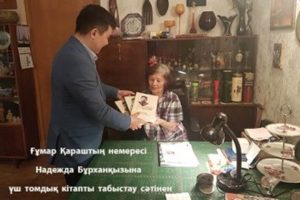 As I considered how best to organise the remaining work, I took a taxi towards Nadezhda Karasheva’s home. Shortly after leaving the building where Zhahansha had lived, we passed Donskoye Cemetery. I had visited this cemetery specifically in December of the previous year, shortly before Kazakhstan’s Independence Day. It is the final resting place of Alikhan Bokeikhanov. One of the leaders who served his nation was arrested near this area, while another was brought here and buried.
That evening, I visited Nadezhda Karasheva at her home. As always, she welcomed me with exceptional warmth. I learnt that she had fallen and broken her leg and had subsequently undergone several operations. Her hearing had also deteriorated. I presented her with the three-volume collection of Gumar Karash’s works, prepared and published using the materials she had entrusted to me six years earlier, together with the results of our subsequent research. She was delighted and asked me to convey her greetings and gratitude to everyone back home. The following day, I presented the three-volume collection to Kazakh students from Kazakhstan studying at the Peoples’ Friendship University of Russia in Moscow. I learnt that these young people, while pursuing their studies far from home, had also established an association called Sana, led by Damir Kadyrbekov. Through this association, they organised various activities aimed at strengthening national identity and cultural awareness. They introduced me to several of their initiatives and expressed their willingness to contribute in any way they could to the installation of a commemorative plaque on the building where Zhahansha had lived. At the end of the event, they also presented me with a book. I returned home with a deep sense of gratitude towards these young people, who, despite living far from their homeland, remained committed to initiatives serving their nation.
Thus, while gathering and preparing the literary legacy of Gumar Karash, I also discovered new information concerning Zhahansha Dosmukhamedov. These experiences convinced me that much further research is needed into the lives and legacies of both men. If we fully appreciate the significance of their words and deeds, they will undoubtedly form a foundation for our national ideology.
Zhantas SAFULLIN
Director General, Zhaiyk Press LLP
Oral – Moscow – Oral
Oral Oniri newspaper
Translated from Kazakh.