At the beginning of the twentieth century, the leaders of the Alash movement turned to the press as a means of uniting the Kazakh people around a common national idea. Their words, spoken in defence of the nation’s interests, and the work they accomplished were preserved in the newspapers of their time. Newspapers were then the most advanced and influential means of reaching the public. In the first issue of Qazaqstan, published in 1911, Gumar Karash wrote: “It is the newspaper that will unite us in one purpose and one aspiration.” One hundred and six years later, the fact that the Head of State published his article “Course towards the Future: Modernisation of Kazakhstan’s Identity” in Egemen Qazaqstan, the country’s leading newspaper whose origins can be traced to Ushkyn, demonstrates the enduring importance of the press in society. To renew our people’s spiritual consciousness, we must know the history of the press, make proper use of it today and plan wisely for its future. This is one of the foundations of national unity.
For many years, it was generally accepted that the history of the West Kazakhstan regional newspapers Oral Oniri and Priuralye began on 17 November 1918, following the establishment of Soviet rule. We have proved that their true origins date back to 28 July 1917. One hundred years. An entire century. We worked tirelessly to establish this fact, spending countless sleepless nights and difficult days in pursuit of the truth. Scholars in Almaty, Astana and Oral who became familiar with our research encouraged us by saying, “You are doing the work of an entire research institute.” Perhaps that was an overly generous assessment, but what exactly had we accomplished to earn such praise?
In his fifteenth Word of Edification, our great Abai urges us to reflect upon our actions: “If you wish to be counted among intelligent people, take account of yourself once a day, or once a week, or at least once a month. Ask yourself how you have spent the time since your last reckoning. Have you done anything worthwhile for your knowledge, your spiritual life or your worldly affairs, anything you will not later regret?” The time has now come for us to give an account of our own efforts to study the history of the press.
A nation subjected to centuries of colonial domination first suffers damage to its language and religion, while its history is systematically distorted. Our press, whose centenary coincides with that of the Alash movement, experienced a similar fate. We devoted all our strength to establishing the truth. Indeed, as we researched the newspapers and learned about the lives and selfless achievements of those who founded them, we gradually began to look to these remarkable individuals as examples for our own lives.
Among them were Shangerей Bukeyev, Gumar Karash, Yeleusin Buyrin, Bakhytzhan Karatayev and Gabdolgaziz Musagaliyev, who organised and regularly published Qazaqstan. Their unwavering service to the nation during an exceptionally difficult period, when they placed themselves at considerable personal risk, taught us an important lesson. Their lives demonstrated that one should not work merely for a salary but should also devote one’s free time to endeavours that will benefit future generations.
As the saying goes, “Even if you cannot equal them, strive to follow their example.” We, too, resolved to work tirelessly for the brighter future of coming generations. Thankfully, we have achieved independence. To strengthen it, however, we must revive our national spirit, and that requires us first to restore our history, which has been so extensively distorted. We concluded that the contribution we could make was to collect the evidence needed to reconstruct our authentic past.
We subsequently launched several projects devoted to our historical and spiritual heritage. One of them, initiated five years ago, involved researching the history of the press in preparation for a worthy celebration of its centenary.
In 2013, when we marked the 95th anniversary of our newspapers, we explained that every effort to recover their history formed part of our preparations for their hundredth anniversary. Thanks to years of painstaking research, we are now celebrating that centenary not five years later, but four.
Many regional and district newspapers throughout Kazakhstan still have histories that have never been properly documented. Their archives undoubtedly preserve valuable evidence that could contribute to a more accurate understanding of our national past. Unfortunately, too few people devote themselves to identifying and making use of these materials.
Our principal reason for describing our work in such detail is to share the path we have taken. We hope that others may find something useful in our experience, learn from it and continue the work. Let me therefore recount, in chronological order, what we have done to research the history of the press.
It all began with Qazaqstan
As the 95th anniversary of Oral Oniri and Priuralye approached, we decided to establish a special museum, study the histories of our newspapers ourselves, organise their surviving collections and identify the people who had founded and published their earliest issues.
One document that attracted particular attention was an article by Tamimdar Safiyev, who was living in Moscow at the time. It had appeared in the special issue of Oral Oniri published on 17 November 1968 to mark the newspaper’s fiftieth anniversary.
The article contained a wealth of valuable information about the history of our newspapers. In particular, it explained that when the newspaper was renamed Durystyk Zholy in 1919, its editorial board included Gumar Karash, Mustafa Kokebayev, Gabdolgaziz Musagaliyev, Khalel Yesenbayev and Tamimdar Safiyev himself.
This discovery radically changed the direction of our research. We knew that three of these five editorial board members — Gumar Karash, Mustafa Kokebayev and Gabdolgaziz Musagaliyev — had also been involved in publishing Qazaqstan between 1911 and 1913. We therefore decided to begin our investigation with Qazaqstan, whose name and founders were particularly significant.
We could find neither a complete collection of the newspaper nor any substantial previous research on it in Kazakhstan. However, our persistent search eventually led us to the M. Saltykov-Shchedrin Public Library in St Petersburg and the Russian State Library in Moscow, where we located sixteen issues.
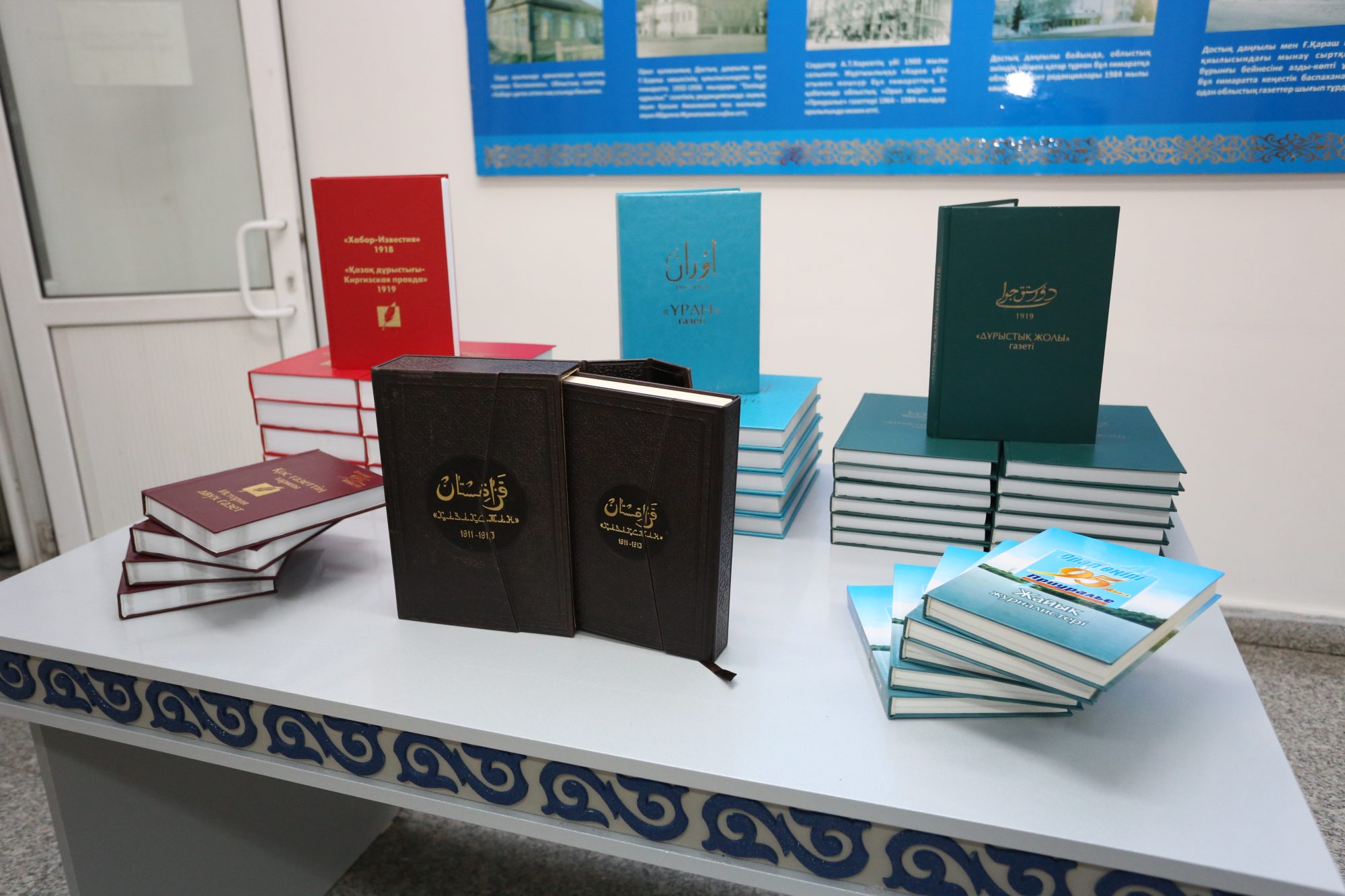
We carefully prepared a collection containing copies of the original issues and transcriptions of their texts from Arabic script into Cyrillic, undertaken by Kazbek Kuttymuratuly. We supplemented these materials with information about the newspaper’s founders, those who subsequently researched it, scholarly studies and articles published in various periodicals. In 2012, we published the results in a book entitled Qazaqstan Newspaper, 1911–1913.
This was a substantial contribution not only to the study of our regional newspapers but also to research into the history of journalism throughout Kazakhstan.
During one of the President’s visits to West Kazakhstan Region, a copy of the book was presented to him. At the beginning of the twentieth century, those who published Qazaqstan had longed for an independent homeland. Each issue carried a statement of the newspaper’s guiding purpose: “The newspaper’s principal aim is to address enterprise, science and the arts.”
In 1991, Nursultan Nazarbayev affirmed the name of our independent state as the Republic of Kazakhstan, thereby continuing the work of our forebears and helping to realise their aspirations. A century after the newspaper’s appearance, he was able to turn its pages and become acquainted with the work of those who had given it the name Qazaqstan.
We subsequently organised a major presentation of the book at the National Academic Library in Astana, after which scholars began undertaking further research into its contents.
At the same time, we were actively preparing another publication on the history of our newspapers. Its purpose was to ensure that no one who had worked for these publications, from editors to ordinary employees, would be forgotten.
We examined newspapers obtained from Almaty, Moscow and St Petersburg and uncovered a considerable amount of previously unknown information through research conducted in the archives of the National Security Committee. We established that at least five editors had fallen victim to political repression and had been sentenced to death by shooting. We also compiled a list of the editors who had headed our newspapers from their earliest years to the present.
Wherever possible, we gathered biographical information and photographs of those who had worked for the newspapers, together with group photographs of editorial teams. We also preserved the recollections of colleagues who had served in the editorial offices at different times. The collection included accounts of our journeys to retrieve historical newspapers from Moscow archives.
We assembled information about the establishment and development of Zhaiyk Press, the media holding that brought the newspapers together, and about the people who had led it. These accumulated materials formed the basis of our first book devoted to the history of the two regional newspapers, The History of Two Newspapers (Qos Gazettin Tarikhy – Istoriya Dvukh Gazet).
In 2013, we also published Journalists of the Zhaiyk Region (Zhaiyk Zhurnalisteri) for the first time. It brought together the best articles published that year by the creative staff of Zhaiyk Press, selected according to each author’s own preference.
Thus, through a year of tireless work, we published three books in 2013: The History of Two Newspapers, under its Kazakh and Russian titles, and Journalists of the Zhaiyk Region.
That same year, we celebrated the 95th anniversary of our newspapers on a large scale in Oral, together with our employees, veterans and readers.
Using our own resources, we produced a documentary about the founders and editorial direction of Qazaqstan, which was broadcast on television. At the initiative of Zhaiyk Press LLP, a street in the settlement of Zashagan was named after Yeleusin Buyrin, the newspaper’s first official editor. A billboard featuring his portrait and biography was installed there.
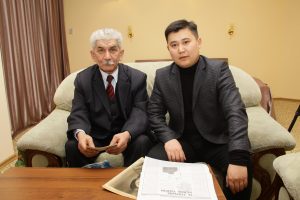
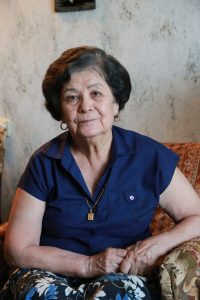
We invited his grandson, Valery Buyrin, who was born in Almaty, to Oral and paid tribute to him. We also located Gumar Karash’s granddaughter, Nadezhda Burkhanovna Karasheva, who lives in Moscow, and travelled specifically to meet her on several occasions. She entrusted us with works and research materials relating to her grandfather that had been collected by various scholars.
For our part, we continue to gather Gumar Karash’s literary heritage piece by piece. We intend shortly to publish two volumes, one devoted to his prose and the other to his poetry.
Why did we turn our attention to Uran?
Having brought together the materials relating to Qazaqstan, we were preparing to investigate Izvestiya – Khabar, which began publication on 17 November 1918 and was then considered the starting point of our newspapers’ history.
We had already begun this work. However, transcribing the earliest issues, which we had obtained from the Russian State Archive in Moscow because they could not be found in Kazakhstan, from Arabic script into Cyrillic once again changed our plans.
The first issue of Khabar, in its Arabic-script version, contained Protocol No. 12 of the Regional Central Committee. It stated:
“To ensure that the dissemination of the press advances successfully and brings useful results, the new printing house brought from Astrakhan shall be merged with the Uran printing house in Khan’s Orda, and Comrade Vygdorshchik shall be entrusted with managing the combined printing establishment.”
The wording concerning the advancement of press distribution clearly suggests that an existing undertaking was to be continued under a new political system. The reference to the “Uran printing house” also indicated that this was the printing house of the Uran newspaper.
It therefore became apparent that Izvestiya – Khabar had succeeded Uran. This discovery prompted us to investigate the history of Uran itself.
Our respected colleague Maksat Tazhimurat located original copies of nine issues of Uran at the Republican Book Museum in Almaty. We travelled there specifically to obtain them.
An inscription on the cover of the bound collection read:
“From the personal collection of the people’s poet Andash Nadraliev (1889–1954). Born in the village of Zhanakazan, present-day Zhanakala District, formerly part of the Bukey Horde in Astrakhan Region.”
According to a museum employee, the newspaper collection had been donated in 1978.
We also discovered that copies of certain issues of Uran had been preserved in the collection assembled by the researcher and scholar Mustafa Ismagulov, held at the West Kazakhstan Regional Museum of History and Local Lore.
In addition to photographic copies of Uran, Mustafa had collected numerous works by Gabdolgaziz Musagaliyev, the newspaper’s editor-in-chief and principal organiser. With the museum management’s agreement, we obtained copies of these materials.
On the basis of the surviving copies, we concluded that at least thirty-eight issues of Uran had been published. We located nine of them:
- No. 6 — Friday, 1 September 1917;
- No. 7 — Tuesday, 12 September 1917;
- No. 8 — Tuesday, 26 September 1917;
- No. 9 — Tuesday, 7 October 1917;
- No. 20 — Sunday, 31 December 1917;
- No. 24 — Friday, 16 February 1918;
- No. 28 — date unknown;
- No. 30 — Thursday, 28 (10) March 1918;
- No. 38 — Thursday, 16 (3) May 1918.
In 2014, we published Uran Newspaper, 1917–1918, bringing together all the issues we had discovered and transcribed into Cyrillic, materials collected by Mustafa Ismagulov, articles by Gabdolgaziz Musagaliyev published in other periodicals and research concerning Uran. We also produced an educational documentary about the newspaper.
During 2013 and 2014, we presented our books at leading educational institutions in Oral, Almaty and Astana, with scholars and students taking part. We screened our documentaries and donated copies of the publications to university libraries.
Another street in Zashagan was named after Gabdolgaziz Musagaliyev, alongside the street honouring Yeleusin Buyrin. A billboard displaying Musagaliyev’s photograph and biography was installed. Our entire team visited the street, planted trees and organised a cultural event.
Khabar
We subsequently began researching Izvestiya – Khabar and Kirgizskaya Pravda – Qazaq Durystygy. We had obtained copies of these newspapers from the Russian State Archive in Moscow.
Izvestiya – Khabar was published from 17 November to 31 December 1918. A total of thirty-one issues appeared. We possessed all except Nos. 4–6, 24 and 26.
From 1 January to 7 February 1919, the newspaper appeared under the title Kirgizskaya Pravda – Qazaq Durystygy. Twenty-four issues were published, nineteen of which were in our possession. The missing issues were Nos. 7, 12, 14, 19 and 21.
The Russian-language sections were printed in Cyrillic, while the Kazakh-language sections used Arabic script. We collected all the surviving issues, transcribed the Kazakh texts into Cyrillic with the assistance of Yersaiyn Mergenbayev and Muratbek Zhakhatov, and supplemented them with information about those who published the newspapers.
In 2015, we released a substantial volume devoted to Izvestiya – Khabar and Kirgizskaya Pravda – Qazaq Durystygy.
On Friday, 21 June 2013, we had been fortunate enough to discover Izvestiya – Khabar and Kirgizskaya Pravda – Qazaq Durystygy in the Russian State Archive in Moscow. The following day brought even greater joy: at the newspaper department of the Russian State Library in Khimki, near Moscow, we found Durystyk Zholy.
We immediately ordered copies and brought them home.
One of the newspaper’s most distinctive features was that, even during the harshest years of Soviet rule, it was published exclusively in Kazakh. Among its founders were the outstanding Alash intellectuals and educators Gumar Karash, Gabdolgaziz Musagaliyev, Mustafa Kokebayev, Khalel Yesenbayev and Tamimdar Safiyev.
Durystyk Zholy was published twice a month in Orda between 20 February and 10 July 1919. Eleven issues appeared, all printed in Arabic script.
We transcribed every issue into Cyrillic and added information about the newspaper’s founders. We also included the memoirs of Tamimdar Safiyev, one of its publishers, written at Mustafa Ismagulov’s request. These memoirs, originally written in Arabic script and transcribed by Gulmaru Myrzagaliyeva, describe the political and social events that took place in the Bukey Horde between 1916 and 1920.
Thus, in 2016, we published Durystyk Zholy Newspaper, 1919.
Why did the history of Ushkyn interest us?
That same year, we published another exceptionally important collection relating to the history of the press. It was devoted to Ushkyn, a newspaper published in Orenburg, then the capital of our republic, between 1919 and 1920. The publication described itself as a political, literary and economic newspaper issued twice weekly on behalf of the Revolutionary and War Committee governing the Kazakh people. Ushkyn stood at the origins of Egemen Qazaqstan, the leading newspaper of today’s independent Republic of Kazakhstan.
We searched far and wide for surviving issues. Our enquiries at archives and libraries in Orenburg produced no results. As usual, we also contacted libraries and archives in Moscow, but received no positive responses. Fortunately, what we sought was eventually found in Kazakhstan itself.
The Scientific Library of the Gylym Ordasy organisation in Almaty held thirty-seven issues. Nos. 2, 3, 5, 6, 7, 13 and 32 were missing. We obtained the available issues and transcribed them.
Ushkyn was the first newspaper intended for the Kazakh population as a whole to appear after the Bolsheviks came to power in Russia. Whatever its political orientation, those involved in publishing it were primarily concerned with the welfare of the Kazakh people and the territorial integrity of their homeland. This is evident from the articles printed in its pages.
Some may ask: “Why should Zhaiyk Press, based in West Kazakhstan, be interested in the history of Ushkyn, which was published in Orenburg?”
First, because we are one people united by a common purpose and shared aspirations, the history of every Kazakh newspaper concerns us.
Second, Tamimdar Safiyev’s memoirs reveal that, to establish Ushkyn, the group of writers in Orda — Gumar Karash, Gabdolgaziz Musagaliyev, Mustafa Kokebayev, Khalel Yesenbayev and Tamimdar Safiyev — discontinued Durystyk Zholy and transferred its printing house to Orenburg.
According to Safiyev’s recollections, Seyitkali Mendeshev proposed the name Ushkyn and entrusted Safiyev with organising its publication. This means that Tamimdar Safiyev, a native of the Bukey Horde who had published Durystyk Zholy, was the first editor of Ushkyn, while Khalel Yesenbayev was among the writers involved in producing the newspaper. Given that researchers had previously been unable to identify with certainty the first editor of Egemen Qazaqstan, this was an important and genuinely new discovery.
We therefore considered it our duty to bring back to life the words of a newspaper that had defended the interests of the Kazakh people during those turbulent years and to place them once again in the hands of readers. As in our previous projects, we transcribed the surviving issues from Arabic script into Cyrillic, with the assistance of Gulmaru Myrzagaliyeva and Muratbek Zhakhatov. We gathered information about the newspaper’s publishers, assembled relevant research materials and included Tamimdar Safiyev’s memoirs, preserved at the West Kazakhstan Regional Museum of History and Local Lore.
The resulting volume, Ushkyn Newspaper, 1919–1920, was published in 2016.
A chronicle of independence
In December 2016, Kazakhstan celebrated the twenty-fifth anniversary of its independence. We wanted to make a tangible contribution to this important national occasion. A newspaper published continuously for a century inevitably preserves a century of its region’s history. We therefore decided to prepare a chronological account of West Kazakhstan’s development over the twenty-five years of independence, from 16 December 1991 to 2016, as our contribution to Independence Day. To compile this work, we examined every issue of our two regional newspapers published since independence, identifying important events, achievements and developments, and recording the precise dates on which they occurred.
The results appeared in two substantial volumes: West Kazakhstan Region: Years of Development and Growth, 1991–2016, published in Kazakh and comprising 700 pages, and West Kazakhstan Region: Years of Achievements and Victories, 1991–2016, published in Russian and comprising 935 pages. While researching the history of the press, we frequently encounter documents that are also of great significance to the wider history of our country. One such discovery was a letter written in 1905, which our colleague A. Yesenalin came across while working in Almaty to prepare electronic copies of newspaper collections. We asked him to bring it back with him.
The document was a letter addressed to various ministers in St Petersburg by respected ishans — Islamic religious teachers — and biys, traditional Kazakh judges and community leaders, who had travelled there as representatives of Oral and Turgay Regions. The letter concerned matters of religion and land. We transcribed it from Arabic script into Cyrillic with the assistance of Saifolla Mollakanagatuly and immediately recognised its exceptional historical importance. It contained a detailed assessment of the political situation at the time and demonstrated a determined effort to resolve the problems confronting Kazakh society. The authors sought to preserve their land by defending their religion and to resist colonial domination by protecting their land. At a time when religious questions remain highly relevant, we considered it essential to publish this letter, written by our ancestors not for personal advantage but out of concern for their people’s future.
We therefore released it as a separate collection entitled For Faith. For Land. The document had never previously been published in full and will provide an important source for those seeking to reconstruct our authentic national history. In 2017, in addition to For Faith. For Land, we began preparing a collection of significant articles selected from Qyzyl Tu, published between 1920 and 1922. Many people assume that a newspaper appearing during this period of harsh Soviet rule must have simply promoted the government’s policies. In reality, this was not the case. Its journalists found ways to write openly about the difficult circumstances facing ordinary people, despite the political restrictions of their time.
This was one of the reasons why many of its editors were later branded “enemies of the people”.
The books we have published
In summary, over the past five years, beginning in 2012, we established a Centre for the Study of Press History under Zhaiyk Press LLP, undertook extensive research into the region’s journalistic heritage and published a series of historical books each year.
Our publications include the following:
2012: Qazaqstan Newspaper, 1911–1913 (400 pages), devoted to the newspaper first published in the Bukey Horde, in what is now Bukey Orda District of West Kazakhstan Region, and subsequently in Oral.
2013: The History of Two Newspapers (Qos Gazettin Tarikhy – Istoriya Dvukh Gazet, 436 pages) and Journalists of the Zhaiyk Region (Zhaiyk Zhurnalisteri, 257 pages), published to mark the 95th anniversary of the West Kazakhstan regional newspapers Oral Oniri and Priuralye.
2014: Uran Newspaper, 1917–1918 (400 pages), devoted to the pro-Alash Kazakh newspaper published in the Bukey Horde.
2015: Khabar – Izvestiya, 1918; Qazaq Durystygy – Kirgizskaya Pravda, 1919 (680 pages), documenting newspapers published in Kazakh and Russian in the Bukey Horde following the establishment of Soviet rule.
2016: Durystyk Zholy, 1919 (300 pages), concerning the Kazakh-language newspaper founded by a group of writers in the Bukey Horde; and Ushkyn Newspaper, 1919–1920 (370 pages), documenting the publication issued in Orenburg.
Also in 2016, to mark the twenty-fifth anniversary of independence, we published West Kazakhstan Region: Years of Development and Growth, 1991–2016 (700 pages, in Kazakh) and West Kazakhstan Region: Years of Achievements and Victories, 1991–2016 (935 pages, in Russian).
2017: For Faith. For Land, presenting the 1905 letter addressed to ministers in St Petersburg by ishans and biys representing Oral and Turgay Regions; and Qyzyl Tu, 1920–1922, a collection of articles published in the newspaper during those years.
Thus, over five years, we have produced ten books relating to the history of the press. The historical value of the information they contain will only increase with time. We are grateful that we have been able to set an example for future generations not merely through words, but through tangible work.
Our purpose in publishing these newspaper collections has been to draw attention to the important place occupied by Oral Oniri and Priuralye among Kazakhstan’s oldest newspapers and within contemporary society.
For a hundred years, these publications have explained state policy to the public, contributed to national unity, mutual understanding and social harmony, and promoted education, the arts, science, history, moral values and national traditions. In doing so, they have helped shape the intellectual and personal development of generations of readers.
A complete century of newspaper archives
 One of our most ambitious projects in preparation for the centenary was an initiative we called “A Century of Newspapers for the Centenary”. Our publications had celebrated many anniversaries over the years, yet a complete collection of their issues had never been assembled. We considered it essential to correct this omission. Otherwise, despite loudly proclaiming our hundredth anniversary, we might have resembled the subject of the Kazakh proverb about a man who drives only five goats but whistles loudly enough to be heard across the steppe — making much noise while accomplishing very little.
We therefore resolved to assemble complete collections of both newspapers in electronic and printed form. We knew from the outset that this would be an enormous undertaking. For a hundred years, the newspapers had appeared at least three times a week, averaging approximately 150 issues annually. During the Soviet period, most were printed in A2 format, with at least four pages per issue. Imagine the total number of pages produced over a century — and then double that figure, because two separate newspapers were published, one in Kazakh and the other in Russian. This was the scale of the task before us.
We began by purchasing a high-capacity scanner suitable for digitising newspapers. Our first step was to scan the issues preserved at the West Kazakhstan Regional State Archive in Oral. We found additional issues at the Zhuban Moldagaliyev West Kazakhstan Regional Universal Scientific Library and made electronic copies of them. These were the only two institutions in Oral that held collections of our newspapers. Even after combining their holdings, however, we were unable to assemble complete sets. We learned that the Department of Rare Books, Manuscripts and National Literature at the Gylym Ordasy Scientific Library in Almaty possessed issues missing from our collections. We therefore sent a member of staff to Almaty with the scanning equipment. He spent a month there, producing electronic copies of every relevant issue available in the library. Having established that additional issues were held in the press archive of Kazakhstan’s National Book Chamber in Almaty, he also visited that institution and obtained everything available.
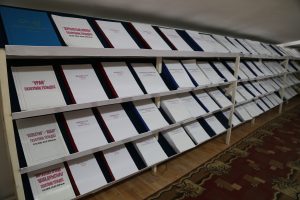
In this way, we collected most of the surviving material from libraries and archives in Almaty and Moscow. Interestingly, Priuralye had been preserved in chronological order at the regional state archive from 1921 onwards. The situation with Oral Oniri was quite different. It was primarily the incomplete state of its collection that compelled us to travel to Almaty and Moscow. We did everything within our power. Finding the remaining issues will be a task for the future. In total, we scanned 56,212 pages of Oral Oniri and 91,636 pages of Priuralye — 147,848 pages altogether.
We processed all these materials, printed them and bound them into volumes. A special room was prepared on the fifth floor of our building, where the complete century-long collections were arranged in orderly rows. We took particular satisfaction in knowing that this work was entirely consistent with the objectives of the President’s Digital Kazakhstan initiative and represented a tangible contribution to its implementation.
Another major task had been accomplished.
Projects that preserve and present our history
Work on establishing a Museum of Press History is continuing. We are bringing together historical artefacts, important documents and other objects suitable for museum display. Our collection already includes original copies of old newspapers, historical photographs, books, manuscripts, various printing and journalistic tools, personal documents and other materials. We are also preparing a dedicated room for the museum. We installed commemorative plaques on the buildings that once housed the editorial office of Qazaqstan in Oral and that of Uran in Khan’s Orda, Bukey Orda District.
Now, anyone passing these buildings can recognise their historical significance. We also began collecting historical photographs of people who had worked for our newspapers. We restored the images where necessary, printed them, placed them in frames and displayed them throughout our building. Visitors walking from the first floor to the fifth can now learn about the history of the press through these photographs. The building itself has become a photographic exhibition devoted to our journalistic heritage. Before the 95th anniversary, we discovered that five editors had been victims of political repression. By the time of the centenary, we had established that fifteen editors had been branded “enemies of the people”, most of whom were sentenced to death by shooting. For several consecutive years, we organised a competition named in honour of Yeleusin Buyrin and Gumar Karash, entitled “If You Want to Become a Journalist…”.
Our aim was both to introduce these two remarkable historical figures to a wider public and to identify talented young people with an aptitude for writing who might join our newspapers. Thanks to the competition, a number of young people found employment at regional and district newspapers. They have since demonstrated their abilities and now work with commitment and enthusiasm. We also produced audio recordings of Gumar Karash’s poetry and released them on special discs. We published school exercise books featuring portraits of historical figures, including Gumar Karash, on their covers. We created the website www.gumar.kz, bringing together his biography, literary works and other relevant information. One of our most important projects for the centenary, bringing together the results of all our work, is the website www.1911.kz. It contains our published books, documentary films, museum exhibits, information about politically persecuted journalists, historical photographs and other valuable materials concerning the history of the press. Everything we have collected is made available to anyone interested in this history. All this work was undertaken by our own employees while they continued to publish newspapers on schedule and update our websites daily. Such an ambitious undertaking can succeed only when a team is united by mutual understanding and a shared sense of purpose.
Every year, we strive to celebrate Nauryz on 22 March, Independence Day on 16 December, New Year, Journalists’ Day and other occasions in ways that strengthen the unity of our team. Our respect for veteran colleagues is rooted in the same principle. We also regard the celebration of significant birthdays and anniversaries of colleagues who have distinguished themselves through their creative achievements as an expression of mutual respect. For example, we organised anniversary creative evenings in the hall of the West Kazakhstan Regional Kazakh Drama Theatre for our colleagues Uldai Sariyeva, Yertai Bimukhanov, Yesenzhol Kystaubayev and Bauyrzhan Gubaidullin.
Projects to be continued
Our work for the centenary will not end here. Several projects launched this year must still be completed before the end of the year. A particularly significant contribution to the celebrations will be the publication of a two-volume collection of works by Gumar Karash — the distinguished poet, educator and thinker whom his contemporaries described as “the poet after Abai”, and one of the organisers of the Qazaqstan and Uran newspapers.
The volumes will include his poetry, literary works, articles, publicistic writings, philosophical reflections and examples of oral literature that he collected. The preliminary design has already been prepared. Never before have Gumar Karash’s works been published in such a comprehensive form. We believe the collection will make a substantial contribution to Kazakh literature and linguistic scholarship. Alongside this publication, we have begun preparing a fully illustrated, full-colour documentary and chronological collection devoted to the centenary of Oral Oniri and Priuralye. It will contain information about the history of the regional newspapers, their different periods of development, changes of name, leading personalities and major events, together with copies of documents, historical photographs, tables and reference lists. In September of this year, we plan to hold a national scientific and practical conference marking the centenary. We intend to invite prominent scholars specialising in press history, discuss the challenges of researching this field and consider opportunities for future cooperation. The principal anniversary celebrations will also take place in September. One of the main reasons why the history of the press has not previously been studied adequately is that historical newspapers were not brought back to Kazakhstan and their texts were not transcribed into an alphabet accessible to contemporary readers.
We are now addressing this longstanding problem. The next step is to make the materials we have collected available for public and scholarly use as quickly as possible. To encourage academic research, we have announced a competition for coursework, undergraduate dissertations and master’s theses on the history of the press among students and postgraduate students of journalism, philology and history at universities throughout Kazakhstan. Our objective is to establish the history of journalism as a recognised field of research.
The first meeting introducing this competition took place at the Otyrar Library of L. N. Gumilyov Eurasian National University, where our initiatives received support from scholars and students. The celebrated Kazakh poet Kairat Zhumagaliyev, a native of Orda — the birthplace of our regional press — spent the final years of his life working at Zhaiyk Press. Through his poetry, he created a lasting tribute to mothers everywhere. Had he been alive, he would have turned eighty this year. To mark the occasion, we announced a creative competition in his name. We are also organising a photography competition in memory of our colleague Medet Dosymov, a remarkably hardworking and dedicated professional photographer who passed away at a young age. Our aim is to honour those who have rendered distinguished service to their country, present their lives as examples to others and remain faithful to the bonds of collegial friendship.
This year, we also intend to award a special badge named after Gumar Karash to outstanding members of the press who have contributed to research into journalism history and the life and works of Gumar Karash, and whose actions have consistently reflected their words. The work we are undertaking today, on the eve of the centenary, will itself become part of history. It is therefore appropriate to describe not only our historical research but also some of the everyday activities through which our organisation continues to develop.
Zhaiyk Press LLP in West Kazakhstan Region is working to meet contemporary standards by adopting innovative approaches to its mission of delivering timely, substantive information through the mass media about state policy and developments in the country and the region. Zhaiyk Press LLP was established in 2003 by bringing together the regional newspapers Oral Oniri and Priuralye. Twelve district newspapers subsequently joined the organisation. To communicate state policy effectively throughout the region while making full use of the internet, Zhaiyk Press established an information centre in 2012, launched www.zhaikpress.kz and developed separate websites for Oral Oniri, Priuralye and all twelve district newspapers.
The principal advantage of this system is that news and information from across the region, including every district, can be selected, processed and published online immediately. Specialist staff work in both Kazakh and Russian. The websites of the regional and district newspapers are updated in the same way. Important publications also appear on Zhaiyk Press social media accounts, which have attracted thousands of regular readers. National newspapers and news organisations can obtain regional articles, reports and information from our website. To strengthen this cooperation, Zhaiyk Press has signed memoranda of understanding with prominent national newspapers and news agencies. In effect, Zhaiyk Press now operates much like a regional news agency.
All materials published on the websites managed by Zhaiyk Press appear in both languages and are accompanied by photographs. The websites have been designed to meet modern standards. At present, there is no other comparable website in the region that covers the city and all twelve districts in the same way. An important feature is that each district newspaper independently manages and updates its own website and maintains its own social media accounts. As a result, district newspapers that appear in print only once a week can publish important articles and breaking news online and through social media before their printed editions are released, reaching readers who may live far from their home districts.
This has created valuable opportunities to increase their visibility and popularity. Local journalists have adapted quickly to the demands of the changing media environment and are actively using the opportunities offered by social networks. We believe these achievements have become possible because regional and district media organisations were brought together within a single media holding, their work was systematically organised and modern media technologies were used effectively. In preparation for the centenary, the logos of the regional newspapers were redesigned. They were made smaller, allowing additional information to be placed above and on either side of the titles. Interestingly, the logos of Qazaqstan, first published in 1911, and Uran, which appeared in 1917, were similarly compact. In an age dominated by the internet and rapid globalisation, newspaper titles, the arrangement of articles and overall visual design must also respond to contemporary requirements. Both newspapers have introduced new sections featuring original content. Oral Oniri now publishes articles under headings including “From Qazaqstan to Qazaqstan”, “My Newspaper” and “100 Figures for the Centenary”. Priuralye has introduced sections such as “Priuralye’s Chronicle Through Newspaper Pages”, “Remembering Them All by Name”, “100 Years of the Newspaper in Facts and Figures”, “People Featured in Priuralye” and “Priuralye in My Life”.
To strengthen direct communication with residents, we launched a dedicated WhatsApp number: 8-707-808-48-55. Any reader can send a message, suggest a topic for the newspaper or website, or report unresolved problems and unexpected incidents requiring journalists to visit the location and investigate.
This is a faster means of communication than traditional correspondence and can help ensure that action is taken more promptly. Readers are already using the number, and their messages have resulted in timely reports appearing in our regional newspapers. Naturally, a person who neither knows nor wishes to discover their own ancestry risks living without a meaningful connection to the past. Similarly, a state that fails to study its history deeply and help its people understand it may ultimately disappear from the historical stage.
The same principle applies to our newspapers. Unless we research and document their history thoroughly and pass that knowledge on to the generations who will work for them in the future, their prospects will remain uncertain. Younger generations must regard these newspapers as living institutions. When every employee understands the history of our publications and appreciates their role in society, they will approach their responsibilities with greater dedication, purpose and care. They will then be better equipped to continue the important organisational and public-service mission for which our newspapers were originally founded. This was the principal reason why I took my colleagues to Orda, the birthplace of our regional press. I wanted them to see with their own eyes and experience the sacred places where the Alash intellectuals had lived and worked at the beginning of the twentieth century — the very ground on which those courageous individuals had risked their lives to secure a brighter future for us. I hoped that visiting the places where they had walked and worked would contribute to my colleagues’ own spiritual renewal.
Everything we have accomplished in preparation for the centenary of our two newspapers is our tribute of respect to the memory of all those writers and journalists who, in difficult times, took up their pens, published newspapers and magazines, and devoted their lives to serving the Kazakh people.
Zhantas NABIOLLAULY
Director General, Zhaiyk Press LLP