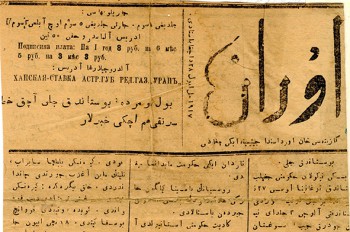
Today marks the anniversary of the founding of Uran, the newspaper from which the West Kazakhstan regional newspapers Oral Oniri and Priuralye trace their origins. Ninety-nine years have passed since 28 July 1917, when the first issue of Uran appeared through the determined efforts of Kazakh intellectuals from the Bukey Horde, amid the upheaval that followed the collapse of the Tsarist regime in the Russian Empire and the establishment of the Provisional Government.
Uran is the forerunner of today’s Oral Oniri and Priuralye newspapers. We have devoted considerable time and effort to establishing this historical connection with confidence. Our research has been systematic and thorough. We have previously explained the purpose and significance of this work. Now, as we approach the centenary and mark the anniversary of the newspaper’s first publication, we believe it is worth reminding our readers of what we have discovered.
A political system driven by colonial ambitions distorted our country’s true history, concealed historical facts and constructed a version of the past that served its own interests. As a result, many outstanding figures who had rendered invaluable service to the Kazakh people, together with their achievements, were consigned to obscurity and became victims of political repression. Only with the restoration of our independence have we gained the opportunity to address these historical injustices.
We believe that the history of the regional newspapers Oral Oniri and Priuralye, which have continued to appear for almost a century despite the consequences of misguided political policies, cannot fail to interest their readers. These publications have been our companions, advisers and trusted sources of guidance through times of hardship and happiness — for our grandparents, our parents and ourselves.
For many years, we believed that the histories of Oral Oniri and Priuralye began with Khabar-Izvestiya, a newspaper published by the Bolsheviks in Orda on 17 November 1918. Yet we had long harboured doubts about the assumption that the origins of these two publications dated only from the establishment of Soviet rule. It was widely known that fully established newspapers had existed in our region before that time. By researching the histories of these two closely connected publications, we were able to determine whether our doubts were justified.
The origins of Oral Oniri lie in Uran
With state support, the material and technical resources of Zhaiyk Press LLP were strengthened, enabling us not only to publish newspapers on a daily basis but also to undertake research into the history of our regional press.
In 2013, during the celebrations marking the 95th anniversary of Oral Oniri and Priuralye, we pointed out that the history of these newspapers might extend further back than 17 November 1918, the date traditionally accepted as their founding day. We emphasised the need for more extensive research and explained that Uran had existed before Khabar-Izvestiya, the publication previously regarded as the first issue in their history. We also announced our intention to begin searching for surviving copies of Uran. There were several reasons for this decision.
First, in 2012 we obtained copies of almost every issue of Khabar-Izvestiya published before the end of 1918 from archives in Moscow. The first issue of that newspaper, in its version printed in Arabic script, contained Resolution No. 12 of the Regional Central Committee. It stated:
“To ensure that the dissemination of printed publications advances successfully and serves a useful purpose, the new printing press brought from Astrakhan shall be merged with the Uran printing house in Khan’s Orda, and Comrade Vygdorshchik shall be entrusted with the management of the combined printing establishment.”
The very wording concerning the advancement of printed publications suggests that an existing operation was being continued and adapted to the new political system. This provides evidence that Khabar-Izvestiya succeeded Uran.
Second, a number of prominent individuals joined forces to publish the newspapers Qazaqstan (1911–1913), Uran (1917–1918), Khabar-Izvestiya (1918) and Durystyk Zholy (1919). Two figures, however, played an active part in all these publications: Gumar Karash and Gabdolgaziz Musagaliyev.
Gumar Karash served as editor of Qazaqstan, while Gabdolgaziz Musagaliyev helped organise subscriptions, raise funds and distribute the newspaper. Musagaliyev subsequently became the editor of Uran. The newspaper published numerous articles by Gumar Karash, including his poem Uran, which expressed the publication’s purpose and guiding principles.
Further evidence of their involvement with Khabar-Izvestiya can be found in an article by Tamimdar Safiyev, published in the newspaper’s special 50th-anniversary issue on 17 November 1968. The article describes discussions about replacing the bilingual newspaper, which had appeared under the names Khabar and Qazaq Durystygy, with a single publication in Kazakh.
Following a collective decision, the newspaper was renamed Durystyk Zholy. Its editorial board included Gumar Karash, Mustafa Kokebayev, Gabdolgaziz Musagaliyev, Khalel Yesenbayev and Tamimdar Safiyev himself. This evidence clearly demonstrates the close involvement of these individuals in the development of the regional press.
Unfortunately, during the Soviet period, the contributions made by such national intellectuals to their people were largely ignored. Even the name of the educator, poet and thinker Gumar Karash was forbidden from being mentioned, let alone his works. Instead, the history of Khabar-Izvestiya was generally associated almost exclusively with its editor, Stepan Milyutin, chairman of the Regional Central Committee responsible for administering the Inner Horde. The contributions of others remained in the shadows.
Gumar Karash and Gabdolgaziz Musagaliyev were both outstanding figures who occupy an important place in Kazakh history. They worked tirelessly for their people and made an immense contribution to awakening national consciousness through the press. Despite successive changes in the political system, these newspapers continued, as far as circumstances allowed, to serve the interests of the people.
Third, because our own research into press history was still relatively new, every discovery seemed to us a major revelation. Yet experienced specialists in the field appeared to have known these facts all along.
For example, the catalogue record for Oral Oniri at the Scientific Library in Almaty contained the following information:
“Qyzyl Tu. Newspaper of the Oral Provincial Party Committee and Executive Committee. Oral, 1922–1929.
From July 1917 to 1918 — Uran; from 1919 — Durystyk Zholy; 1919–1920 — Sakhara Tany; 1920–1930 — Qyzyl Tu; 1931–1957 — Ekpindi Qurylys; 1958–1964 — Oktyabr Tuy; from 1 January 1965 — Oral Oniri.”
Here, the newspaper’s origins are unequivocally traced to Uran. The sequence is presented clearly and systematically, leaving no room for doubt about the historical connection.
Fourth, Soviet political ideology would not allow Uran to be officially recognised as the starting point of the regional press. Evidence of this attitude can be found in Saken Seifullin’s novel Tar Zhol, Taygak Keshu (The Thorny Path), in which he wrote:
“Several educated people of the Bukey Horde, led by the poet and religious scholar Karashuly, published a newspaper called Uran and rallied around Alashorda…”
Because those associated with Alashorda were branded “enemies of the people”, the newspaper itself was placed in the same category. This may explain why our attempts to locate it initially proved unsuccessful.
Although the newspapers changed their names, they used the same printing facilities and involved many of the same people. They were therefore successive publications that continued one another’s work. Taken together, the evidence outlined above demonstrates that the origins of today’s Oral Oniri and Priuralye can be traced to Uran, first published in July 1917 under the editorship of Gabdolgaziz Musagaliyev.
How Uran was rediscovered
As early as 2013, when the two regional newspapers were preparing to celebrate their 95th anniversary, we wanted to introduce Uran to the public and extend the recognised history of our publications further into the past. However, despite extensive searching, we were unable to find either an original issue or a copy. We therefore had to leave the final confirmation of our hypothesis for future research.
Drawing upon our earlier experience of locating issues of Qazaqstan, published between 1911 and 1913, in Russian archives, we sent enquiries to numerous archives and libraries throughout Russia. Unfortunately, none of them held the newspaper. Nevertheless, there was no doubt that Uran had existed. Many historical figures had seen it, referred to it and expressed their opinions about it.
We continued our determined search, believing that surviving copies might still be preserved in an archive, museum, library or private collection. The first encouraging news came from the scholar Maksat Tazhimurat. He had discovered several issues of Uran at the Republican Book Museum in Almaty.
Knowing how desperately we had been searching for these valuable materials, he decided to make them available to us. He even arranged for electronic copies to be prepared so that we could collect them. We travelled to Almaty and obtained the copies.
An inscription on the bound collection stated:
“From the personal collection of the people’s poet Andash Nadraliev (1889–1954), born in the village of Zhanakazan, present-day Zhanakala District, formerly part of the Bukey Horde in Astrakhan Region.”
According to a museum employee, the bound collection had been donated to the museum in 1978.
We also knew that, during his lifetime, Mustafa Ismagulov had donated several sacks of collected documents to a museum. He was the first researcher to undertake a thorough study of the Qazaqstan newspaper. However, the restrictive political climate of the Soviet period prevented him from making the results of his research publicly known.
As it turned out, Mustafa had also preserved photographic copies of the exceptionally rare Uran newspaper in a separate folder. Moreover, he had collected and studied numerous works by Gabdolgaziz Musagaliyev, the newspaper’s editor-in-chief and principal organiser. With the agreement of the museum’s management, we obtained copies of these valuable materials.
On the basis of the surviving newspaper copies, we concluded that approximately 40 to 50 issues of Uran had been published. We managed to locate ten issues. More precisely, the available materials included the following:
- No. 6 — Friday, 1 September 1917;
- No. 7 — Tuesday, 12 September 1917;
- No. 8 — Tuesday, 26 September 1917;
- No. 9 — 7 October 1917;
- No. 20 — Sunday, 31 December 1917;
- No. 24 — Friday, 16 February 1918;
- No. 28 — date unknown;
- No. 30 — Thursday, 28 (10) March 1918;
- No. 38 — Thursday, 16 (3) May 1918.
The beginning of the twentieth century was a period when the colonisation of the Kazakh land entered an especially intense phase. One colonial power was replaced by another, leaving the people uncertain whom to trust or whose guidance to follow. Those attempting to point the way towards justice and truth struggled to make their voices heard among the wider population.
At such a moment, the newspaper was the one medium capable of bringing Kazakhs together around a common purpose and shared interests. Recognising this, representatives of the Kazakh intelligentsia established the first regular, systematically published newspaper in the western region, Qazaqstan (1911–1913). They subsequently organised Uran (1917), Khabar-Izvestiya (1918) and Durystyk Zholy (1919).
Uran: the beginning of great achievements
In 2014, the Centre for the Study of Press History at Zhaiyk Press LLP published a historical collection entitled Uran Newspaper, 1917–1918. A special advisory board was established to oversee the preparation of the publication. Alongside the regional leadership of the time, its members included distinguished scholars and historians of journalism such as Svetlana Smagulova, Garifolla Anes, Maksat Tazhimurat, Kaliolla Oryngali, Kylyshbai Sundetuly and Gabit Kabekenov.
The surviving issues of Uran were transcribed into the modern alphabet, while previously little-known information was gathered about the lives and activities of prominent Alash figures involved in publishing the newspaper, including Gabdolgaziz Musagaliyev, Nugman Manayev and Bakhytkerei Kulmanov. This became the first substantial collection devoted to Uran, a newspaper whose founding was approaching its centenary.
It should also be emphasised that the Zhaiyk Press media holding has consistently worked to honour the legacy of earlier generations. A number of events were organised to introduce the collection to the general public, specialists and academic researchers.
Book presentations were held at the Otyrar Library of L. N. Gumilyov Eurasian National University in Astana and at the Faculty of Journalism of Al-Farabi Kazakh National University. Extensive articles about the publication also appeared in newspapers including Egemen Qazaqstan, Ana Tili, Qazaqstan-Zaman and Astana Aqshamy.
A special round-table discussion was held in Oral, bringing together historians and academic specialists. During the meeting, participants proposed that the founding date of the West Kazakhstan regional newspapers should be recognised as 28 July 1917 rather than 17 November 1918, the date established during the Soviet period. The proposal received unanimous support. A formal resolution was adopted, and an official letter was sent to the Ministry of Information and Communications of the Republic of Kazakhstan.
Our purpose was never simply to move the founding date of our newspapers further into the past or make them appear older. What mattered most was establishing the truth. For seventy-three years under Soviet rule, this was a subject that could neither be openly discussed nor, in many circumstances, even contemplated. We are grateful to live in an independent country. At last, we have the opportunity to examine our history and pass on its worthy achievements to future generations.
Today, the West Kazakhstan regional newspapers stand on the threshold of a century of publication. The coming year, 2017, will be of exceptional significance to our nation. It will mark the centenary of the Alash movement, an event of profound importance to the Kazakh people. It will also be the year when Kazakhstan hosts the international EXPO exhibition.
At the same time, it will mark the 100th anniversary of Uran, a newspaper whose origins are associated with such leading national figures as Gumar Karash, Bakhytkerei Kulmanov and Gabdolgaziz Musagaliyev. Understanding and remembering this history calls upon us, today’s journalists, to remain faithful to the legacy entrusted to us by our predecessors and to continue serving our nation with dedication.
The Zhaiyk Press media holding intends to make the anniversary year as meaningful and educational as possible. The newspapers’ collections spanning a hundred years are being assembled and converted into electronic format. The book The History of Two Newspapers (Qos Gazettin Tarikhy — Istoriya Dvukh Gazet), first published in 2013, is to be expanded and reissued. Meanwhile, the search for a complete collection of Uran continues in the archives of Kazakhstan and Russia.
Beginning today, special anniversary sections will appear in the regional newspapers and on the Zhaiyk Press information website. These sections will feature valuable recollections, historical photographs and archival documents illustrating different periods in the newspapers’ century-long history.
If the history of the press is also the chronicle of a nation, then we invite our readers to participate actively in preserving it. We encourage you to share your memories, historical accounts and old photographs relating to people and events you know.
Plans are also under way to hold a national academic conference in Oral dedicated to the centenary of the regional newspapers and the history of the press. Prominent scholars who have been systematically researching the development of journalism in Kazakhstan will be invited to take part.
To mark the 100th anniversary of the West Kazakhstan regional newspapers, Zhaiyk Press LLP has also announced a competition for undergraduate and postgraduate students in journalism, philology and history. The competition aims to promote the study of the development of the Kazakh press, draw the attention of young researchers to this important subject and encourage greater academic interest in it.
Cash prizes will be awarded to students and emerging scholars whose coursework, graduation dissertations or master’s research examines the history of Kazakh journalism, particularly the development of newspapers in western Kazakhstan and the lives and public activities of the figures who stood at the origins of the regional press. The results of the competition will be announced shortly before 28 July 2017.
Zhantas NABIOLLAULY
Oral Oniri newspaper
Article written in 2016, ahead of the centenary of the Uran newspaper in 2017.