Why is it important to study and understand history? I believe there are two fundamental reasons. First, knowledge of the past helps us make sense of the present and consider what lies ahead. Second, the lessons of history help us raise future generations with a strong sense of national identity. We cannot expect to understand the history of our country, let alone that of the wider world, without first learning about the history of our own birthplace. The past of our native land must be explored within the broader context of national and world history.
Near my home village of Egindikol lie ancient burial mounds that have stood for thousands of years. Many of their secrets remain undiscovered. In recent years, Kazakhstan has paid increasing attention to the study of its historical heritage, and I hope these monuments will also receive the attention they deserve. The burial grounds, known to archaeologists as part of the Lebedevka archaeological complex, have been investigated on several occasions. Yet even today, many people living in the surrounding villages are unaware that these mounds preserve evidence of the Sarmatian past.
Numerous burial mounds lie north of Egindikol, in the Karatobe District of West Kazakhstan. As children tending livestock, we often sheltered behind them from the cold wind. If an animal went missing, we climbed the mounds to survey the surrounding steppe. We knew from our school history lessons that the Sarmatians had once inhabited this land and that the mounds marked their burial places. Older villagers also told us stories of people who had come here in earlier times in search of gold. My mother remembered the archaeological excavations near our village: “Around 1977, archaeologists were excavating the burial mounds near the village. Your father helped them several times with machinery at their request. Once, he took me along and showed me the excavation site.”
Among Kazakhs, stepping on a grave has traditionally been regarded as disrespectful. Yet perhaps because the people buried in these mounds lived some 2,000–2,500 years ago, local residents had come to regard the ancient earthworks as part of the familiar landscape. They climbed them to look across the steppe or sheltered behind them from the wind, often knowing little about the discoveries made during the archaeological investigations of 1967 and 1977–1980.
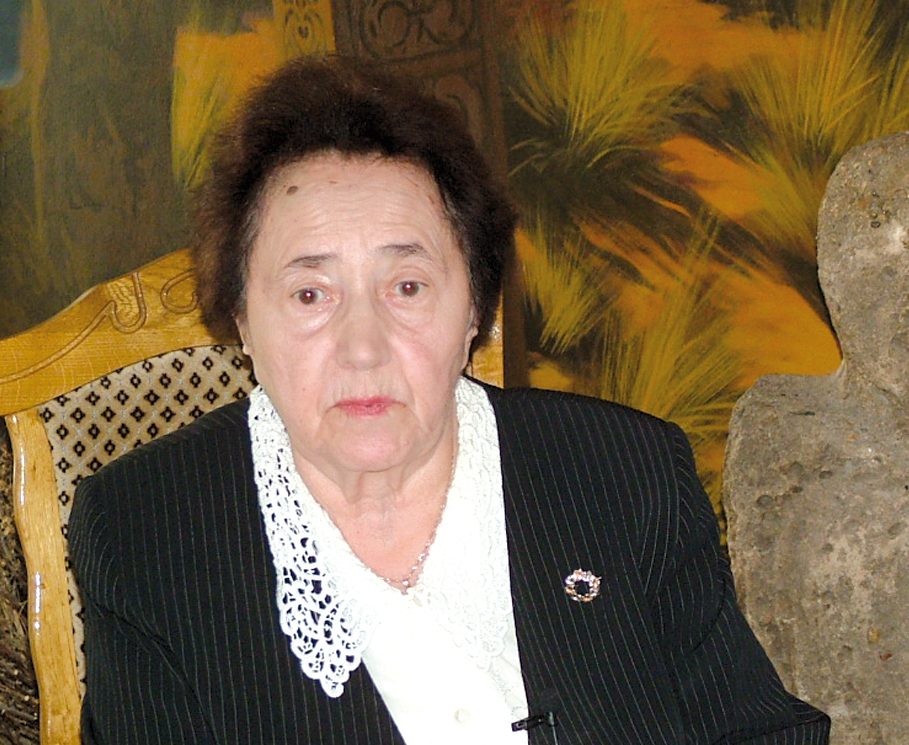
In 2012, Oral hosted an international academic conference entitled Medieval Urban Culture in the Ural River Basin and the Civilisation of Nomads. One of its participants was Professor Marina Glebovna Moshkova, Doctor of Historical Sciences and a researcher at the Institute of Archaeology of the Russian Academy of Sciences. Her presentation addressed, among other subjects, the burial grounds situated between Segizsai and Egindikol. Unfortunately, the time available did not allow her to discuss the discoveries in detail.
After the conference, I approached Professor Moshkova to learn more about the ancient burial mounds near my home village. She kindly agreed to an interview and shared a wealth of information about a place I had known since childhood. Much of what she told me was entirely new. I am pleased to share our conversation with readers.
— Professor Moshkova, who first began investigating the Sarmatian burial mounds between Egindikol and Segizsai?
— As far as I know, Grigory Ivanovich Bagrikov visited the area in 1966–1967 with students undertaking archaeological fieldwork. He began investigating the burial mounds between the two villages, excavating several smaller mounds and two large ones. We carried out a preliminary survey in 1969 and, following an agreement with the pedagogical institute, resumed excavations in 1977.
— What were the results of Bagrikov’s investigations?
— His work produced some remarkable discoveries. Indeed, it was his published account that encouraged us to undertake further research at the site. He reported human remains and numerous artefacts dating to the Late Sarmatian period. Two large burial mounds standing close together were of particular interest. Although his publication did not describe every aspect of the excavations in detail, the discoveries were sufficiently important to justify further investigation.
— What position did you hold at the time, and who took part in the excavations?
— I was a research fellow at the Institute of Archaeology, or perhaps still a junior research fellow. I cannot remember precisely. Apart from the laboratory assistants, I was the only participant from Moscow and led the expedition. The other members included Boris Fyodorovich Zhelezchikov, a lecturer at the Uralsk Pedagogical Institute, and students from that institution.
— Could you explain the main chronological periods of Sarmatian history for our readers?
— Sarmatian history is divided into four periods. The first is the Sauromatian period, from the sixth to the fourth centuries BC. The second, the Early Sarmatian period, extends from the fourth century BC to approximately the middle of the first century BC. The third, the Middle Sarmatian period, runs from the middle of the first century BC to the middle of the second century AD. The fourth is the Late Sarmatian period, lasting from the middle of the second to the middle of the fourth century AD. The Huns subsequently arrived in the region.
— What made this particular site worth travelling such a long distance to investigate year after year?
— Its exceptional character became apparent during our preliminary survey in 1969. The burial ground contained graves dating to the Late Sarmatian period. Sites from the Sauromatian, Early Sarmatian and Middle Sarmatian periods were relatively common, but Late Sarmatian burial grounds were much rarer.
Another striking feature was the wealth of objects associated with burials from the Sauromatian, Early Sarmatian and Late Sarmatian periods. We found no material attributable to the Middle Sarmatian period.
— Does that mean people inhabited this area from the sixth century BC to the fourth century AD, a period of approximately a thousand years?
— Broadly speaking, yes, although there is a gap corresponding to the Middle Sarmatian period. That is another reason the site is so remarkable.
— How did you organise the excavations?
— We first divided the burial mounds into six groups according to their locations. We then investigated them systematically.
— What did you discover?
— We recovered many interesting artefacts, although our excavations did not produce assemblages as rich as those Bagrikov had uncovered in the two large mounds. I will return to those discoveries shortly.
Among our finds were various bronze mirrors, including a rare Chinese mirror with an eight-arched design, and a Roman fibula, or brooch, decorated with coloured enamel. We also recovered a particularly unusual sword pommel made of chalcedony, a mineral belonging to the quartz family.
A sword with a chalcedony pommel was a valuable object. Its presence in a burial could indicate that the deceased had enjoyed considerable wealth and status, possibly as a distinguished warrior. Such finds are especially important because they provide evidence of social distinctions within Sarmatian communities.
The pommel had an opening through which it was fitted to the sword’s hilt and was secured by a decorative pin. Although the head of this fitting resembled that of an ordinary nail, it was carefully ornamented. One example included a decorative figure combining human and animal features, embellished with gold and glass.
— You have mentioned Bagrikov’s discoveries several times. Could you tell us more about them?
— In 1966–1967, Grigory Ivanovich Bagrikov, a lecturer at the Uralsk Pedagogical Institute, investigated burial mounds between Lebedevka, now Segizsai, and Egindikol. Among the mounds he excavated were two large examples that had escaped looting. This was particularly significant because large burial mounds were often the first to attract grave robbers.
The two mounds stood close together. One contained a male burial and the other a female burial. The man’s grave had a substantial timber-supported covering over the burial chamber. We have no anthropological material from this burial, and I do not know where the skulls were sent.
The male burial contained an exceptionally rich assemblage, including two light-coloured clay amphorae. These vessels were identified as imports from Asia Minor and dated to the second or early third century AD. They were regarded as exceptionally rare finds in the Southern Ural region. I had previously seen the amphorae in a museum and photographed them myself.
Two niches had been constructed in the corners of the burial chamber. Among the objects discovered were a large bronze cauldron, a smaller vessel and an elaborately decorated jug with an unusual handle. The vessels may have been imported, possibly from Iran, although I have not examined them closely enough to establish their origins.
The discovery of two spears was also important. Spears are uncommon in Late Sarmatian burials, although examples are known from earlier archaeological contexts in the Southern Ural region. According to Bagrikov’s description, the wooden shafts of both spears were wrapped along their entire length with thin silver strips. I should emphasise that I did not see these objects myself and am relying on his published account.
Other finds included pottery, knives, an iron tripod whose purpose remains unclear to me, and small vessels that may have been associated with ritual practices.
The female burial in the neighbouring mound was particularly rich. It contained gold beads, elaborate earrings and numerous gold appliqués that had been sewn onto the woman’s clothing. Crystal and glass beads were also discovered, together with gold ornaments set with red gemstones, a silver spoon, a jug, a bucket and various other vessels.
— How many burial mounds are there altogether, and how many did your expedition excavate?
— There are a great many. I would estimate more than 150. They belong to different historical periods, sometimes separated by several centuries. Some of the older mounds may now be barely visible above the surrounding ground. Of the mounds we excavated, 51 belonged to the Late Sarmatian period. Many others remain unexcavated.
— What distinguishes the artefacts recovered from these burials?
— One striking feature was the abundance of pottery. I believe some of these vessels may have come from the west, possibly from Tana on the River Don.
Another important feature was the large number of warrior burials. Many of the graves contained long swords, while only two contained daggers. Four or five swords had chalcedony pommels. Such objects suggest that some of those buried here held a prominent position in their communities.
Numerous Late Sarmatian burial grounds have been discovered in the Southern Ural region, but comparable concentrations of swords with chalcedony pommels were exceptional. These discoveries suggest that wealthy and influential members of Sarmatian society lived in this area over a considerable period.
Horse-harness fittings were another remarkable category of finds. In three male burials, we discovered elaborate ornaments associated with the breast straps of horse harnesses. Initially, we could not determine the function of the decorated bronze plates. After consulting other specialists, we concluded that they formed part of the horses’ equipment.
Similar ornamental breast straps are known from the equipment used on Akhal-Teke horses. Does that mean such horses were present here? I cannot say. What made the fittings particularly unusual was their silver decoration. I had not encountered comparable examples elsewhere.
We also discovered two or three areas that we interpreted as sanctuaries. These were circular spaces, approximately 10–12 metres in diameter, situated on relatively level ground. The excavations yielded fragments of pottery, which I took to Moscow. The archaeologist D. B. Shelov dated them to the beginning of the third century AD.
Interestingly, jugs were rarely found in the graves themselves. Many appeared to have been deposited in these ritual areas instead.
— Thank you for sharing these valuable insights into the history of our region.
Two remarkable burial mounds at Lebedevka
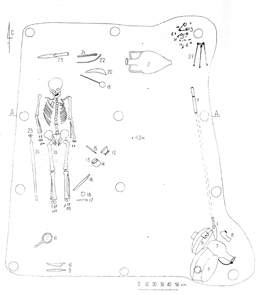
During our conversation, Professor Moshkova drew particular attention to the two large burial mounds excavated by Grigory Bagrikov in 1967. She also provided diagrams showing the construction of the graves and the positions of the objects found inside them.
The following descriptions accompany those diagrams.
Diagram 1. The male burial
Mound No. 1, Lebedevka burial ground
The mound measured 27 metres in diameter and approximately 2 metres in height. Beneath its central section was a rectangular burial pit measuring 3.2 × 2.5 metres. The covering of the burial chamber was supported by 12 timber posts arranged around the perimeter and along the centre. The central row divided the chamber into two sections.
The skeleton lay in the western part of the chamber. The deceased had been placed on his back, with his head pointing north. Near his head stood a large jug with a narrow neck and angular handles. Beside his left shoulder were an iron ladle, an iron sickle and a socketed iron spearhead with traces of its wooden shaft. To the right, near his legs, lay a double-edged sword in a wooden scabbard, with a rounded agate pommel at the end of its hilt.
The man’s clothing was decorated with hemispherical gold appliqués. In the eastern part of the chamber, archaeologists found another socketed iron spearhead and horse-harness fittings, including bits, rings, buckles and decorative bridle mounts made of iron and silver.
The vessels included a copper-alloy cauldron, a round-bottomed handled vessel and a copper-alloy jug with a narrow neck and curved handle. The jug was particularly notable for its elaborate ornamentation. Its lower handle attachment bore a mask traditionally associated in the account with Dionysian imagery; subsequent archaeological research identifies the figure more specifically as Silenus. The upper part featured additional decorative elements, including bird-head motifs.
Diagram 2. The female burial
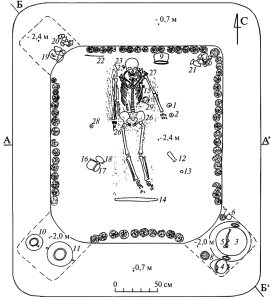
Mound No. 2, Lebedevka burial ground
The mound measured approximately 21–22 metres in diameter and 1.45 metres in height.
The objects in the archaeological diagram are numbered as follows:
1 — silver candlestick;
2, 3, 4 — bronze cauldrons;
5 — sheep bones;
6 — bronze bell;
7 — iron bell;
8 — silver strainer;
9 — small bronze cauldron;
10, 11, 17, 18 — ceramic vessels;
12 — stone pestle;
13, 14 — whetstones;
15 — diamond-shaped bead or pendant;
16 — copper-alloy jug handle;
19–21 — pottery fragments;
22 — silver spoon;
23 — gold earring;
24 — gold pendant;
25 — V-shaped gold appliqués;
26 — gold appliqués and plates;
27 — beads;
28 — clay;
29 — mirror fragments.
Could she, too, be called an Altyn Adam?
The archaeological significance of a burial depends not only on the human remains it contains but also on the objects buried with the deceased. These artefacts can reveal much about the material culture, social position and traditions of the people who lived at the time.
The gold ornaments discovered in the large female burial mound were extraordinary, both in their quantity and craftsmanship. Many were decorative appliqués of different shapes, originally sewn onto the woman’s clothing.
According to the museum records cited in the original account, artefacts recovered during Bagrikov’s 1967 excavations were transferred to the West Kazakhstan Regional Museum of History and Local Lore. The gold ornaments were described as being of high purity, with fineness values of 900 and 950.
The quantities alone are striking:
- 207 pieces — hollow, semicircular gold appliqués with loops on the reverse for attachment to clothing. Gold fineness: 900.
- 83 pieces — flat, shaped gold appliqués with three sewing holes. Gold fineness: 900.
- 130 pieces — raised, triangular gold appliqués. Gold fineness: 900.
- 2 pieces — crescent-shaped gold earrings decorated with gemstones. Gold fineness: 900.
If all these gold ornaments were sewn onto the clothing of a single woman, could she not also be called an Altyn Adam (“Golden Man”)?
Zhantas NABIOLLAULY
Originally published in Oral Oniri, No. 113, 12 September 2013.