Some welcome news: we have brought back from Ufa nearly 10,000 pages of archival documents containing valuable information about our region. At the National Archive of the Republic of Bashkortostan, we made digital copies of the Inner Horde’s metrical registers for 1865, 1871 and 1875, enriching the newly established holdings of the West Kazakhstan Regional Centre for History and Archaeology with valuable historical records. Once these materials, written in the Arabic script, have been fully transcribed and translated, many people will be able to trace their ancestors and discover when and where they were born, whom they married, how much bridewealth was paid, when and from what illnesses they died, and where they were buried. These records will also make it possible to examine birth rates during that period, the proportion of boys and girls, the social circumstances of the population as reflected in the amounts of bridewealth paid, the diseases prevalent at the time, and the burial places of historical figures.
We had previously brought back various valuable materials from archives abroad and published them in collections. While archival documents are historically significant in their own right, the story of how they are brought home is also worth telling. Of course, as time passes and newly discovered records enter scholarly circulation, the public may give little thought to how this information came to our country. Yet behind every document discovered abroad and brought back to our people lies the hard work of particular individuals. Sometimes documents that have long remained undiscovered, or inaccessible even after being located, come into the hands of a determined researcher without any apparent difficulty. At times, it almost seems as though the documents themselves have sought out the person searching for them.
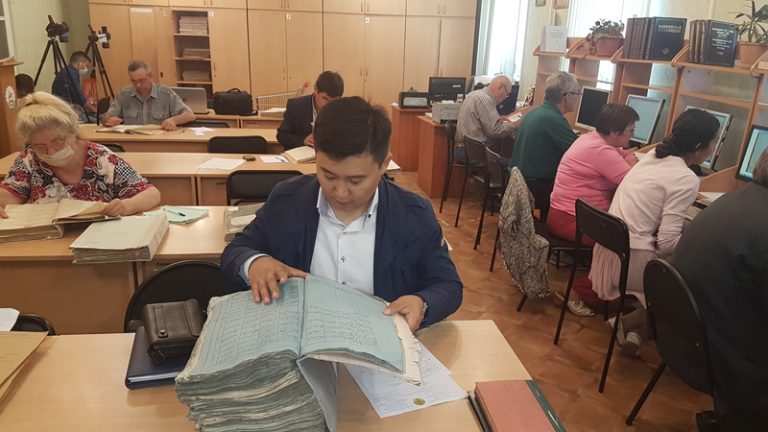
Last year, after joining the West Kazakhstan Regional Centre for History and Archaeology, I began my research trips with a visit to Ufa. My first journey was a preliminary visit to the National Archive of Bashkortostan to examine documents relating to the history of our region and explore how copies might be obtained and brought home. My main priority was to examine the metrical registers, although I also hoped to look at other documents if possible. I discovered that the registers alone comprised nearly 10,000 pages. There was also a wealth of other valuable material. Purchasing copies at the archive’s established rates would have required a considerable sum of money. I learnt that taking our own scanning equipment would substantially reduce the cost. Once I had gained a clear understanding of the situation, I returned home and began organising the work needed to obtain the documents. A month later, in early October, I travelled to Ufa with Kazbek Kabzhan, with whom I had visited numerous archives while researching the history of the press, who had transcribed the newspapers we obtained from the Arabic script and worked alongside me on gravestone research, and Akylbek Yesenalin, who had made digital copies of a century’s worth of bound volumes of regional newspapers using a photographic scanner. Akylbek had even travelled to Almaty carrying his equipment to obtain copies of newspaper issues unavailable in our region. Together, we began making digital copies of the metrical registers held at the National Archive in Ufa, Bashkortostan.
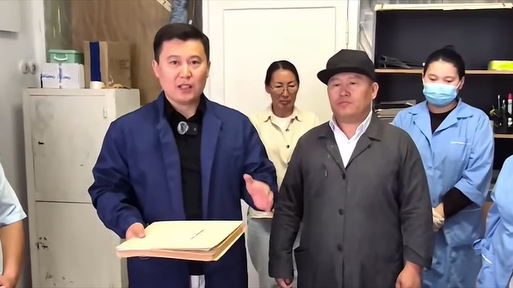
The archive staff were surprised to see us arrive carrying our own equipment. As soon as we set up the scanner, employees came over one after another to examine it with interest. In fact, the archive had temporarily suspended its operations. Major renovations were planned for the building, and all the documents had already been packed away. However, following an agreement I had reached with the archive’s director, Galey Gulyaddinovich, the archive, although closed to other visitors, was opened to us so that we could carry out our research. Our principal interest was Fond 295.
Kazbek Kuttymuratuly and I requested the finding aids for this fond and began by searching for the metrical registers. We examined the files brought to us and passed those relating to our region to Akylbek Yesenalin for photographic scanning. Once we had requested all the available registers, we turned our attention to other documents concerning our region. Eight archival inventories from Fond 295 were brought to us. Each inventory consisted of five or six volumes, and identifying the relevant files was taking a great deal of time. We therefore began photographing, on our mobile phones, the inventory pages containing the reference numbers of documents relating to our region. Each evening, after returning from the archive, we organised the photographs we had taken. The following day, we submitted requests for the relevant files.
Under the usual rules, each researcher is allowed to consult five archival files per day. We requested every file that appeared to contain information we needed and examined around thirty files a day. It became clear that making copies would require at least a week. Meanwhile, the archive had already packed away all its documents and was due to close completely once the major renovation work began. I therefore asked the archive director for permission to continue working on Saturday and Sunday. He understood our circumstances and agreed. Archive staff also came to work over the weekend. We were deeply grateful to the director, Galey Gulyaddinovich, for his assistance. The goodwill shown by people far away, with whom we share common ancestral roots, held a special significance. As a result, we brought home copies of nearly 10,000 pages of metrical registers, along with numerous other archival files of historical importance. In November and December 2018, we began work on transcribing and translating the materials. Muratbek Zhakhatov completed 600 pages, while Gulmaru Myrzagaliyeva translated a further 200 pages after completing her work on gravestone inscriptions. As I read through the translations, I could not help but be astonished by the wealth of information they contained. I realised that until then I had not fully understood the underlying purpose of bridewealth (kalym). All these findings will provide material for articles to be written in the future.
I would like to express my sincere gratitude to Galey Gulyaddinovich, Director of the National Archive in Ufa, the capital of the Republic of Bashkortostan, for carefully preserving the records of our history and wholeheartedly helping us obtain copies of these invaluable materials. I am equally grateful to my friend Batyrbek Bisenkulov and to Vadim Davletshin, who is connected to Kazakhstan through marriage, for helping to make this undertaking a success.
Zhantas SAFULLIN
Director, West Kazakhstan Regional Centre for History and Archaeology
Translated from Kazakh.