Last year, we managed to contact Nadezhda Karasheva, the granddaughter of Gumar Karash, who lives in Moscow, and had an opportunity to speak with her at length. It soon became clear that she was a remarkable person in her own right, much like her grandfather. During our conversation, Nadezhda Burkhankyzy mentioned that she had corresponded regularly with Mukhtar Auezov and that his final letter had been addressed to her.
The subject interested me, but since our conversation was primarily devoted to her grandfather, Gumar Karash, I felt it would be inappropriate to turn our attention to Auezov’s letters at the time. Believing that their correspondence might be of interest to our readers, I subsequently sent her several questions over the internet and soon received her replies. We are pleased to present this brief interview conducted at a distance.
— How did you first meet Mukhtar Auezov?
— Like any educated person in Kazakhstan, I was, of course, familiar with Mukhtar Auezov’s life and literary work. However, I first met him in person in 1953, after graduating from Lomonosov Moscow State University and joining the Institute of Language, Literature and Art of the Academy of Sciences of the Kazakh SSR, where Mukhtar Omarkhanovich headed the Department of Kazakh Folklore.
At that time, the institute brought together linguists, literary scholars and art historians. It was subsequently divided into separate institutes of linguistics and literature. Among those working there were some of the republic’s most prominent scholars and cultural figures: the linguists S. Kenesbayev, N. Sauranbayev and G. Musabayev; the writers and literary scholars M. Auezov, E. Ismailov and M. Silchenko; and the composers A. Zhubanov and E. Brusilovsky, among others. There were also many young researchers.
Mukhtar Auezov arrived at work at the same time every day. He was always surrounded by his students, young scholars and writers. His conversations with younger colleagues were a source of fresh inspiration. He took a keen interest in their plans, opinions and thoughts about their writing, and supported activities organised for young people at the institute. He also took an active part in the traditional light-hearted performances held to mark International Women’s Day on 8 March and the men’s celebration on 23 February.
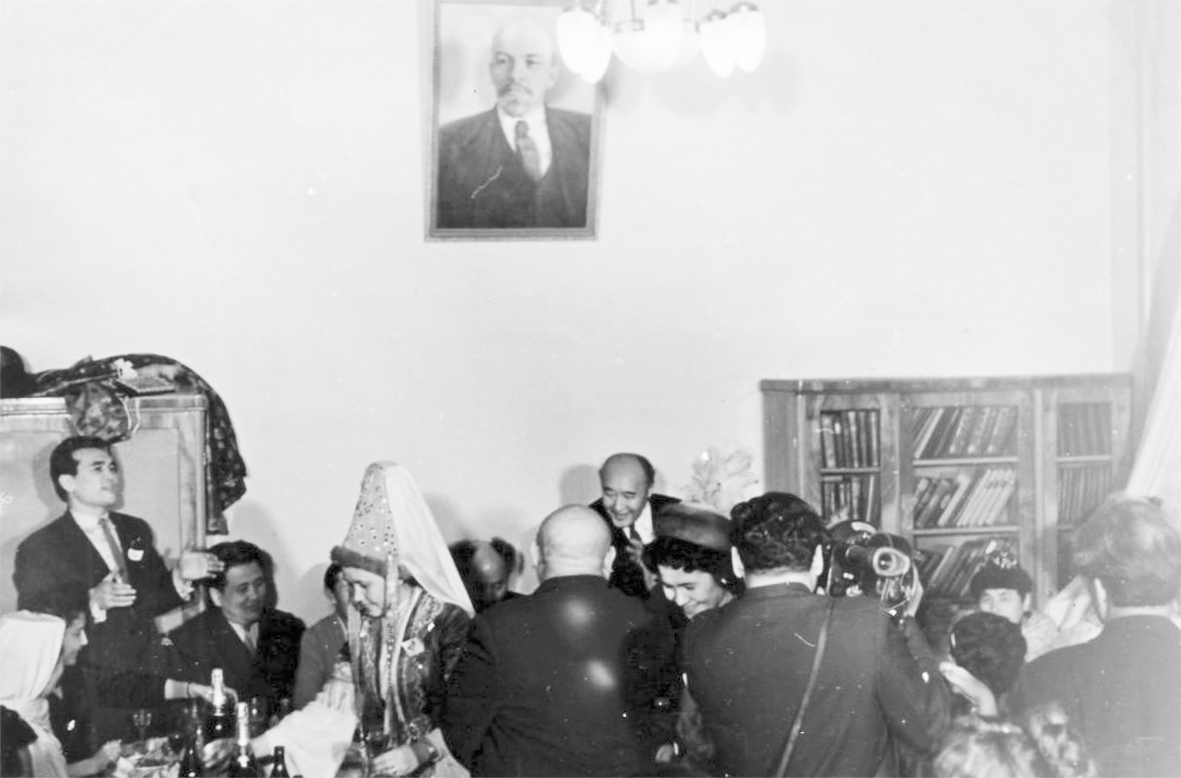
We particularly remember the New Year’s costume party we organised in 1960. We rented traditional Kazakh costumes from the Kazakh Drama Theatre and invited camera operators from the Kazakhfilm studio, together with their lighting equipment. Mukhtar Omarkhanovich joined in the celebrations, told jokes, proposed toasts, sang and danced. A documentary film was made of the occasion. It is preserved in the Kazakhfilm archives and, I am told, is regularly shown on television in Kazakhstan during commemorations of Auezov’s anniversaries.
Mukhtar Omarkhanovich had certain reservations about young Kazakh writers who wrote in Russian. He believed that a poet or writer could express themselves fully only through a single language. At the same time, he often said, “My new novel, Ösken Örken, should be published in Russian as well, at the same time, so that readers of different linguistic backgrounds can become familiar with it and understand it.”
At the institute, Mukhtar Omarkhanovich always showed particular interest in young bilingual Kazakhs who were equally proficient in Kazakh and Russian. In this regard, he strongly encouraged my efforts to improve my knowledge of my native language and consistently supported my first public presentations in Kazakh at meetings and conferences.
— When you were young, did you know that Mukhtar Auezov was acquainted with your grandfather, Gumar Karash?
— At the institute, people called me Nadiya, the Kazakh form of my name. Mukhtar Auezov never mentioned my grandfather, nor did he show any particular interest in my biography or family connections. Nevertheless, I believe he must have known Gumar Karashev, as they both participated in the Congress of Russian Muslims held in Moscow in May 1917. Perhaps the political climate of the time played a part. Until the 1960s, the names of many Kazakh cultural figures remained effectively banned from public discussion in Kazakhstan, having previously been excluded from public recognition. Restrictions surrounding religious subjects and associations may also have contributed to this silence.
— Could you tell us about the contents of the last letter Mukhtar Auezov wrote to you?
— I was particularly close to two colleagues at the institute: Yevgeniya Vasilyevna Lizunova, a literary scholar who studied Mukhtar Auezov’s work, and Rabiga Galiyevna Syzdykova, a linguist who researched the language of Abai Kunanbayev’s writings. Mukhtar Omarkhanovich treated the three of us with great respect, shared his plans with us and invited us to his home.
When he arrived at work, he would usually come into the office I shared with Muslim Bazarbayev, the institute’s deputy director. I was the institute’s academic secretary at the time. I would invite Yevgeniya Vasilyevna and Rabiga Galiyevna to join us, and we would have long, fascinating conversations. The writer generously shared his ideas and plans, reflected on his work and sought our opinions. It was to the three of us that Mukhtar Auezov addressed his second letter, one of the last he ever wrote. He sent it on 7 June 1961 from a hospital in Kuntsevo, Moscow.
The writer had told us that he was travelling to Moscow for a routine course of preventive medical treatment. However, as Yesmagambet Ismailov later recalled, Mukhtar Omarkhanovich had confided in him his concerns about an impending operation and its possible consequences. Before leaving for Moscow, Auezov also invited Mukhamedzhan Karatayev to meet with him. They spoke for approximately two hours, during which the writer explained that he was going to Moscow for a medical consultation at the Kremlin Hospital and that a serious operation might be necessary.
There is a note of sadness in this letter, one of his last to us. The writer said that he had taken with him “one unfulfilled dream, one unrealised wish”: to rest among the poppy- and tulip-covered fields of his native Kazakhstan. Nevertheless, he hoped to leave the hospital safely by the middle of the summer of 1961. In his letter, he expressed a wish to invite all three of us to stay at his little house on Lake Issyk-Kul, in Kyrgyzstan, where he loved to work on his books. Sadly, those hopes were never realised.
Yet Mukhtar Omarkhanovich remains forever in our hearts. Through the pages of his wise and thoughtful books, he continues to teach us about life.
Zhantas SAFULLIN
General Director, Zhaiyq Press LLP
Originally published in Priuralye newspaper.
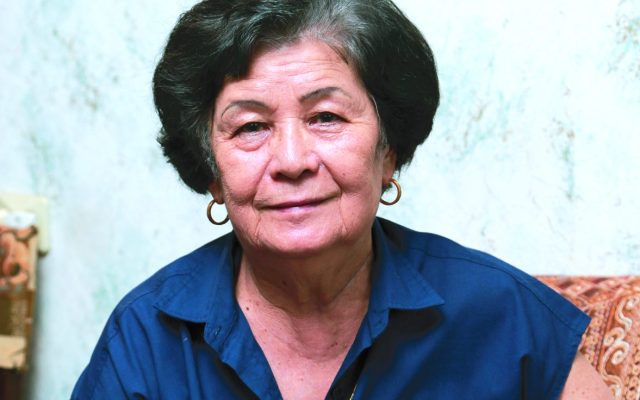
Nadezhda Burkhankyzy Karasheva
Nadezhda Burkhankyzy Karasheva is a granddaughter of Gumar Karash. She was born in 1930 in Uralsk, Kazakhstan. In 1948, she graduated with a gold medal from a Russian-language secondary school in Alma-Ata. In 1953, she graduated from the Oriental Studies Department of the Faculty of Philology at Lomonosov Moscow State University.
From 1953 to 1962, she worked at the Institute of Language, Literature and Art of the Academy of Sciences of the Kazakh SSR, where she defended her Candidate of Sciences dissertation entitled Grammatical Features of the Language of Kazakh Literary Writing in the Early Twentieth Century (Based on Materials from the Aiqap Journal).
She has lived in Moscow since 1963. At the time of the interview, she was serving as academic secretary at the Philological Centre of the Russian Academy of Education. She is the author of more than 120 scholarly works on linguistics and language-teaching methodology. She has two daughters and a grandson.
New Year’s Costume Party, 1960
A scanned photograph from the New Year’s costume party held in 1960. From left to right: Muslim Bazarbayev, Mukhamedzhan Karatayev, Alkey Margulan (historian), Rabiga Syzdykova, Iskak Duisenbayev, Mukhtar Omarkhanovich Auezov and Nadezhda Karasheva. Yesmagambet Ismailov can be seen farther back, near the cupboard.
One of Mukhtar Auezov’s Final Letters
The second letter addressed by Mukhtar Auezov to Nadezhda Karasheva, Yevgeniya Lizunova and Rabiga Syzdykova. Written on 7 June 1961 at a hospital in Kuntsevo, Moscow, it was among the writer’s final letters.