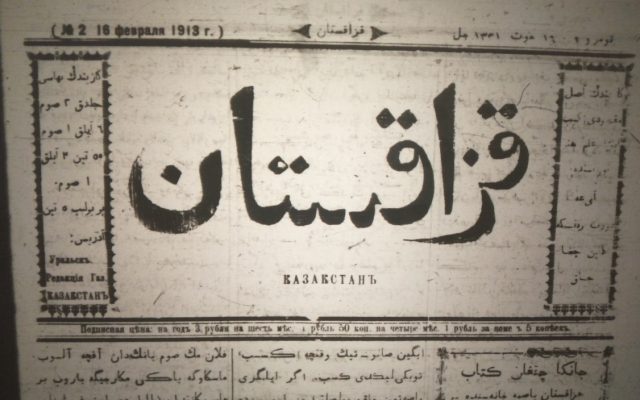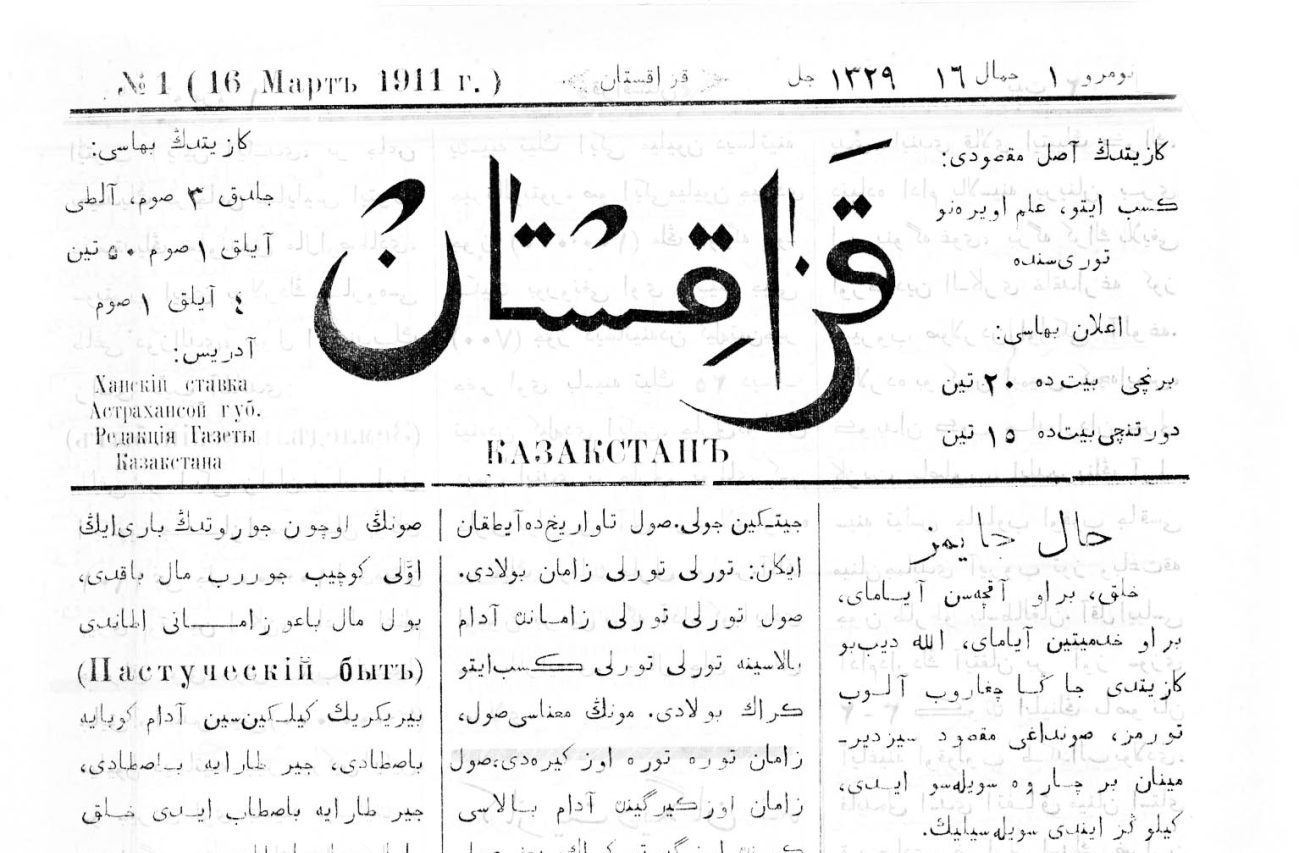
Exactly 102 years ago today, on 16 March 1911, the first issue of Qazaqstan appeared on the Kazakh steppe. The newspaper was founded by a group of patriotic intellectuals who dreamed of independence for their homeland and devoted themselves to awakening national consciousness, fostering unity and solidarity, and inspiring their people to strive for freedom. Their ambition was to establish a regular publication that would promote education, science, practical skills and the transition to a settled way of life.
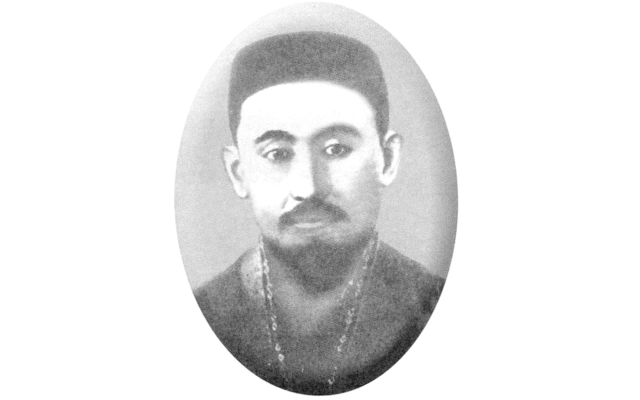
At a time when the Kazakh steppe had no newspaper capable of bringing people together and advancing their common interests, the appearance of Qazaqstan marked an important milestone, not only in the history of the Kazakh press but in the history of the nation itself. Its principal founders and publishers included Gumar Karash, Bakytzhan Karatayev, Eleusin Buyrin, Shangerey Bokeev, Seitkali Mendeshev and Gabdolgaziz Musagaliyev.
Yet this remarkable publication has never been studied as thoroughly as it deserves, nor has it received due historical recognition. For many years, neither original issues nor copies could be found in any museum or library in Kazakhstan. One could not help wondering whether they had been deliberately destroyed. A major reason for the newspaper’s neglect lay in a resolution adopted in 1947 by the Central Committee of the Communist Party (Bolsheviks) of Kazakhstan, entitled On Gross Political Errors in the Work of the Institute of Language and Literature of the Academy of Sciences of the Kazakh SSR. The resolution condemned Gumar Karash and Shangerey Bokeev as figures associated with the allegedly bourgeois-nationalist Alashorda movement, which the authorities regarded as hostile to the revolution. Their names were removed from school textbooks, and further research into and promotion of their work were prohibited. In such circumstances, scholars dared not openly discuss the historical significance of Qazaqstan or its educational mission. Even those who knew that copies survived in the rare-book collections of libraries in Moscow and Leningrad were unable to bring them to Kazakhstan, establish their historical importance and make them available to the public.
How Was Qazaqstan Rediscovered?
The history of the Kazakh press dates back to the early twentieth century. Among the publications established during that period were the West Kazakhstan regional newspapers Oral Öñiri and Priuralye. The history of Oral Öñiri began on 17 November 1918, when it appeared under the title Khabar (Izvestia). On 1 January 1919, it became Qazaq Durystygy, and from 26 February to 10 July that year it was published as Durystyq Zholy. It subsequently adopted the name Sakhara Tany. Between 1920 and 1932, the newspaper appeared as Qyzyl Tu; from 1932 to 1957, as Ekpindi Qurylys; and between 1957 and 1963, as Oktyabr Tuy. Since 1963, it has been published under its present name, Oral Öñiri. Its sister newspaper, Priuralye, also underwent several changes of name in response to the political circumstances of successive periods. Today, both publications belong to Zhaiyq Press LLP and are regarded as among Kazakhstan’s oldest newspapers.
Nevertheless, it would be difficult to claim that the histories of Oral Öñiri and Priuralye have been thoroughly researched. Their earliest issues have not survived, although a careful examination of their contents could shed valuable light on events of a century ago. Interest in the history of Alashorda has grown in recent years, and some historians have begun searching archives and studying previously neglected documents. Yet newspapers with almost a century of history have attracted surprisingly little attention. Their pages may contain important evidence concerning some of the most difficult and tragic periods in Kazakh history: the Alashorda government’s recognition of Soviet authority in 1918, the famine of 1920–1922, the events described as the Little February upheaval of 1925, the famine of 1932–1933, the mass political repressions of 1937–1938 and the Second World War of 1941–1945.
This year marks the 95th anniversary of Oral Öñiri and Priuralye. To commemorate the occasion, we conceived the idea of establishing a museum devoted to the history of these newspapers and their nearly century-long existence. We therefore decided to investigate our own publications, trace their surviving issues and identify the people who had founded and produced them from the outset. One source proved especially valuable: an article written by Tamimdar Safiyev, who was then living in Moscow, for the fiftieth-anniversary issue of Oral Öñiri, published on 17 November 1968. Safiyev recalled discussions about replacing the previously bilingual publications Khabar and Qazaq Durystygy with a newspaper published exclusively in Kazakh. Following a collective decision, the newspaper was renamed Durystyq Zholy, and its editorial board included Gumar Karash, Mustafa Kokebayev, Gabdolgaziz Musagaliyev, Khalel Yesenbayev and Safiyev himself. As the editorial board was the newspaper’s principal decision-making body, establishing where its members had previously worked and what positions they had held became an important part of our investigation. We discovered that two of the five men — Gumar Karash and Gabdolgaziz Musagaliyev — had also been involved in publishing Qazaqstan between 1911 and 1913. This discovery prompted me to begin our research with Qazaqstan.
Although I had heard that a newspaper bearing the name Qazaqstan had been published in our region between 1911 and 1913, I had never examined its history closely. I began by consulting earlier research. In 1962, the scholar M. Ysmagulov published an extensive study entitled The Publication History and Ideological Content of the Qazaqstan Newspaper. Another historian of the Kazakh press, Q. Bekkhozhin, observed: “There is significance in the newspaper’s name, Qazaqstan. It points to the idea of uniting the Kazakh lands and establishing a democratic republic.” Maksat Tazhimuratov, who researched Shangerey Bokeev and Gumar Karash and published a book about them, argued that both men had been directly involved in producing the newspaper. His work referred to research by M. Ysmagulov preserved in the collections of the West Kazakhstan Regional Museum of History and Local Lore. We therefore visited the museum, where its director, Abil Zholamanov, kindly helped us locate several folders of Ysmagulov’s research on Qazaqstan. The documents revealed the extent of his work: he had carefully examined the publication and transcribed articles originally written in the Arabic script into Cyrillic.
But to understand Qazaqstan properly — its history, its contents and the principles that guided its editors — there was no substitute for reading the newspaper itself. I began searching for surviving copies. Having heard that the State Book Chamber held sixteen issues, I visited the institution, only to find that its staff could locate just four rather poor-quality copies. These had apparently been acquired when Yermekqali Nygmetov, a public figure from Bokei Orda District, served as the institution’s director between 1956 and 1971. It seems that several issues subsequently disappeared or were stolen. I obtained photocopies of those that remained, but enquiries to libraries and museums throughout Kazakhstan brought no positive results.
Another question remained unresolved. Some researchers maintained that sixteen issues of Qazaqstan had been published, while others put the number at eighteen. Unable to locate a complete collection in Kazakhstan, I contacted libraries in Russia. Then came the news we had been hoping for: copies of Qazaqstan had been found. They were held in two institutions — the M. Saltykov-Shchedrin Public Library in St Petersburg and the Russian State Library in Moscow. We negotiated the necessary arrangements, paid the fees and received electronic copies. Issues missing from one collection could be found in the other, and at last we had assembled sixteen. Most of the articles were written in Kazakh using the Arabic script, although the newspaper also carried Russian-language material printed in Cyrillic. It was produced in A3 format, initially with six pages and later with eight. Eleusin Buyrin was its official editor, while Gumar Karash wrote many of its most substantial Kazakh-language articles, often under pseudonyms. The more I examined the surviving issues, the clearer the scale of Karash’s contribution became.
From Arabic Script to Cyrillic
Finding the newspaper was only the beginning. Our next challenge was to transcribe its Kazakh-language articles from the Arabic script into Cyrillic, making them accessible to contemporary readers. At this point, Kazbek Kuttymuratuly, an experienced journalist and department head at Oral Öñiri, offered to undertake the work. He began with the first issue, and when I read his transcription, I was astonished. Here was a newspaper whose contributors had looked ahead, recognised the importance of the press and urged their people to unite and build a nation. They were educated men with an extraordinarily broad outlook, and the ideas they expressed were both perceptive and thought-provoking. Eventually, all sixteen issues were transcribed. Each one moved me. I felt immense admiration for our forebears, who had struggled against extraordinary difficulties to keep the newspaper alive. Yet I also felt deep regret that a century had passed, and Kazakhstan had been independent for more than twenty years, while neither the publication nor its founders had received the recognition they deserved.
Consider the circumstances in which they worked. The Tsarist administration exercised its authority through governor-generals and district officials. Sultans, aristocrats, wealthy landowners and local rulers held considerable power, while mullahs and ishans were engaged in religious instruction. Against this background, the declaration published in the very first issue of Qazaqstan was an act of extraordinary courage:
“What can bring us together in purpose and aspiration is the newspaper. That is why the newspaper is our guide, our source of pride before our friends and our weapon against our enemies. The newspaper is our teacher, showing us what we do not know. It is the lamp that lights our way through darkness and leads us along the right path.”
Every issue carried a statement setting out the publication’s guiding purpose: “The newspaper’s principal aim: to promote enterprise, science and the arts.” One reader, who was also a contributor, described the importance of its appearance in memorable language:
“The people had fallen into a deep sleep. Though there was reason to fear that the Kazakhs might remain asleep forever, without ever seeing the dawn, few could have imagined that they would awaken so quickly in these rapidly changing times. The appearance of Qazaqstan was like one or two people waking from their sleep and calling out to rouse their neighbours. And when someone takes out a subscription to the newspaper, it means that another of those neighbours has awakened.”
At a time of profound national uncertainty, Qazaqstan was like the first lamp lit in darkness. It encouraged people to pursue education, learn trades, strengthen unity and solidarity, adopt a settled way of life and develop new occupations. These were turbulent years. For generations, the Kazakhs had lived as nomads, but now they faced the need to adapt to settled living. Many were bewildered. Some longed for the past, others could scarcely understand what was happening, while still others searched for someone who could show them the way forward. At this critical moment, Qazaqstan recognised the demands of the changing times and offered guidance for the nation’s future. Educated readers welcomed the newspaper. Some regarded it as a trusted adviser and put its recommendations to practical use.
The newspaper argued that the country had fallen at least two hundred years behind neighbouring states in its development. If the Kazakh people were to survive as a nation, it maintained, they needed to pursue education and science, acquire practical skills and earn their livelihoods through productive work.
The Significance of Qazaqstan
Historians and scholars will undoubtedly continue to assess the newspaper’s importance. As a reader, however, I believe the following aspects of its legacy deserve particular attention.
1. A pioneering national newspaper. Qazaqstan was the first national newspaper established on the initiative of Kazakh intellectuals themselves. It developed into a fully functioning periodical, appeared as regularly as circumstances permitted for approximately two and a half years, and possessed its own printing press.
2. The significance of its name. The decision to call the newspaper Qazaqstan reflected its founders’ ambition to see the Kazakh people become a free nation with an independent state of their own. Under the colonial rule of Tsarist Russia, Kazakhs were officially referred to as “Kirgiz” or “Kirgiz-Kaisak” rather than by their own national name. A century ago, progressive Kazakh intellectuals brought the name Qazaqstan into formal public use through their newspaper.
3. Progressive ideas and practical guidance. For its time, Qazaqstan advanced remarkably forward-looking ideas. It promoted education and science, encouraged settled living and offered practical advice on acquiring occupations and improving livelihoods. Many of the issues raised in its pages remain relevant a century later.
4. A newspaper for the entire Kazakh nation. Qazaqstan did not confine itself to the concerns of western Kazakhstan. It addressed problems affecting Kazakhs throughout the country. Its contributors came from different regions, as did those who provided financial support. That breadth of participation demonstrates that Qazaqstan served as a common newspaper for the Kazakh people.
5. The remarkable figures behind its publication. Gumar Karash, Eleusin Buyrin, Shangerey Bokeev, Bakytzhan Karatayev, Seitkali Mendeshev, Gabdolgaziz Musagaliyev and the other figures associated with Qazaqstan were widely respected educators and public figures. Their efforts to publish the newspaper formed only one part of their wider service to the nation.
7. A legacy that speaks to independent Kazakhstan. Introducing younger generations to Qazaqstan, the educational ideals of its founders and their extraordinary efforts to bring the Kazakh people into the ranks of the world’s advanced nations is, in my view, directly in keeping with the state ideology pursued by President Nursultan Nazarbayev in independent Kazakhstan.
The Qazaqstan Newspaper of 16 March 1911
The first two issues of Qazaqstan, dated 16 March and 27 May 1911, were prepared at an editorial office located in Shangerey Bokeev’s residence in Kolborsy. They were printed at the Apresyants and Okur printing house in Astrakhan. On 15 November 1911, publication resumed at the Shchelkova printing house, with the numbering beginning again at Issue No. 1. From 4 February 1912, the newspaper was printed on its own press in Oral.
Those who published Qazaqstan received no financial benefit from the undertaking. On the contrary, they spent their own money to keep it going. Gumar Karash and Eleusin Buyrin even travelled far from home in search of the funds needed to sustain the publication. Karash recalled one such journey in his article “Baku”:
“Last year, in 1911, at the beginning of the month of Zauza, we were deeply concerned with finding a way to get the Qazaqstan newspaper firmly established. Following a decision we had heard discussed among the people, the two of us set out from home, placing our trust in Allah, to seek out Haji Zeynelgabiden Tagiyev in Baku.
“Many said, ‘Two idle troublemakers have left their homes.’ Yet we knew that there were also kind-hearted people who sincerely prayed for us, wishing us a blessed journey — that we might travel out lightly and return with much to show for our efforts.
“Because our intentions were sincere, Allah granted us success. The Haji welcomed us warmly, donated one thousand roubles to Qazaqstan and spoke to us with the kindness of a father. As we parted, he said, ‘Give my greetings to the children of the Kazakh people. This wealth is not mine; it belongs to the nation.’ Tears filled his eyes as he spoke.
“The distinguished Ali Mardan Bey Topchubashov helped us explain our circumstances. May Almighty God grant them long lives and bless us with more people like them.”
At a time when many people will not work unless they are paid, such dedication offers a remarkable example of selfless service. It shows what it means to work honestly for one’s country, one’s land and future generations. Today, living in a time of peace, we have a duty to preserve the memory of such ancestors and share their achievements with younger generations, nurturing patriotism and national pride.
Recently, at a meeting with media representatives in Astana, Secretary of State Marat Tazhin recalled the President’s instruction to undertake a more thorough study of national history. He called for the continuation of the Cultural Heritage programme and for teams of scholars to be sent to archives in neighbouring and more distant countries to search for documents relating to Kazakh history. It is gratifying to know that the work we have undertaken is in keeping with this national effort. And so, on this significant anniversary, we are presenting readers with the complete first issue of Qazaqstan, originally published on 16 March 1911.
The full newspaper, published 102 years ago, can be found on pages 10–13 of this edition.
Zhantas SAFULLIN
General Director, Zhaiyq Press LLP
Oral Öñiri, Nos. 32–33, 16 March 2013
The People Who Published and Financially Supported Qazaqstan
One of the leading figures behind Qazaqstan was Bakytzhan Karatayev, a prominent public figure who devoted himself to the cause of Kazakh independence. In a screenplay for the documentary The Newspaper Was Called Qazaqstan, preserved in the collections of the West Kazakhstan Regional Museum of History and Local Lore, the researcher Mustafa Ysmagulov identified Karatayev as the newspaper’s editor-in-chief. The principal editorial and creative work in Kazakh and Russian was carried out by Eleusin Buyrin and Gumar Karash. Other prominent figures who helped establish this pioneering publication in western Kazakhstan included Shangerey Bokeev, Gabdolgaziz Musagaliyev and Seitkali Mendeshev.
Bakytzhan Karatayev (1860–1934)
Bakytzhan Karatayev was born on 10 May 1860 in the village of Akbakai, in what is now Karatobe District. One of Kazakhstan’s prominent historical figures, he was the first Kazakh lawyer, a distinguished public activist and a democratic educator. He came from a family of sultans and was a descendant of Abulkhair Khan, ruler of the Junior Zhuz. Recognising his son’s eagerness to learn, Karatayev’s father sent him to a gymnasium in Orenburg, from which he graduated with excellent results. In 1890, he graduated from the Faculty of Law at St Petersburg University with a gold medal.
Between 1891 and 1897, Karatayev worked as a judicial investigator and court officer in St Petersburg, Kutaisi and Orenburg. From 1897 to 1905, he practised law in Karatobe, Zhympity and the Orenburg and Oral regions. He was a member of the Constitutional Democratic Party, commonly known as the Kadets, from 1905 to 1914. In 1907, he was elected to the Second State Duma as a representative of Oral Province, where he defended the interests of the Kazakh people, particularly on questions of land and water rights.
Between 1907 and 1916, Karatayev was actively involved in educational initiatives and helped support the publication of Qazaqstan and the Aiqap journal. According to researcher Mustafa Ysmagulov, Gumar Karash prepared the newspaper’s Kazakh-language material, while Eleusin Buyrin was responsible for its Russian-language content. The materials were taken by train to Astrakhan, where Karatayev, serving as editor-in-chief, oversaw their publication.
Following the February Revolution of 1917, Karatayev joined the Bolshevik Party. In 1919, he served as head of the political department and commander of a cavalry brigade within the 25th Rifle Division led by Vasily Chapayev. Having devoted much of his career to defending people’s rights, Karatayev later spoke out against the suffering inflicted on Kazakhs by Bolshevik policies. At a public meeting in Aktobe, he openly confronted Filipp Goloshchekin, First Secretary of the Kazakh Regional Committee of the All-Union Communist Party (Bolsheviks), accusing him of responsibility for policies that had brought famine and death to the population. In 1927, Karatayev was expelled from the Bolshevik Party because of his religious views. He continued his scholarly and research activities for the rest of his life and died in Aktobe on 28 August 1934.
Eleusin Buyrin (1874–1933)
Eleusin Buyrin was born in 1874 in the Naryn Sands, in what is now Zhangala District of West Kazakhstan Region. Having lost his father at an early age, he experienced hardship from childhood. While herding livestock for wealthy families, he studied Arabic under village mullahs. Determined to continue his education, he travelled to Kazan with Tatar livestock traders, where he worked for wealthy Russian and Tatar families and endured considerable hardship. Naturally intelligent and eager to learn, Buyrin quickly mastered Russian and was admitted to the Kazan Teachers’ Seminary. After completing his studies, he taught Russian language and literature at a school in Astrakhan.
At the beginning of the twentieth century, Kazakh intellectuals from the Bokei region — including Shangerey Bokeev, Gumar Karash, Bakytzhan Karatayev, Seitkali Mendeshev and M. Shombalov — worked tirelessly to establish a genuinely national newspaper. They invited Buyrin, then teaching in Astrakhan, to serve as its editor. Thus began his career as one of the first publishers of Qazaqstan, which appeared between 16 March 1911 and July 1913.
Buyrin’s commitment to the future of the Kazakh people continued under Soviet rule. Documents preserved in the West Kazakhstan Regional Archives provide evidence of his public service. Among them is a 277-page record of the Fourth Bokei Provincial Congress, held from 15 to 26 May 1920. The records include a questionnaire completed by Buyrin, who attended the congress alongside figures such as Seitkali Mendeshev, Gumar Karash and A. Orazbayeva. His entry reads: “Byurin Ileusin. Age 44. Mandate No. 1512, representing the K-Samara section. Position: investigator. Before the October Revolution: livestock breeder.” Under Soviet rule, Buyrin worked as a defence lawyer and as an employee of the People’s Commissariat of Education of the Kazakh SSR. He later became a research officer at the Central Museum in Almaty.
The political repression of the period eventually forced him to leave. In the autumn of 1932, fearing persecution, Buyrin travelled to Stalinabad with his ten-year-old daughter Sofia. His final petition to the Executive Committee of the Tajik SSR suggests that he survived for only another seven or eight months before dying of starvation. Written in June 1933, the letter provides a harrowing account of his family’s circumstances:
“Since the autumn of last year, I have been employed as an inspector at the Central Archives Administration under the Central Executive Committee of the Tajik SSR. As my health deteriorated, I left my position on 16 April of this year. My daughter Gaisha has advanced to the fourth year of the Faculty of Medicine in Moscow. My son Anvar has advanced to the second year of the Institute of Non-Ferrous Metals in Moscow.
“Since leaving my position, I have been starving. My daughter Sofia is already bedridden from hunger. In short, we are facing death by starvation. I myself can barely walk.”
The persecution did not end with Buyrin. In 1933, having failed to apprehend Buyrin himself, the NKVD arrested his eighteen-year-old son Anuar in Moscow. He was expelled from his educational institution and sent, together with his mother and six-year-old sister Khadisha, to perform forced labour at the Third International mine in a forested area approximately forty kilometres from Nizhny Tagil. Buyrin’s twenty-one-year-old daughter Gaisha was also expelled from her institute and exiled to Sverdlovsk.
After years of hardship and humiliation, the family was finally released from the camp in 1937 and returned to Almaty. Thus, the tragedy of political persecution fell not only upon one of the pioneering editors of the Kazakh national periodical press, but also upon his children and descendants.