The regional governor recently announced that the performance of district and city akims would be assessed and ranked across various areas of responsibility. In response, we decided to conduct our own analysis of newspaper circulation figures and rank the districts and regional capital according to the distribution of publications involved in implementing state information policy.
The greatest achievements of independent Kazakhstan today are peace, unity, solidarity and social harmony. These achievements have been made possible by the prudent policies of the Head of State. Newspapers involved in implementing state information policy have undoubtedly played an important role in communicating these policies to the public.
The circulation of our newspapers, Oral Öñiri and Priuralye, has increased considerably during the latest subscription period. Nevertheless, there is no room for complacency. The overall situation regarding the distribution of newspapers involved in implementing state information policy remains far from satisfactory.
In West Kazakhstan Region, state information policy is communicated through the state-owned newspapers Oral Öñiri, Priuralye, Zhaiyq Üni and Puls Goroda, as well as district newspapers. The national publications Egemen Qazaqstan and Kazakhstanskaya Pravda should also be included.
According to figures recorded on 1 January 2012, the combined circulation of these publications in West Kazakhstan Region amounted to 84,215 copies.
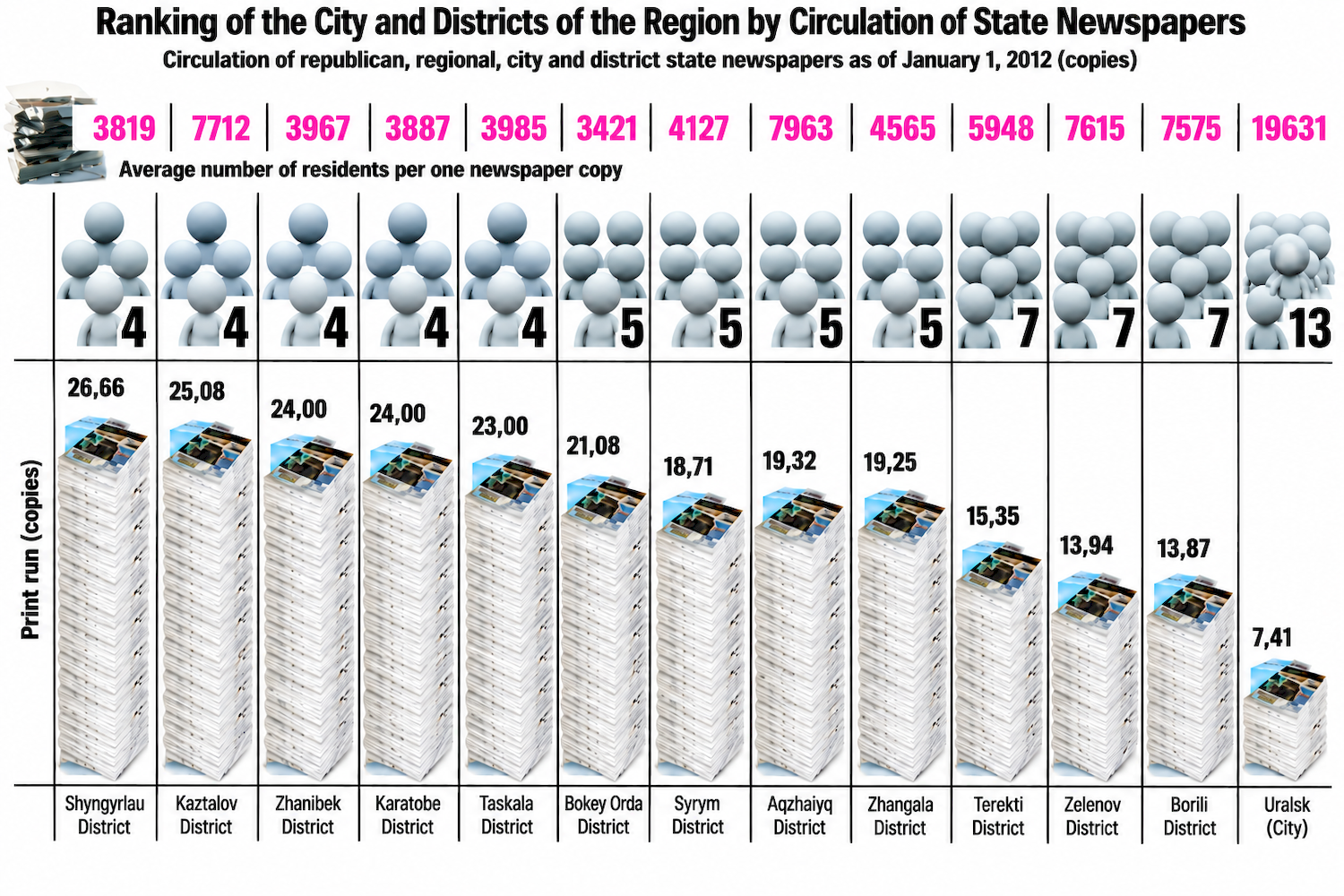
We examined the circulation of these newspapers in Oral (Uralsk) and every district of the region, comparing the figures with the population of each area. This enabled us to calculate the proportion of residents covered by state newspapers.
Which districts have the highest readership of state newspapers?
In Shyngyrlau, Kaztalov, Zhanibek, Karatobe and Taskala districts, there is approximately one newspaper for every four residents. This is a favourable indicator, placing these districts at the top of the rankings.
In Bokey Orda, Syrym, Aqzhaiyq and Zhangala districts, there is one newspaper for every five residents. Newspaper coverage in these areas can therefore be described as moderate.
The situation is considerably less encouraging in Terekti, Zelenov and Borili districts, where there is barely one newspaper for every seven residents.
The position of Oral, home to almost half of the region’s population, is even more alarming: there is only one newspaper for every thirteen residents.
West Kazakhstan Region has a population of more than 600,000. Of these, 280,000 live in Oral, while Borili and Zelenov districts each have approximately 54,000 residents.
In other words, around 70 per cent of the region’s population is concentrated in the regional capital and these two districts. Yet it is precisely these three areas that occupy the lowest positions in the rankings. This is a matter that deserves serious consideration by those responsible for political affairs.
Another important factor must be taken into account. Satellite television is widely available in Oral and the surrounding areas. Consequently, local residents do not regularly watch domestic television channels such as Khabar, Qazaqstan, El Arna and others that communicate state information policy.
It is no secret that many residents prefer foreign television channels. Meanwhile, local websites devoted to explaining and promoting state policy are virtually nonexistent.
The significance of these figures can also be seen in the results of the elections held earlier this year. In most districts where media outlets involved in implementing state information policy have a wider reach, voter participation was also relatively high.
A Lack of Funding or a Lack of Will?
During the subscription campaign for the first half of 2012, we made considerable efforts to increase the circulation of Oral Öñiri and Priuralye in Oral.
One particularly noteworthy example was set by Askhat Imangaliyev, Rector of Makhambet Otemisov West Kazakhstan State University.
Previously, the university had subscribed to approximately 50 copies of each newspaper. This year, however, it arranged a subscription for 800 copies and established a system allowing students and lecturers to receive and read the newspapers free of charge in every academic building.
Students and teaching staff began receiving each issue promptly, reading the articles and discussing the issues raised in them. This helped increase civic engagement.
It would be encouraging if other educational institutions and major organisations followed this example.
In this year’s Address to the Nation, the Head of State instructed that the economies of districts dependent on a single sector should be diversified.
The oil and gas industry is highly developed in Borili District, which includes the town of Aksai.
The number of Kazakhstani specialists currently working at the Karachaganak field has reached 13,394.
Two or three years ago, the field’s main operator, KPO B.V., arranged subscriptions for its veterans to two regional newspapers, ordering 500 copies of each publication. Today, even this arrangement has been discontinued.
We have sent numerous letters, only to receive the same response: “There are no funds.”
The current position of KPO B.V., which appears not to consider it a priority to inform its employees about the state policies being implemented in Kazakhstan, is difficult to understand.
Spiritual Deprivation: A Threat to Independence
Our ancestors worked tirelessly, shed their blood and sacrificed their lives for us. They preserved our vast homeland and entrusted it to future generations.
A century ago, the intellectual leaders of the Alash movement published newspapers to awaken public consciousness, calling upon the people to embrace unity, solidarity and the aspiration to establish an independent state.
Today, our ancestors’ dreams have come true. It is the duty of the contemporary press to preserve the memory of their sacrifices and convey their extraordinary dedication to future generations.
Experts who examined the causes of the social unrest that has recently affected numerous countries concluded that the influence of state media had weakened in those societies, leaving the public insufficiently informed about the extensive work being undertaken by their governments.
There is a Kazakh proverb: “When there is no dog, even a pig will bark.” The saying implies that when responsible voices are absent, others will step forward to fill the silence.
If people do not receive reliable and balanced information from state media, the resulting information vacuum will inevitably be filled by provocative reports from irresponsible publications. The consequences, it goes without saying, are unlikely to be positive.
Of course, no form of hunger is desirable. Yet spiritual deprivation — a lack of intellectual and moral nourishment — is a phenomenon that can threaten the future of independence.
We therefore believe that newspaper editorial teams must make every possible effort to ensure the broad distribution of publications involved in implementing state information policy.
At the same time, overseeing and supporting these efforts should be regarded as an unwritten responsibility of every district akim and institutional leader.